Natalie Delgadillo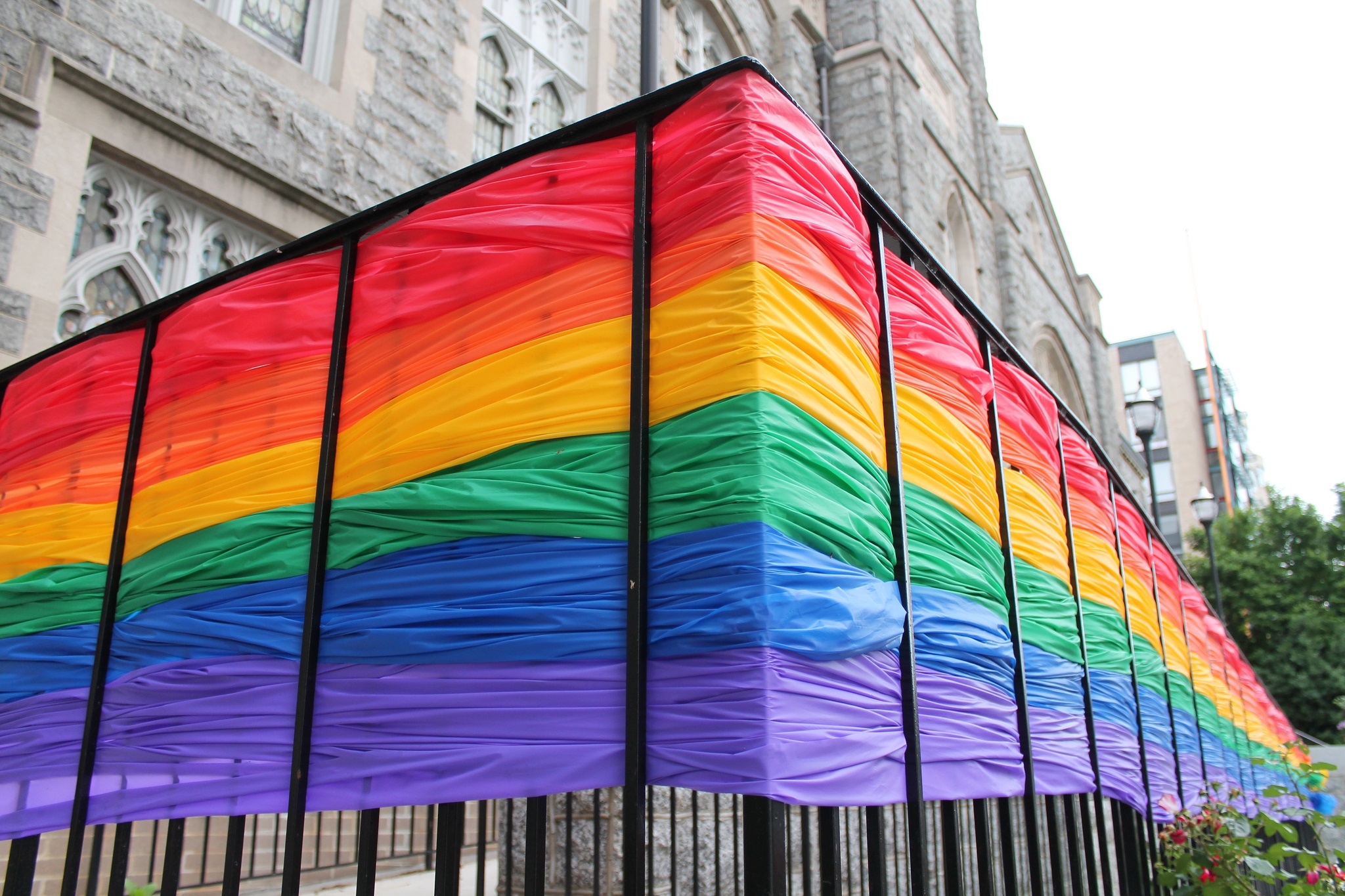
As the United Methodist Church prepares for a historic vote that is expected to officially fracture a denomination already deeply divided over questions of LGBTQ inclusion, D.C- area Methodists are both grieving the coming split and accepting its inevitability.
“Any sort of separation is certainly not my preferred outcome,” says Reverend T.C. Morrow, a gay woman was ordained last year after being repeatedly rejected over the past decade. “But I’m enough of a realist that I understood something needed to be done, because frankly if nothing was done and things continued on the current trajectory, individual congregations were going to choose to leave.” That process, she says, would have been messy and difficult without formal guidance from church leadership.
Unlike other mainline Protestant denominations, the Methodist Church does not officially allow gay marriage or the ordination of LGBTQ people as clergy. But in the District of Columbia, many congregations lean liberal and have already done so for years.
Division over the issue has roiled the denomination in recent years, and on Friday, church leaders announced they had reached an agreement to split the church.
The plan, dubbed the “Protocol of Reconciliation and Grace Through Separation,” allows for the formation of a new “traditionalist Methodist” denomination that would continue to hew to conservative theology. More liberal congregations and leaders would remain in the United Methodist Church and be able to vote to allow gay marriage and gay clergy in the church. The agreement provides $25 million to the new conservative denomination in exchange for those congregations’ assets, like church buildings.
It still has to be approved at the 2020 general conference, a legislative session where church leaders and congregants from across the world gather to vote on legislation.
Ellie Crane, a gay woman and a third-year student at Wesley Seminary’s Master of Divinity program in D.C., says she understands why church representatives are looking toward a split, but that she’s deeply disappointed in this outcome. “I don’t think separation is the best option, period,” she says. “But I don’t think it should continue to be queer and marginalized people who continue to be stepped on” in order to preserve unity.
Crane says she has long struggled to square her identity as a gay woman with her calling to work in the church, whose official rules still do not technically allow her to be ordained. The split “is certainly hopeful for me,” she tells DCist. “There is hope for me that there will be a United Methodist Church somewhere that I can be a part of and fulfill my call to ministry.”
Last year, the denomination held a special general conference specifically to grapple with the question of gay marriage and clergy. After a long few days of debate, church leaders ended up voting in favor of a conservative plan that not only kept current practice in place, but instituted harsh penalties for clergy and churches that flouted the rules (while there were U.S. Methodist leaders who voted in favor of this plan, it was largely carried by conservative Methodists from across the globe, in particular Africa). That plan technically went into effect on January 1, but the protocol released last week asks church leaders to refrain from doling out punishment until this year’s general conference, when the split is expected to be approved.
Reverend Ginger Gaines-Cirelli, senior pastor at the liberal Foundry Methodist Church, says that she is deeply disappointed by the fact that the church is headed toward schism, but that she, like many others, has come to see it as necessary.
“I was so hopeful at this time last year, working for the 2019 general conference and trying to find a way that would allow the denomination to remain truly united,” she says. “That didn’t happen, and it was heartbreaking. And in the months following, it became clear that if you’re in a relationship with someone who doesn’t want to be in a relationship with you, you just can’t make it work.”
Regardless of what happens with the church, however, Gaines-Cirelli says that Foundry (famous for being the home church of the Clintons) will continue to be the same as it has been for the last 25 years. The congregation has long performed same sex marriages, and been a “fully inclusive, anti-racist, anti-colonial organization,” Gaines-Cirelli says.
Though separation may provide a fix to the divide currently roiling the Methodist Church, Morrow believes that the conservative faction will still have to deal with tensions around LGBTQ inclusion. “Regardless of what happens, there will be LGBTQ people in whatever denomination. Any time you’re baptizing babies and raising them in the church, you’re always going to have new generations of LGBTQ people, so it’s not like the question of LGBTQ inclusion is going to go away, even in a conservative denomination,” says Morrow, a volunteer clergy member at Foundry. “They might hope that it would, but if they are successful as a denomination at all, in a generation or two they will be confronted with it again.”
It’s not clear exactly how many or which churches in the D.C. area might vote to leave the denomination to join the traditional faction, though Morrow believes it’s likely that a majority of churches in D.C. and immediately surrounding the city will remain in the UMC.
Mark Tooley, the president of the Institute on Religion and Democracy and a Methodist who has argued against allowing same-sex marriage, agrees that most of the churches in the area will likely be on the liberal side of the issue. Tooley attends a Methodist church in Alexandria, and he says he’s not sure which way his own congregation would go.
“This plan acknowledges an emerging consensus that we are heading for a split,” Tooley tells DCist. “It’s a good thing in that it closes a divisive chapter. It’s sad and tragic in that it leads to a split and maybe even the death of thousands of local churches … We were hoping the whole denomination could adhere to traditionalism, but that was not possible, so this is the second best option.”
The plan also allocates an additional $2 million to go to any other denominations that want to split from the UMC, as well as $39 million to support “ministries for communities historically marginalized by racism.” Gaines-Cirelli emphasizes that monetary commitment, and says that the split, while tragic, could be an opportunity to right some historical wrongs.
“I’m looking at this as an opportunity to address some of those historic oppressions we have been dragging around for a long time,” she says. “I don’t want to waste a good crisis. If everything is coming apart, let’s use this time when we’re going to have to change to make the change be for the better.”
There’s No Paywall Here
DCist is supported by a community of members … readers just like you. So if you love the local news and stories you find here, don’t let it disappear!