 Mikaela Lefrak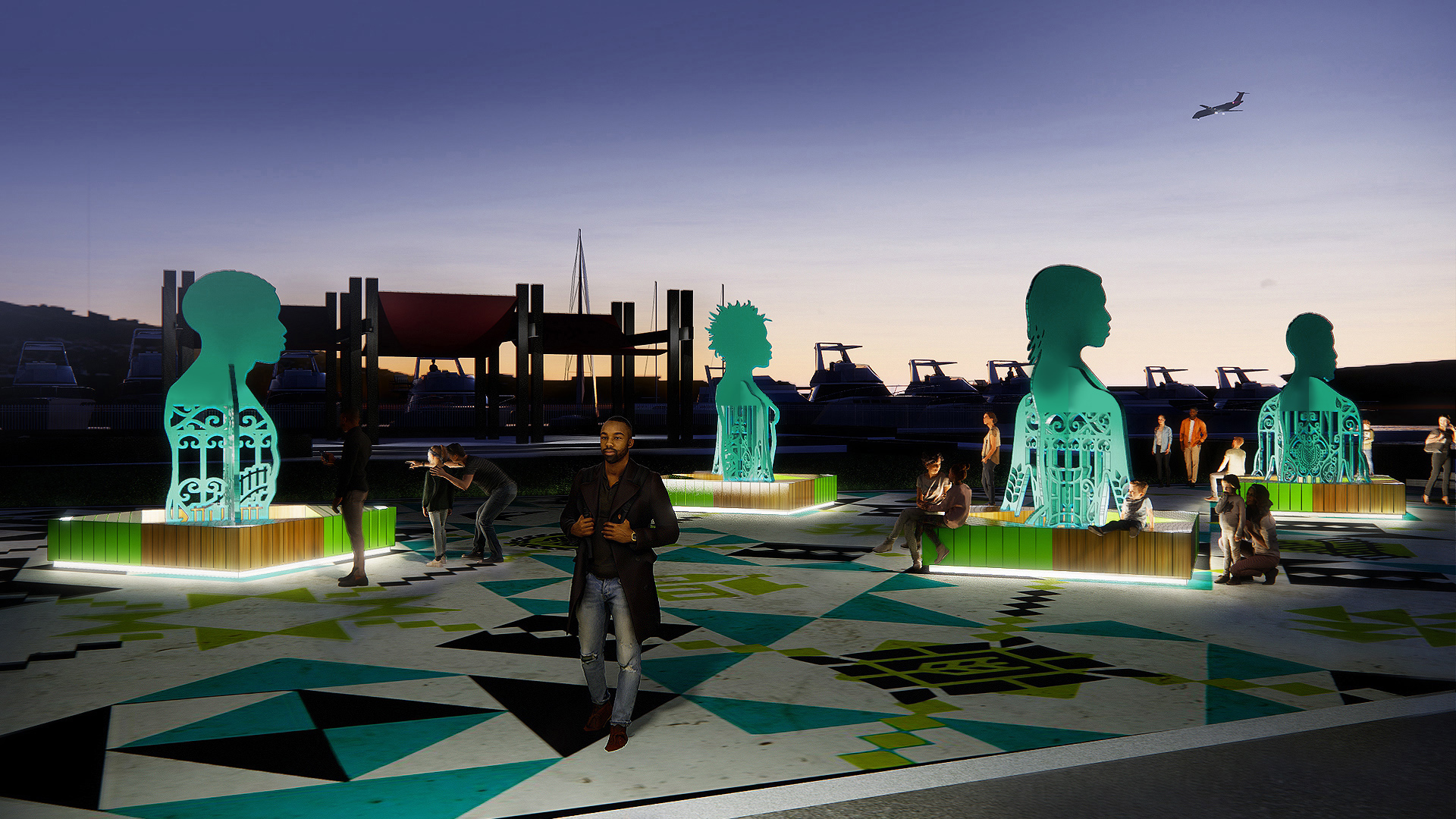
Long before Alexandria’s waterfront became the picturesque tourist destination and launch point for dinner cruises that it is today, it was a bustling industrial port and hub for the country’s domestic slave trade.
That ignominious history is the inspiration for a new public art project going up at Waterfront Park this March. Titled “Wrought, Knit, Labors, Legacies,” the installation will feature four metal silhouettes created by Brooklyn-based artist Olalekan Jeyifous. Each silhouette will face the water, and Jeyifous will paint the concrete ground underneath them with designs reminiscent of African textiles and African American quilting patterns, with manufacturing icons appearing throughout.
From the 17th to the 20th century, Alexandria was a prosperous port city bursting with tobacco warehouses, breweries, rail lines, and factories. But much of its residents’ financial success came from the slave-trading businesses headquartered there. Enslaved people from Africa were taken from boats docked in the port to holding pens owned by slave-trading companies. From there, they were sold and shipped farther into Virginia or deeper into the south.
“It’s always presented as a history that’s kind of set aside from a more triumphant American history,” Jeyifous says of the slave trade. “But it’s so connected. It’s simply one history. As a black artist, this is a very clear part of our legacy.”
Born in Nigeria but raised in cities across the U.S., Jeyifous is perhaps best known for his Brooklyn monument to Congresswoman Shirley Chisholm. In 1968, Chisholm became the first black woman to serve in Congress and the first to seek the presidential nomination from a major political party. The 40-foot-tall sculpture will be unveiled later this year.
Alexandria city officials invited Jeyifous to submit a design for the city’s “Site See: New Views In Old Town” series at Waterfront Park. Once he was selected, Jeyifous took a trip to Virginia to tour the city and learn more about its history. The tour included a stop at Freedom House, a former slave pen that’s now a museum about Alexandria’s role in the slave trade. He says the property’s history felt deeply personal.
“I just felt it’d be kind of ridiculous not to acknowledge it,” he says.
Jeyifous’s piece is the second temporary installation in the “Site See” series in Alexandria. The first, an interactive installation by a New York design firm called “Mirror Mirror,” featured colorful mirrored surfaces that transformed from reflective to transparent when activated by visitors.
Each project gets a $100,000 budget—$80,000 for the installation and $20,000 for the ground treatment.
This investment in public art is something of a new venture for Alexandria. While Old Town is full of immaculately preserved old buildings and historic plaques, it’s a bit of a latecomer to current trends in immersive exhibitions and interactive installations.
Diane Ruggiero, the deputy director of the city’s Parks, Recreation and Cultural Activities Department, sees the projects’ ephemerality as a way to acclimatize Alexandrians to publicly funded art.
“It’s an amazing way to talk about some of what happened here in Alexandria through the language of contemporary art,” she said. “Folks don’t have to love it, they just have to live with it until the next [installation] comes along,” she says.
Each piece in the series, including Jeyifous’s, stays up from March through November. The park itself is temporary, too: Within the next decade, the city will begin an extensive flood mitigation construction project along the shoreline.
Alexandria plans to celebrate “Wrought, Knit, Labors, Legacies” with an opening ceremony on March 21.
This story originally appeared on WAMU.