 Mikaela Lefrak
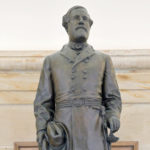
Many of Washington, D.C.’s statues have a common theme: There are white men on horses, white men holding books, white men sitting in chairs, white men sitting on benches, white men … standing.
On Thursday, the D.C. Council will hold a public hearing for two bills that could potentially diversify the city’s public memorials. The first would mandate the construction of at least eight new statues, one per ward, of women or people of color who were born and raised in the District and who made significant contributions to the region or country. The second would create a committee to review the city’s street and school names, some of which have recently attracted heated debate.
The statues proposal has been stuck on a slow-moving bureaucratic train for more than two years. D.C. Councilmember Kenyan McDuffie (D-Ward 5) first introduced a version of the bill in 2017, but the Council didn’t vote on it.
Instead, the city allocated $300,000 to create a statue of pioneering black civil rights lawyer Charles Hamilton Houston. D.C. Mayor Muriel Bowser established a commission last February to find a location for the statue and select an artist. Neither has been announced yet.
Still hoping to get all eight statues, McDuffie reintroduced the bill last year, with minor changes. It would task the city’s Commemorative Works Committee with spearheading the public art projects and installing the statues by January 1, 2030.
McDuffie also wants the city to reconsider potentially offensive street and school names. He introduced a bill last April to set up a commission to review “all symbols of hate and racism on District property.” (The measure excludes federal property like the U.S. Capitol and the National Mall—the Capitol Building’s National Statuary Hall Collection holds two statues from each state plus the District of Columbia and one of Rosa Parks. In the past couple of years some Southern states have replaced their Confederate statues there.)
He introduced that bill amid a debate over changing the name of his alma mater, Woodrow Wilson High School. Proponents of a name change argued that Wilson’s policies marginalized black federal employees and contributed to segregation in some of D.C.’s neighborhoods.
The public hearing on Thursday will cover both the statues bill and the place-names bill.
Attention to public memorials swelled during the summer of 2017 when a debate over a statue of Confederate general Robert E. Lee in Charlottesville, Virginia sparked a white nationalist rally that left one counter-protester dead.
A number of major cities began to debate their own Confederate memorials and pass laws to diversify their monuments after Charlottesville. New York City is in the process of building four statues to honor women. When the project is finished, all five boroughs will have at least one public statue of a woman, according to the New York Times.
The lack of diversity and local representation among the city’s memorials is, in part, an inherited problem. Most of the city’s statues were built in the late 1800s and early 1900s. Currently, of the 100-plus statues in the District, only about a half dozen are of American women. Of those, only one is of a woman of color—Mary McLeod Bethune in Capitol Hill’s Lincoln Park. Jazz musician Duke Ellington and Motown singer Marvin Gaye are two of the only D.C.-born people of color honored with a statue.
As the process for commissioning and installing a statue can take years, some neighborhoods honor women, people of color and D.C. natives through other forms of public art. The famous Ben’s Chili Bowl mural depicts a dozen black legends, and this past summer a half dozen new murals went up across five different wards. One depicts the late saxophonist and D.C. mailman Buck Hill, another features Supreme Court Justice Ruth Bader Ginsburg.
Also last year, a local artist transformed eight historic call boxes in downtown D.C. into mini-museums honoring famous women. Each call box features a cast-iron sculpture of a notable woman and a plaque that tells her story.
But to McDuffie, building a statue is a more prominent and lasting way to teach residents about the city’s diversity.
Along with Houston, McDuffie’s statues bill names four possible subjects for D.C.’s new statues:
- Dr. Charles Drew (1904-1950), a surgeon medical researcher who developed groundbreaking blood storage methods;
- Rose Greely (1887-1969), D.C.’s first licensed female architect;
- Mary P. Burrill (1881-1946), a playwright and teacher at Dunbar High School; and
- The Shaed sisters, all five of whom taught at D.C. public schools.
“I’m hopeful and very optimistic that we’ll actually pass the legislation for both bills in the Council period,” McDuffie says.
This story originally appeared on WAMU.