D.C. officials and volunteers have conducted this year’s census of the city’s homeless population.
The annual Point-in-Time (PIT) count determines how many people are homeless and why. Mayor Muriel Bowser, The Community Partnership for the Prevention of Homelessness, and a group of volunteers conducted this year’s count Wednesday night. They visited shelters and counted those they found on the streets.
Last year’s count found the number of people experiencing homelessness in the District had fallen by more than 5 percent, continuing a downward trend. The city expects to see a further decrease in homelessness when this year’s numbers are tabulated. They will be made public in May.
“We know that we have fewer families in shelter now than we did last year and we expect to continue to see that the system reforms that we’re doing are working,” says Laura Zeilinger, director of D.C.’s Department of Human Services.
According to District officials, family homelessness in Washington is down 45 percent since 2016, when the Mayor began implementing Homeward DC. The city’s five-year strategic plan, which is drawing to a close, states that: “By 2020, homelessness in the District will be a rare, brief, and non-recurring experience.”
But while overall homelessness has dropped, in 2018 the number of single adults without homes rose 5 percent, from 3,578 to 3,761.
And D.C.’s homeless population is facing new challenges. At least 117 homeless people died in the District in 2019, according to a recent investigation by The Washington Post. The unofficial tally of deaths maintained by advocacy organizations is lower, but no matter what data is used, the number of deaths reached a five-year high last year.
Advocates say that the homeless population in this region is aging and that brings new health challenges that are contributing to the rise in deaths. As the shortage of affordable housing in the region continues to make headlines, many support organizations are struggling to find permanent housing solutions.
Zeilinger says to combat the city’s housing crisis, her team is focused on making changes to the entire system rather than any one program. She says they’ve worked to improve the quality of local shelters and enhance the department’s outreach capacity. The PIT count, Zeilinger says, allows her staff to better target resources that can help break the cycle for the individuals affected.
“That said, we know that housing has not become more affordable and that we just have not kept pace with the cost of housing. It’s not a static number,” Zeilinger adds.
In a news release issued Wednesday, Mayor Bowser touted spending in her fiscal year 2020 budget. The plan puts millions of dollars toward new and upgraded emergency shelters and permanent supportive housing facilities.
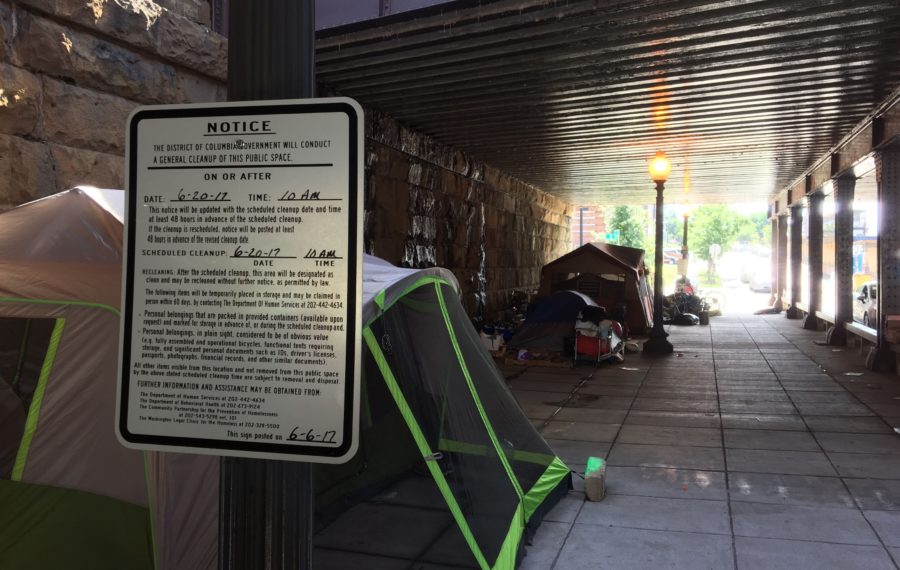
This year’s PIT count comes one week after District officials permanently cleared dozens of people living on the sidewalks of K Street NE. News of the scheduled clearing spread when the city posted signage on January 3 signaling an “immediate removal and disposal” of all property on the sidewalk.
“Several of them are in a housing process receiving subsidies and support from the city. And others, we’re still assessing what they need and qualify for,” Zeilinger says. “And while staying under the overpass in a way that people can’t walk on the sidewalk is not sustainable in the long run, these are the things that are sustainable. That is shelter being available and connection to resources to help people get to a place of permanency,” she adds.
“My general sense of this is just sadness, that the city is following through with this when they know there’s a winter storm coming,” Ann Marie Staudenmaier, with the Washington Legal Clinic for the Homeless, told DCist after K Street NE was emptied.
But Zeilinger says the city hasn’t lost sight of the issue at hand: that there are still too many people without a home, and prices continue to rise.
To live modestly in D.C. itself, a family of four needs to make nearly $124,000, according to the Economic Policy Institute. Median household income is at a record high in the District>, but it’s still below that number. And the suburbs are in a similar situation: A family of four needs to make about $91,000 in Prince George’s County, where the median income is below $80,000.
Bowser says D.C. needs 36,000 new units by 2025 in order to keep up with the demand for housing.