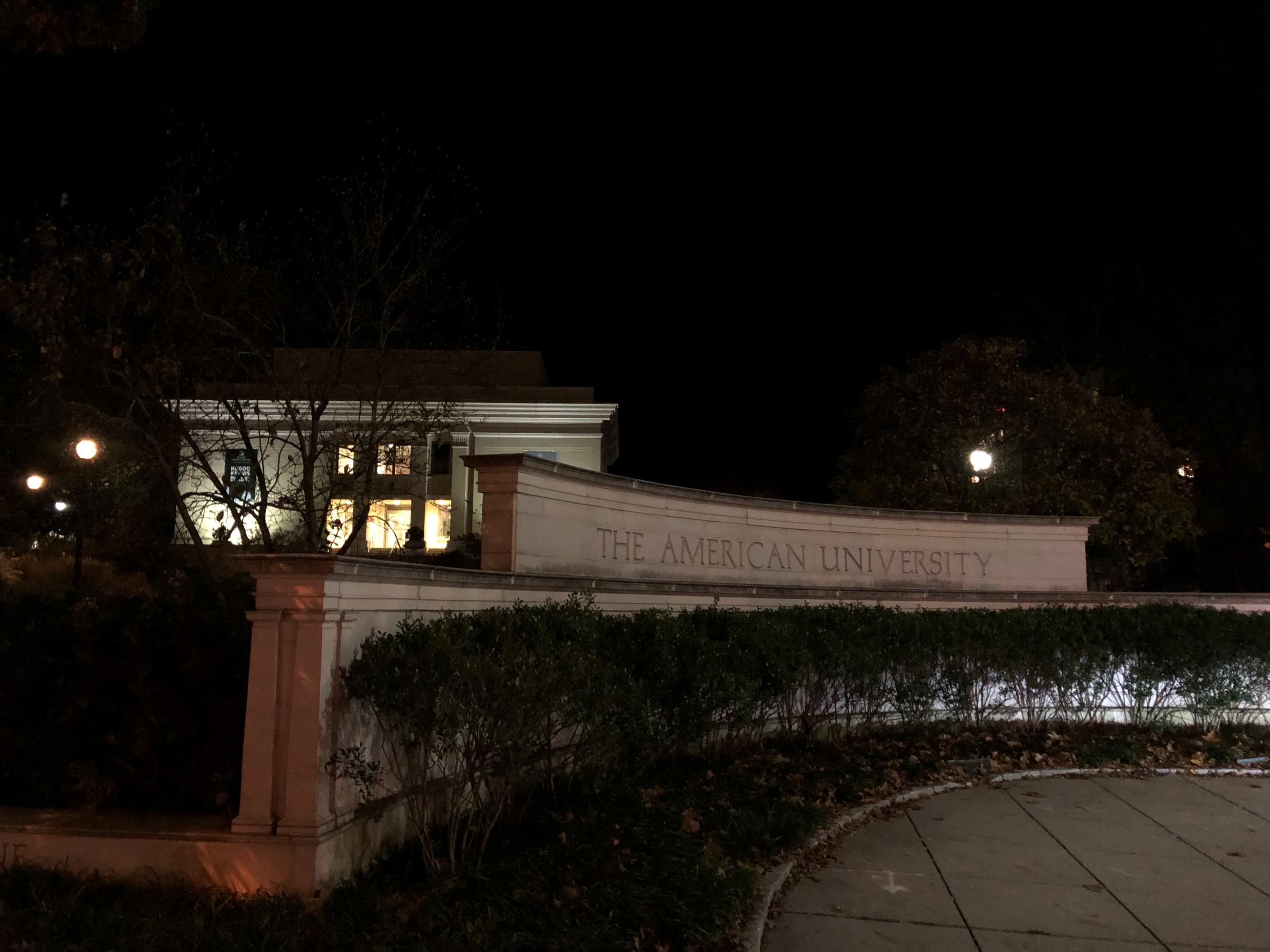
Students at American University were angered Sunday evening by an email which they felt unfairly blamed students who failed to attend an appointment for long wait times at their counseling center.
In an email signed by Vice President of Campus Life Fanta Aw, the university said it had been reviewing mental health appointments after students complained that it could take a month or longer to schedule their first appointment. (Disclosure: AU holds the license for DCist’s parent company, WAMU, and this reporter is a graduate student at the university.)
After the review, the Office of Campus Life reported that students skipped about 1 in 5 appointments to see a counselor and about 1 in 4 initial consultations during the Fall 2019 semester.
The office also reported that “48 hours of appointment time with psychiatrists at the Student Health Center were not kept, which is the equivalent of 48 new students being seen or 96 follow-up visits.”
Some students felt that this sentence, and another in which the university admonished students to attend their appointments or cancel ahead of time, unfairly placed the blame for lack of services on students who couldn’t keep their appointments, many of whom presumably are going through struggles with mental health in the first place.
Frustrations with American University over its email spilled onto Facebook and Twitter, where students vented that this was just the latest example of the university’s lack of interest in improving mental health services. The university’s ever-active meme page erupted with posts comparing the Office of Campus Life to a clown and including the popular out of touch Mr. Skinner meme saying “It’s the students with mental health concerns who are wrong.”
But the university maintains that it was just trying to provide more data to its students. “We wanted to just make sure that everyone understood their role in cancelling an appointment if they weren’t going to use it,” says Traci Callandrillo, the assistant vice president of campus life.
Callandrillo says that individual counseling appointments should be treated differently than, for example, a stairmaster at a university gym, which can be taken over by someone else immediately if a student elects not to use it.
“We certainly know that some students struggle with ambivalence for reaching out with mental health care,” Callandrillo said. “I think a lot of students don’t understand that if they don’t come for an appointment, someone else can’t use the appointment.”
In a statement released late Sunday evening on Facebook, the AU College Democrats called on the Office of Campus Life to apologize for the email and make substantive changes to mental health services.
“When you place the burden on people struggling with mental health problems rather than advocating for a system that supports us, you put our lives in danger,” the statement reads in part.
The question about AU’s ability to provide services is part of a larger national debate about mental health care on college campuses. A majority of college students have said they experience overwhelming anxiety and slightly less than half of all students said they were too depressed to function within the past year in a recent study conducted by the American College Health Association.
Steven Rostain, an expert in student mental health said during a Fresh Air interview in March 2019 that students often feel a high degree of pressure to succeed in a campus environment, and that feeling can discourage them from seeking mental health care, even when they’re in trouble.
“You’re so much a part of a community when you’re in college,” Rostain said. “The thought that, ‘Gee, I can’t function anymore and I may need to take a break’—that’s a hard pill to swallow, so to speak.”
Maria Humayun, a senior at American University, said she originally originally transferred to the school from the Ohio State University because she’d heard friends say good things about the mental health services available.
Once she arrived, however, Humayun’s friends told her she’d have to wait weeks for an appointment. One friend even told her she had been told by the counseling center that she’d need to wait weeks for a counseling appointment after she disclosed she had just been sexually assaulted.
“That’s just not okay,” Humayun tells DCist. “If it’s a three-plus-week wait for someone that was sexually assaulted on campus and had an active Title IX case, what’s the wait going to look like for me?”
Humayun says she eventually sought mental health care off campus.
Callandrillo, of AU, says the university is using a variety of approaches when confronting mental health issues on campus and that she’s always thinking about ways to improve the student experience.
“This is a national issue, we are no different than others,” Callandrillo said. “I’m not going to say that we don’t need to be looking at our staffing levels, but when it comes to the level of care that we offer, we are in some of the highest levels nationally.”
American University currently has 17 people on staff who can offer individual counseling sessions, and the university is continually looking at staffing levels, per Callandrillo. In the email, the Office of Campus Life reported 907 students were served by the counseling center last fall, and an additional 298 students were served by Student Health Center psychiatrists.
Giliann Karon, a senior at AU, tells DCist that Sunday’s email confirmed her suspicion that her university wasn’t listening to its students.
“They seem very disconnected,” Karon said. “I think as long as they’re pushing this mentality of you should be taking classes, you should be interning, all of that, then they should be able to handle [providing care.]”
During her sophomore year, Karon attended eight counseling sessions with a doctoral student. While she thought they were helpful, they weren’t anywhere near a “permanent solution,” she says.
“I think it’s a service sort of like, intermediary for like ‘Here’s some mental health care.t’s not good but it’s what we’ve got,’ which begs the question—what are they doing with our tuition?” Karon said. “For 60k, I think we deserve more licensed counselors.”
There’s No Paywall Here
DCist is supported by a community of members … readers just like you. So if you love the local news and stories you find here, don’t let it disappear!