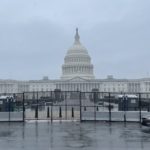
The stately Capitol, with its iconic dome literally crowned by Freedom, presides over the eastern end of the Mall. Its hallowed halls have seen plenty of action (and inaction) in the course of its 200-plus years. Here’s a look at 10 facts you might not know about the building itself.

1. America’s leaders held a nationwide contest to design the Capitol.
Pierre L’Enfant, the Frenchman who masterminded the District’s layout, was also originally slated to design the chambers for the House and Senate. His plans for the city included the site of what he called “Congress house.” Secretary of State Thomas Jefferson edited L’Enfant’s map prior to its publication, changing every reference to “Capitol.” That might seem to be a minor edit, but it was actually steeped in significance, according to a Senate history of the U.S. Capitol: “Instead of a mere house for Congress, the nation would have a capitol, a place of national purposes, a place with symbolic roots in the Roman Republic.”
But L’Enfant failed to produce physical plans for the building, and, coupled with his obstinate refusal to submit himself to the commissioners in charge of the project, found himself dismissed from his post in 1792 by President George Washington.
The country still needed a building to house its lawmakers, so the government embarked upon a rather democratic venture by creating a nationwide design, with a grand prize of a plot of land in the city and $500 awarded to the designer of the winning layout. The city’s commissioners placed the first ad in the March 24, 1792, edition of the Gazette of the United States, specifying that designs must be of brick and include: “a conference room, a room for representatives (sufficient to accommodate 300 persons each), a lobby or [antechamber]to the latter, 12 rooms of 600 square feet area each for committee rooms and clerks’ offices,” among the requirements. Of the 17 submissions, no winner emerged.
Then, technically too late for the competition, a physician in the British West Indies was granted the opportunity to send in his plans (more on him to come). Washington had found his winner, and the Capitol had a design.

2. The War of 1812 destroyed much of the original structure, so Congress had to convene in alternate locations for years until the Capitol could be rebuilt.
British forces seeking revenge for America’s attack on Canada in 1812 sailed up the Patuxent River in August 1814. Secretary of State James Monroe sent a letter to President James Madison, writing that the British were in “full march for Washington. Have the materials to destroy the bridges.” But the British didn’t just have the materials to destroy the bridges—on Aug. 24, 1814, British forces entered the city, vandalizing and setting fire to many government buildings, including the Capitol. The blaze burned so hot that the marble columns in the Senate chamber were reduced to limestone. Benjamin Latrobe, the second Architect of the Capitol, described the Capitol later as “a most magnificent ruin.”
When Congress returned for its new session in September, the city was short on undamaged buildings so Madison arranged for a temporary meeting space at the building known as Blodgett’s Hotel, at Eighth and E streets NW, which housed the U.S. Patent Office and Post Office. Nineteen senators and 157 representatives crowded in there, and according to Senate history, they had many questions, including whether the government should remain in Washington or move to Philadelphia, and should the Capitol be rebuilt or should a new one be built near Georgetown? Congress met there until December 1815, when it moved to the “brick capitol,” which was located on the site of the Supreme Court today. Four years later, Congress returned to its restored home.

3. The Capitol’s famous dome contains 8,909,200 pounds of cast iron.
The current dome is the Capitol’s second iteration. The first dome, completed in 1824, was made of wood covered by copper, which was a significant fire hazard—and required a lot of upkeep. It was removed in 1856 and work began on the new structure, which is actually two domes in one: an inner dome and an outer dome. Cast iron was chosen because, in the era before steel construction, it was the cheapest and lightest material available at the time. Construction on the outer dome was completed in 1863, and the inner dome was completed three years later, in 1866. The dome is painted to blend into the stone.
There have been a number of restoration efforts over the years, but in June 1999, the Architect of the Capitol launched a massive $44 million restoration project to rehabilitate both the inner and outer domes, stripping them of their many layers of paint and searching for any structural concerns or defects. It was a hazardous project: According to news reports at the time, nearly 88 tons of lead were expected to removed from the dome’s paint during the course of the nearly four-year project. The most recent major project to restore and repaint the Capitol began in 2013 and lasted until 2016, when workers put up scaffolding to restore ornaments and repaint (the name of the color? “Dome white”).

4. A slave, Philip Reid, played a crucial role in the construction of the Capitol’s crowning statue, the Statue of Freedom.
While enslaved people played a significant role in building the Capitol, Philip Reid is believed to be the only known enslaved person to have worked on the statue of Freedom. He was an enslaved worker purchased in Charleston, S.C., as a youth by sculptor Clark Mills. Mills later operated a foundry on Bladensburg Road in Northeast Washington and was commissioned to cast the Freedom statue in bronze.
The statue was designed by Thomas Crawford, an American sculptor working in Rome, according to the Architect of the Capitol. Crawford died in 1857, so his widow shipped the plaster model from Italy in pieces. An Italian sculptor was hired to assemble it inside the Capitol for temporary display. But as the AOC details, when it was time to move the model over to the foundry, “no one knew how to separate it and the Italian sculptor refused to help unless given a pay raise.” Reid, however, devised a system using a pulley and tackle to reveal the seams, so workers could disassemble the model and transport it accordingly.
For his efforts on Freedom, the government paid Reid $41.25 — $1.25 for each of the 33 Sundays he worked on the project. His June 1862 pay voucher details that Reid worked “keeping up fires under the moulds.” However, Reid didn’t just work on Sundays; Mills earned the other six days of pay for Reid’s labor, according to the AOC.
Reid became a free man on April 16, 1862, upon passage of the D.C. Emancipation Act. Former slaveholders could petition to receive compensation for the loss of their slaves, and Mills sought compensation for 11 slaves, including Reid. In his compensation claim, Mills described Reid as “a good workman in a foundry” and wrote that he “bought him because of his evident talent in the business in which your Petitioner was engaged.” (Mills wrote that he paid $1,200 for Reid at the time, and was seeking $1,500 in compensation.)
It would take more than a year and a half before the statue would be completed atop the Capitol, on December 2, 1863, and it’s not known if Reid was present when it was placed. With his freedom, Reid changed the spelling of his surname to “Reed,” and in 2014, a plaque was placed in National Harmony Memorial Park in Hyattsville, Md., to honor his contributions to the Capitol.
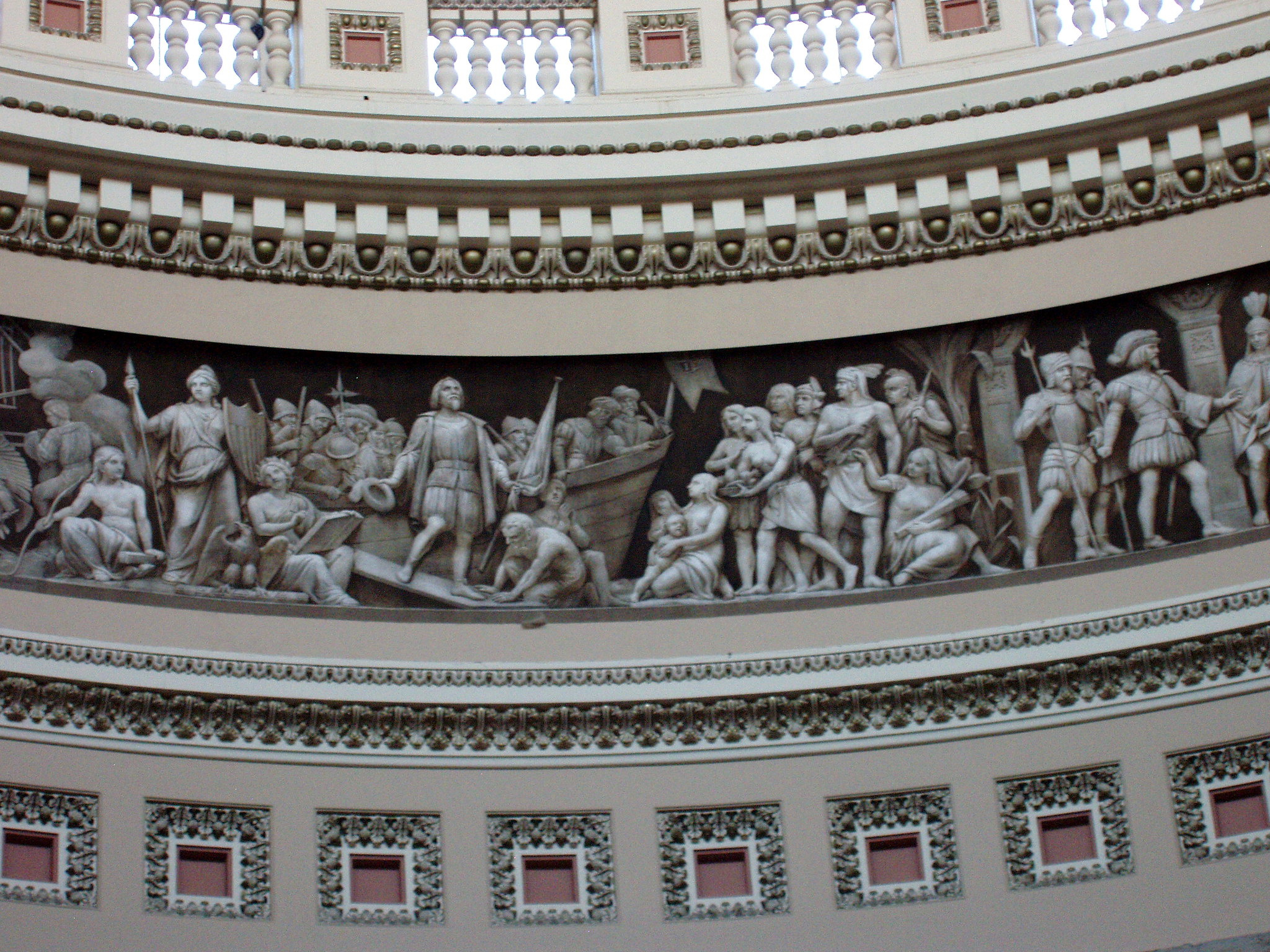
5. Constantino Brumidi did not plunge to his death from a scaffolding while painting the Rotunda frieze. (It’s just an urban legend.)
How the Italian artist Constantino Brumidi wound up adorning much of the interior of the Capitol with his elaborate artwork is a bit of a wild tale. He rose to prominence as an artist in his native Italy, where he was commissioned to do paintings for the pope, but he was later imprisoned after being accused of committing serious crimes during the Italian Revolution. The pope pardoned his 18-year sentence, and Brumidi fled to America in 1852 and applied for citizenship, which was granted in 1857. (He proudly signed a mural of Washington during the Revolutionary War that he finished in late 1857 “C. Brumidi Artist Citizen of the U.S.”)
In 1854, Brumidi had an interview with Capt. Montgomery Meigs, the engineer who oversaw the Capitol’s recent expansion, and painted a test mural in a meeting room to showcase his abilities, according to Boundary Stones, WETA’s history blog. It was so well received that Brumidi became a fixture inside the building. He painted both the famous works in the Rotunda, the Apotheosis of Washington (180 feet above the ground) and the Frieze of American History, which is a panorama of significant events in the country’s history, roughly 58 feet above the ground. The work was not for the faint of heart, as a book commissioned by Congress details: “After ascending a long flight of stairs, the white-haired artist had to climb over the balcony under the windows and descend a long ladder to the small scaffold dangling almost sixty feet above the Rotunda floor. Some comfort was provided by a chair placed on the scaffold.”
In April 1879, a Washington Post reporter interviewed Brumidi, who was 73 at the time and still working regularly on the frieze: “’Do you not find the work beyond your strength,’ asked the reporter. ‘Oh, no. I am not so strong as once. I cannot walk well, or stand, but my arm has lost nothing; my hand and my eye are as good as ever. It is my life-long work. In Europe one studies as one does not study in America,’ with an eloquent Italian shrug that disposed of American art-training.”
Just months later, though, on Oct. 1, Brumidi very nearly fell to his death when his chair slipped off its platform. A Post article from Oct. 2 reported that Brumidi, “who has been almost helplessly feeble for a long time, managed to grasp a run off of the ladder by which he is raised into position.” A Capitol police officer spotted him dangling on high and rescued him, though Brumidi “lay for some time unable to speak from an attack of asthma, which seemed to be developed by the excitement.” A Baltimore Sun article from the same day said that “the shock was so great it that there is no telling how much it would affect him. He said tonight that he did not think he would ever go on the scaffold again.” Brumidi did, however, scale the platform occasionally. But many say he never fully recovered from the terror and died on Feb. 19, 1880, with the frieze less than halfway completed.
As time went on, misconceptions surrounding the circumstances of Brumidi’s death became widely circulated. A 1902 Evening Star article quoted a guide lamenting how “nine in every ten people who live in this city, and who bring their friends to see the building, believe that Brumidi fell from the scaffold while at work on the frieze and was killed,” according to a blog post from the U.S. Capitol Historical Society. Authors in the early 20th century also mischaracterized Brumidi’s death, such as a volume of The American Architect from 1919, which declared that “Brumidi fell from the scaffold and died from injuries.”
Two artists, Filippo Costaggini and Allyn Cox, went on to complete Brumidi’s frieze, though it was decades before it was completely finished.

6. Plans in the early 20th century called for East Capitol Street to become a second National Mall that spanned from the Capitol to the Anacostia River.
The National Capital Park and Planning Commission (nowadays known as just the National Capital Planning Commission) developed plans to extend the Mall east of the Capitol in an “Avenue of the States,” as a WAMU story from 2013 detailed. In the 1920s, looking for places for public buildings, the commission had closed in on Capitol Hill, which “with row upon row of Victorian houses, appeared deteriorated,” according to “Worthy of the Nation,” by Frederick Gutheim and Antoinette Lee. William Partridge, the consulting architect on the project, drafted a map in 1941 that proposed more federal office buildings and semi-public buildings, as well as parking areas, schools and sporting areas along the span of East Capitol Street. As evidenced by the Victorian homes still lining East Capitol Street, the plans never came to fruition.

7. The building’s exterior has gone through a number of facelifts, including sandstone, marble, and limestone.
Short on cash and means of transportation, sandstone was the original façade of choice by the Capitol’s builders, thanks to its ease of carving and its proximity to Washington. A government-owned quarry just down the Potomac, in Aquia Creek, Va., provided much of the original sandstone. (You can visit the site of the quarry, which is now part of a 17-acre park known as Government Island in Stafford.) But sandstone isn’t the most ideal choice among building materials, as it’s susceptible to erosion.
When it came time to expand the Capitol in the mid-1850s, more-durable marble was chosen instead—partially because marble had been discovered along the upper Potomac and could be quarried and ferried affordably, according to the AOC. Marble from other states was used in later Capitol extension projects as transportation of the stone became more possible. An extension of the east front began in 1958, but the walls were left in place to become an interior corridor and reproductions were made in marble on the new exterior. In the 1980s, another facelift, this time on the west-central front, replaced 40 percent of the original sandstone with limestone instead. Restoring the Capitol’s façade is no easy task: Bybee Stone Co., the company that replicated the sandstone pieces in Indiana limestone in that project, explained that “each piece of stone was removed and catalogued, and a fabrication ticket was generated from approved drawings and the original pieces.”
Want to own a castoff piece of Capitol sandstone? The U.S. Capitol Historical Society sells bookends crafted from remnants removed from the east front in the 1950s for $125 (or $175 if you want them on a walnut base).
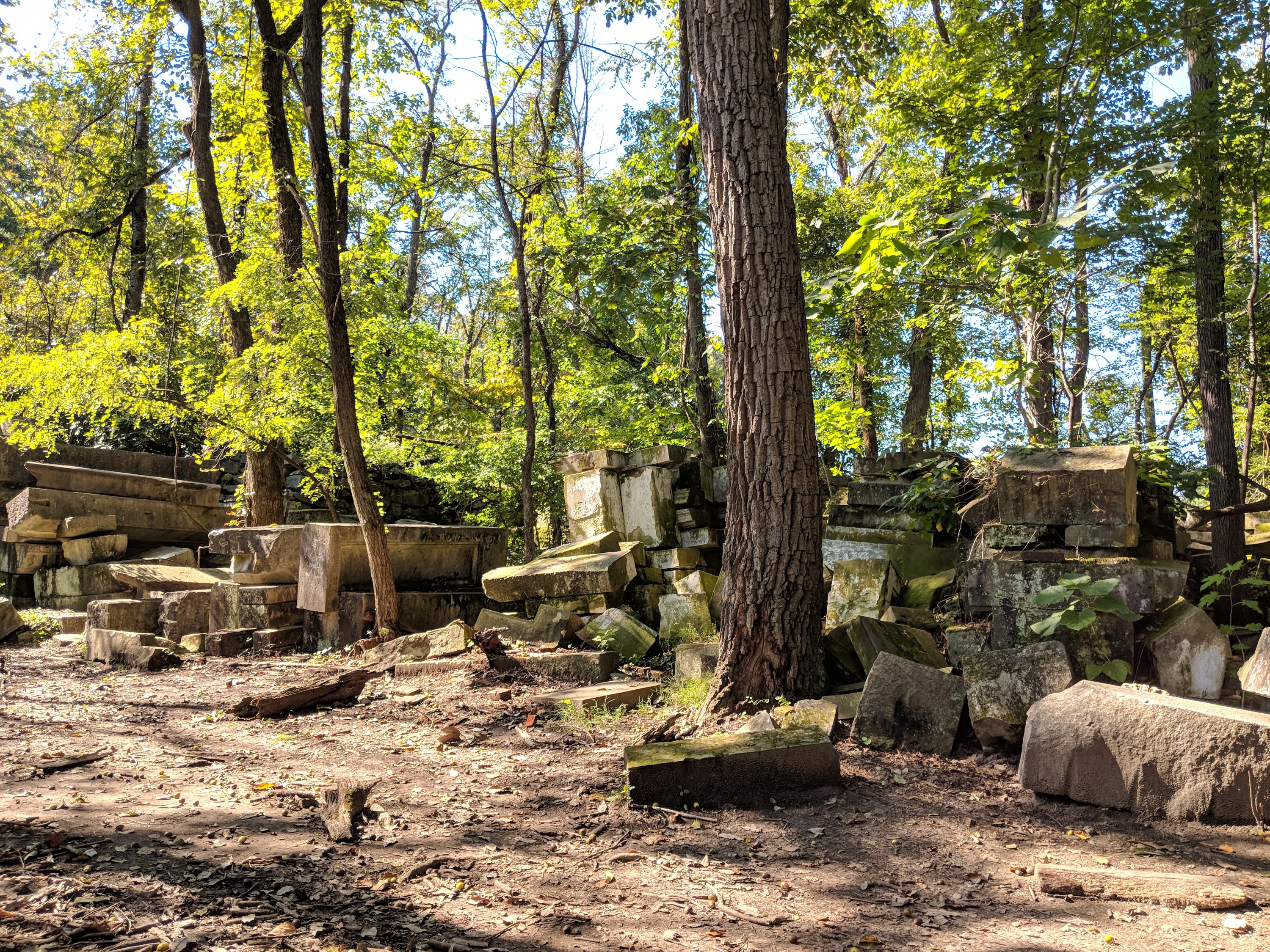
8. The National Arboretum and Rock Creek Park both house historic remnants (the building’s original columns and assorted stones, respectively) from the building.
Thanks to all the work on the Capitol’s east front in the 1950s, the government needed to find a place for the tons and tons of old sandstone that was removed. Many blocks of marble and sandstone were unceremoniously tucked away in Rock Creek Park, where they still sit in lowly, mossy heaps along an unmarked trail. Atlas Obscura says that at the time of their removal, it was illegal to sell or dispose of the historic stone, though the law has apparently eased up on the sales side of things. Some of the rock has also been used to renovate historical buildings and a cenotaph at Congressional Cemetery was created with it.
The columns were put into storage after their removal in 1959, and Ethel Garrett, a benefactress of the National Arboretum, sought to raise the funds to get the columns out of storage and create a permanent home for them. Garrett died in 1986, about two years before she could see her vision come true: Twenty-two of the 24 columns were installed in a rectangular colonnade in the Arboretum (one was too damaged to be used and another was placed elsewhere in on the grounds) in spring 1988, and they are still a celebrated display.
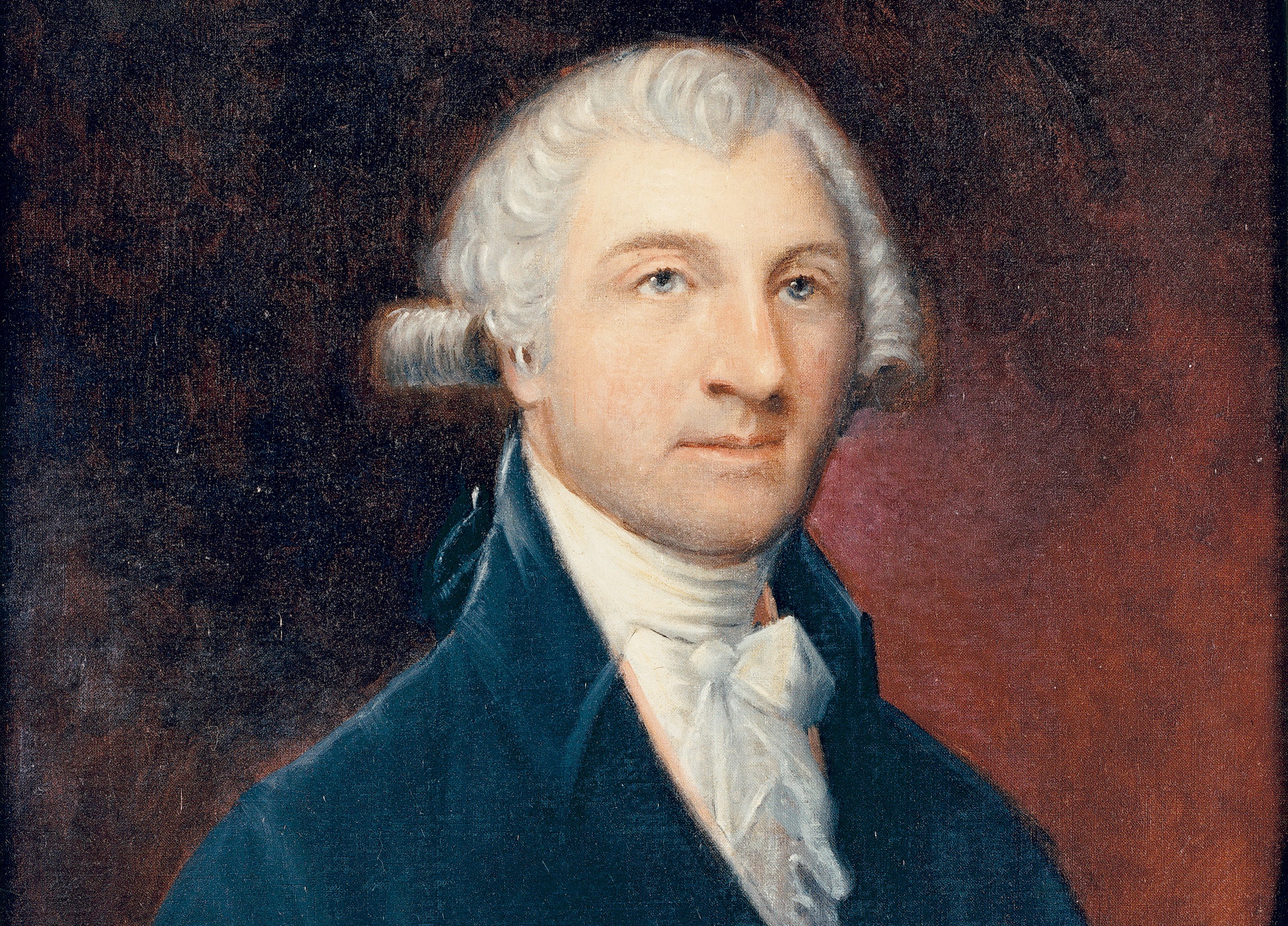
9. Despite the title, the Architect of the Capitol isn’t always an actual architect by trade.
The Architect of the Capitol is appointed by the president, and oversees a department of more than 2,000 employees that functions as the caretaker of more than 570 acres of grounds and the Capitol Hill landmarks on them, including the Capitol, House and Senate office buildings, the Supreme Court, the Library of Congress, and the U.S. Botanic Garden.
The first Architect of the Capitol was, as you might guess, the building’s original architect: William Thornton, a doctor from the British West Indies. The amateur architect became an American citizen in 1787 and, after President George Washington chose his winning design, he relocated to Washington in 1794, where he went on to serve in government roles until he died in 1828.
Thornton’s successors were all architects, until 1902. That’s when President Theodore Roosevelt appointed Elliott Woods as the “Superintendent of the Capitol Building and Grounds,” because he wasn’t an architect, resulting in the title change. It reverted back to the “Architect of the Capitol” in 1921 to honor Woods, who by that point had overseen the construction of the new House and Senate office buildings and proven his mettle. After Woods died in office in 1923, President Calvin Coolidge appointed David Lynn to the position. Lynn was also not an architect, but the engineer “worked his way up through the ranks to become the agency’s number one assistant at the time of predecessor’s death,” according to the AOC. There have been 12 Architects of the Capitol, including J. Brett Blanton, who took office last month, but the position wasn’t always present throughout the course of American history: The Capitol was turned over to the Commissioner of Public Buildings for roughly 20 years, from 1829 until 1851, after Charles Bulfinch completed the reconstruction of the building in the wake of the War of 1812 and the AOC position was terminated.
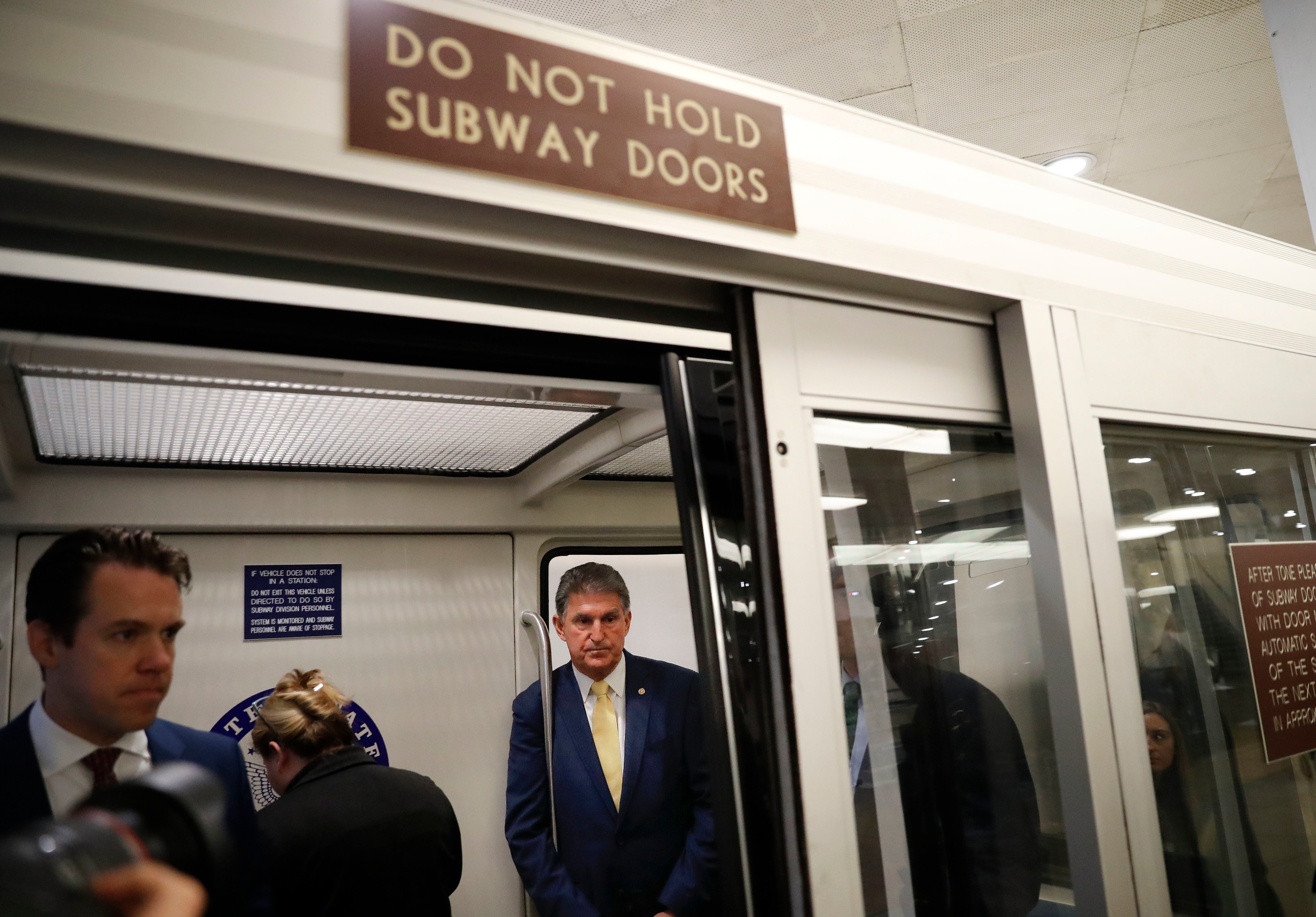
10. The Capitol’s subway system has been around for more than 100 years.
Plans for a subway system to ferry people between the Capitol and what is now known as the Russell Senate Office Building had been in the works for years when an August 18, 1908 article in the Washington Post reported that “those cute little electric railroads” were not going to be installed, and that transit in the newly constructed subway tunnels “will be in the good old way, on foot.” The House Building Commission and “others among the older members have a strong tendency toward practicality and economy,” the article explained, and “the running of electric cars just to carry members and attaches a distance of a couple of blocks, when walking is perfectly good, seemed like a useless expense.” It estimated the installation of such a system would cost $80,000 to $100,000, and annual operations would likely cost about 15 percent of that.
The opposition was quickly derailed, however, and by March 9, 1909, the subway system was up and running. However, it wasn’t a train system: Studebakers were designed specifically for the subway and cost $5,000 a piece, the Post reported in March 1909. A March 28, 1909, article in the Evening Star described the senators’ new ride: “Each machine accommodates ten persons. They are of tan color, handsomely upholstered and so arranged that they may be run backward or forward, as the subways are too narrow to permit turning.” It also said that if the subway determined to be a hit, that a similar service would be installed to connect the House office building to the Capitol. (Construction on the House subway tunnel wouldn’t begin until the early 1960s, however.) The cars were abandoned within a few years, however, and a monorail with wicker-seated trolleys was installed.
The subway was at times a source of quirky news, like when a Post article from 1914 described how “automobile honeymooning in the Senate subway was inaugurated Saturday by a pair of newlyweds with economy as their watchword and ingenuity as their guide in a search for thrillers.” The couple rode the subway for about a half hour, according to the account, and thoroughly enjoyed their honeymoon: “‘Wasn’t it grand?’” chirped the bride as George helped her from the car after the fifteenth spin. “Great, sweetheart,’ said George. ‘Why go to Niagara Falls or Pikes Peak?’” It also was the site of the occasional controversy, too, as a Washington Post article headlined “Subway in Capitol Reeks of Rum Odor, Scandal” on April 17, 1929 — smack-dab in the middle of Prohibition — reported. A “scandalous slip” occurred in the subway, the story detailed, as someone dropped “a flask of what appeared to be whisky and fled. When reporters arrived at the spot they found the shattered glass strewn about in what was left of the liquor and a silver cap lying nearby. Judging by the aroma the liquor was of a very good quality.”
In 1961, an upgrade came in the form of faster, electric-powered cars on double rails, coinciding with the creation of a new Y-shaped tunnel system connecting the new Senate office building (now known as the Dirksen Senate Office Building). But the new system wasn’t necessarily received with great applause. A Washington Post article from July 10, 1961, quoted Sen. J. William Fulbright’s description of the new subways and cars as “incredibly vulgar … noisy … disgusting …poorly designed … combining all the bad taste of the Western World.”
In 1993, the Senate system was replaced by an automatic train, but the House line still requires an operator. If you’re hoping to catch your own honeymoon ride on the system, you’re mostly out of luck: It’s not open to the public, unless you’re invited to ride with a member of Congress.
Previously:
10 Facts You May Not Know About National Airport
10 Facts You Probably Didn’t Know About Union Station
Ten Facts You May Not Know About Takoma
10 Facts You May Not Know About Columbia Heights
Ten Facts You May Not Know About Petworth
Ten Facts You May Not Know About Chinatown
Ten Facts You May Not Know About Spring Valley
Ten Facts You May Not Know About Navy Yard
10 Facts You May Not Know About Brookland
Ten Facts You May Not Know About Anacostia
Ten Facts You May Not Know About Dupont Circle
Nine Facts You May Not Know About The Southwest Waterfront
This story was updated to reflect the correct date that the Capitol building was destroyed and the height of the Freedom statue.