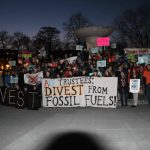
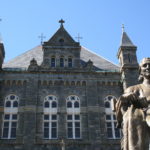
Georgetown University has announced it will fully divest from public and private investments it’s made with fossil fuel companies within the next ten years.
John J. DeGioia, president of Georgetown University, announced the decision in a university community email Thursday. Under the new policy, Georgetown will cease new investments in fossil fuel companies and will seek to invest in renewable energy and related areas, according to a statement.
DeGioia’s announcement came the same day that the Georgetown University Student Association voted to support the university’s divestment, according to Georgetown’s campus newspaper the Hoya.
Student groups, like GU Fossil Free (GUFF), have been advocating for the campus to divest since 2012. In January 2019, GUFF submitted a proposal to the university’s Committee on Investments and Social Responsibility to divest from all fossil fuel companies by January 1, 2024.
Georgetown has made incremental steps toward divesting in recent years. In 2015, its board of directors approved a proposal to divest from coal mining companies, and three years later the university divested from companies focused on extracting from tar sands.
Jacob Janz, a sophomore at Georgetown and member of GUFF, says he was shocked by the university’s decision.
“If you would have asked me a month ago if Georgetown would divest, I would flat-out say no, not in a million years,” Janz says.
Michael Barry, Georgetown’s chief investment officer, says the university has been partaking in conversations about divestment with advocacy and student groups since 2012, but needed to research the impact it could have on the university’s finances.
“We decided that the time is right and that we had conducted enough of our study to ascertain the potential impacts making this move,” Barry says. “We decided at best the impact will be negligible, there’s some case to be made that this might even have a positive impact on our financial results.”
According to Barry, the university does not disclose the specific fossil fuel companies it has been invested in.
While Georgetown has stated that it wants to achieve “full divestment” in the future, it will evaluate mixed investment funds that “may hold exposures to fossil fuel companies” on a “case-by-case” basis.
“From time to time it might be the case that we have a need to be involved in an index fund, and we can’t control what shares or what stocks of companies are in that fund,” Barry says.
While Janz is eager for Georgetown to fully divest, he understands that it won’t happen overnight.
“I think it does become necessary to examine things more granularly, and so I think [examining case-by-case] is fine,” Janz says. “I understand that the university has commitments, I’m very hopeful that Georgetown will continue its commitment to divest as soon as it becomes reasonably possible.”
In the meantime, Janz and GU Fossil Free will find a new position to advocate for.
“The past year or so we’ve been saying our goal with this mission [to divest] is to sort of work ourselves out of a job,” Janz says, adding, “there’s still a lot to be done when it comes to transparency in investments. I think working on the transparency and ensuring that Georgetown does what it says it’s going to do is still an important step we need to take.”
Divestment continues to be an issue at other local universities, including American University, where a member of student protest group Fossil Free AU was fired from her campus job, fined more than $1,200, and placed on disciplinary probation in November.
At George Washington University, dozens of students recently protested in front of university president Thomas LeBlanc’s house and called for the board of trustees to commit to divestment.
“There is absolutely no need to ‘explore’ whether or not GW’s endowment should divest from fossil fuels,” environmental advocacy group Sunrise GW wrote in a letter. “The moral imperative is clear and does not need a moment’s thought as to whether or not it is actively contributing to the degradation of our planet.”
This story originally appeared on WAMU. Elliot Williams also contributed reporting.
This story was edited to include additional context about other schools’ efforts to divest from fossil fuels.