
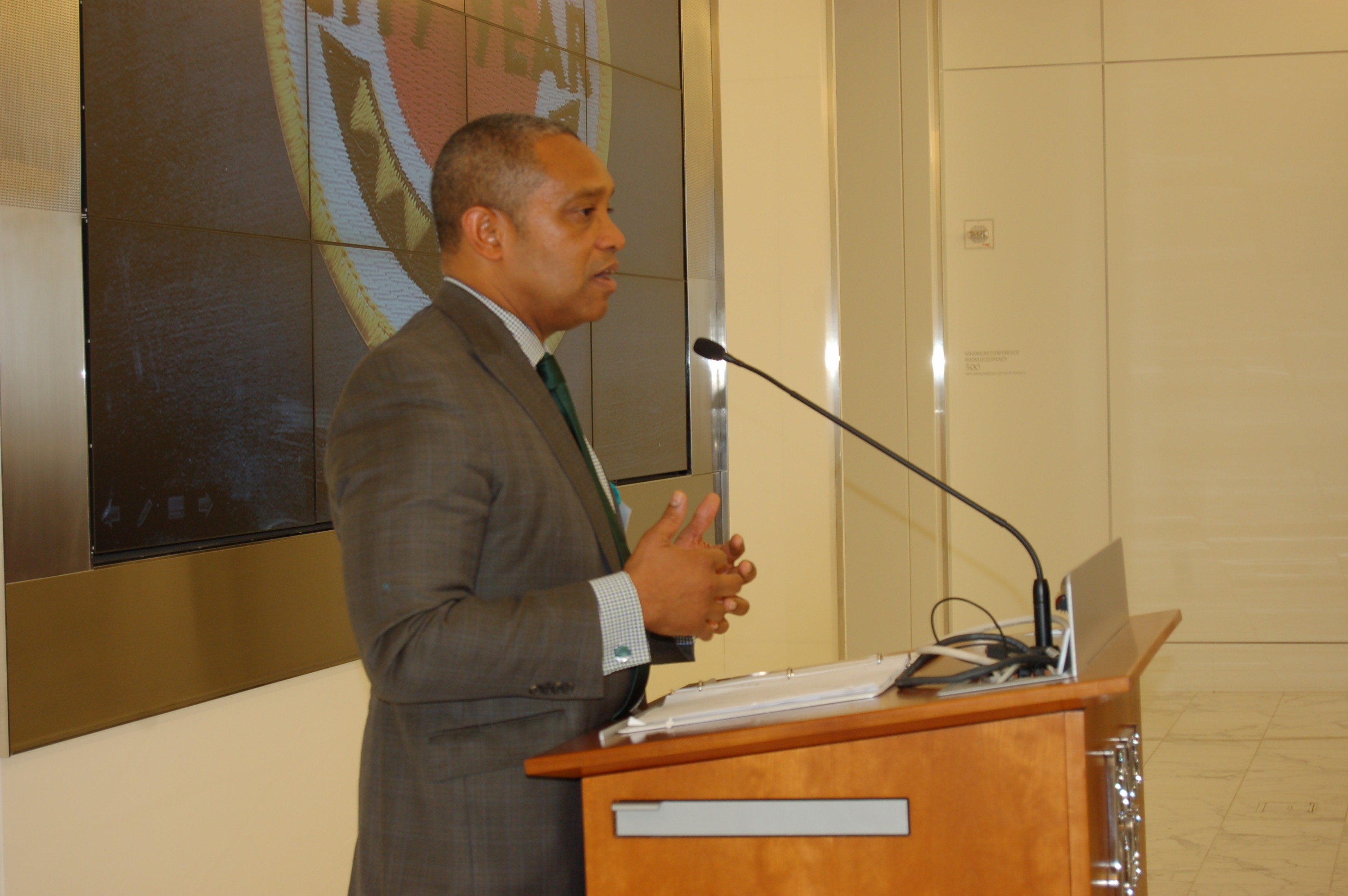
D.C. Attorney General Karl Racine is suing three related real estate companies for discriminating against people who sought apartments using taxpayer-funded housing vouchers, including those exiting local homeless shelters.
On Tuesday, Racine filed a lawsuit in D.C. Superior Court against Daro Management Services, Daro Realty, Infinity Real Estate, and Carissa Barry, an executive at the companies. The Daro entities operate about 1,000 units across 12 District apartment buildings, while Infinity is their parent company, according to Racine’s office. The lawsuit alleges that the companies and Barry charged extra fees for low-income voucher holders, who receive rental assistance thanks to the federal Section 8 program. The fees allegedly included application, move-in, and security fees that the Daro entities waived for non-voucher tenants.
The companies also required voucher holders to pay a security deposit, despite representing on rental applications that such deposits depended on the applicant’s credit score, notes the lawsuit. The Daro entities would set up payment plans for those who couldn’t afford the full amount up front, and then “evict them for falling behind — even while allowing unsubsidized tenants who fell into arrears to remain in their units,” Racine’s office says in a release. Roughly 10,500 D.C. residents have Section 8 vouchers, which are distributed by the D.C. Housing Authority.
Additionally, Racine’s office alleges that these companies refused to rent to people enrolled in the city’s rapid rehousing program, which places people in apartments following shelter stays. Per the attorney general’s office: “The companies explicitly touted this discriminatory policy in an online advertisement, which was approved by Barry. This advertisement was posted to real estate listing platforms and stated, ‘!!!!NO RAPID REHOUSING!!!!'”
The office is requesting a judge’s order to prohibit the alleged practices, which also include circumventing D.C.’s rent control laws by raising rents on vacant units in amounts that were higher than legally allowed under a 2018 law. In 2017, the Daro entities reached a six-figure settlement with the District over accusations that they broke consumer protection laws.
In a statement, Racine says there’s “a severe affordable housing crisis” in D.C. and many low-income residents depend on public rental assistance. “Discriminating against recipients of that assistance is illegal in the District of Columbia,” explains Racine. “That’s why the Office of the Attorney General is filing this lawsuit, reminding landlords that trampling over the civil rights of residents is unacceptable.”
Barry is a licensed real estate broker in D.C. and serves as the managing director for New York-based Infinity Real Estate, according to Racine’s office; Daro Realty owns all but three of the 12 District apartment buildings it operates.
“The allegations within the complaint are false and are completely inconsistent with our business practices,” Barry says in a written statement to DCist. “We have, and will continue to offer housing in a fair and consistent manner to all qualified residents regardless of their source of income. We look forward to working with the Office of the Attorney General to provide information supporting the ethics of our business practices and to resolve this matter.”
This isn’t the first time Racine has sued a landlord for discriminating against voucher holders and tenants in the rapid rehousing program. In 2019, he filed a lawsuit against Maryland-based Curtis Investment Group, which allegedly said it didn’t accept vouchers or rapid rehousing tenants. A month later, a Superior Court judge issued a preliminary injunction against Curtis requiring it to remove the problematic language from its ads. In 2018, Racine filed suit against Evolve and Evolve Property Management for allegedly explicitly stating in online advertisements that they did not accept housing vouchers. The practice of discriminating against voucher holders is illegal, but widespread across the District.
Rapid rehousing is a rental assistance program for people leaving D.C.’s shelter system or getting off city streets. Administered by the Department of Human Services, it pays for the vast majority of a participant’s rent, while the participant contributes between 40 to 60 percent of their income to the rent, whether that income comes from a job or another welfare program. The program has its roots in the 2008 federal stimulus package, and helps stabilize thousands of District residents annually in private apartments. But the subsidy is short-term: Most people in rapid rehousing get the assistance for a year or two at most, and many aren’t able to afford the rent when their benefits expire. That’s why critics of the program say it sets people up to fail. And while city officials say it has a high success rate, former rapid rehousing participants have returned to shelter or left D.C.
Racine was originally elected to his position in 2014, making him the District’s first-ever elected attorney general. (Previously, the attorney general was appointed by the mayor, but a 2010 ballot measure changed that.) He won reelection in 2018 and has made housing and civil rights issues a hallmark of his tenure. In addition, he has brought lawsuits against the Trump administration and family company.
This story has been updated with comment from Barry.
