 Jenny Gathright
Update 3/5: UFCW Local 400 has overwhelmingly ratified a collective bargaining agreement with Safeway instead of taking a strike vote Thursday at 1 p.m.
The deal includes an $18.6 million per year increase to pension contributions, or $74.4 million over the four-year life of the contract, according to the union. The agreement also includes $49.5 million in overall wage increases over four years.
In an emailed statement, Mark Federici, president of UFCW Local 400, said, “These negotiations were long and unusually complex due to the difficult pension issues we needed to resolve, but I am pleased to say we were able to reach a tentative agreement with Safeway that preserves retirement security for our members. This would not have been possible without a united union membership willing to take a stand for the fair contract they have earned. I couldn’t be more proud of our members at Safeway and I look forward to presenting the details of the proposal at our membership meeting later today.”
The union also ratified a four-year agreement with Giant early Thursday morning that preserves pensions and protects retiree benefits, boosts wages, and more.
Original:
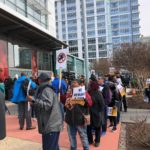
A day before a scheduled strike vote, the union representing thousands of Safeway employees in the region says it remains far apart from the company on key issues regarding worker pensions. Negotiations between the two sides lasted well into last night, and are continuing today, according to UFCW Local 400.
If Safeway employees do end up walking off the job, the action would include 10,000 workers at 116 stores in the region. The union says it has not yet transmitted the 72-hour notice required for a work stoppage to the company.
Local 400 has been advising Safeway employees to postpone major purchases, stock up on food and medicine, and get financially prepared to strike.
“We’re really still hoping for a deal here,” said Jonathan Williams, a spokesperson for Local 400, which represents grocery store workers at Giant, Safeway, and Shoppers in the region. “But because of the scale of what this potential strike could be and the sacrifice it means for our members, we have the responsibility to be getting prepared right now.”
According to the union, the major issue at the bargaining table remains Safeway’s large pension liability.
The multi-employer pension fund for Safeway workers is expected to become insolvent next year. Once the fund can no longer cover worker pensions, the union wants Safeway to pitch in to guarantee that workers will continue to receive retirement benefits at the same level.
Pensions were also an issue at the bargaining table for the union’s recent negotiations with Giant. The union reached an agreement with Giant the night before a union rally last month, and plans to vote on that deal tomorrow morning. During negotiations, a Giant spokesperson told WAMU in an email that it had offered to more than double its annual pension costs, “representing the single largest labor expense” in company history.
Albertsons, the company that owns Safeway, said in a press statement earlier this week that it has proposed “the same economic package” that led Giant to its tentative agreement with the union.
“The Unions have involved countless reporters on the East Coast in their inflammatory and unproductive narrative that claims the company is ‘not even in agreement with the basic facts’ regarding pension obligations,” said the statement. “This tactic has been counterproductive at best, and incredibly confusing at worst for the thousands of workers whose careers and lives are entangled in this unnecessary delay.”
In a March 4 strike update, the union directly contradicted Safeway’s statement: “What Safeway has proposed is still far from our tentative agreement with Giant. The company’s proposal still does not fully fund our pension.
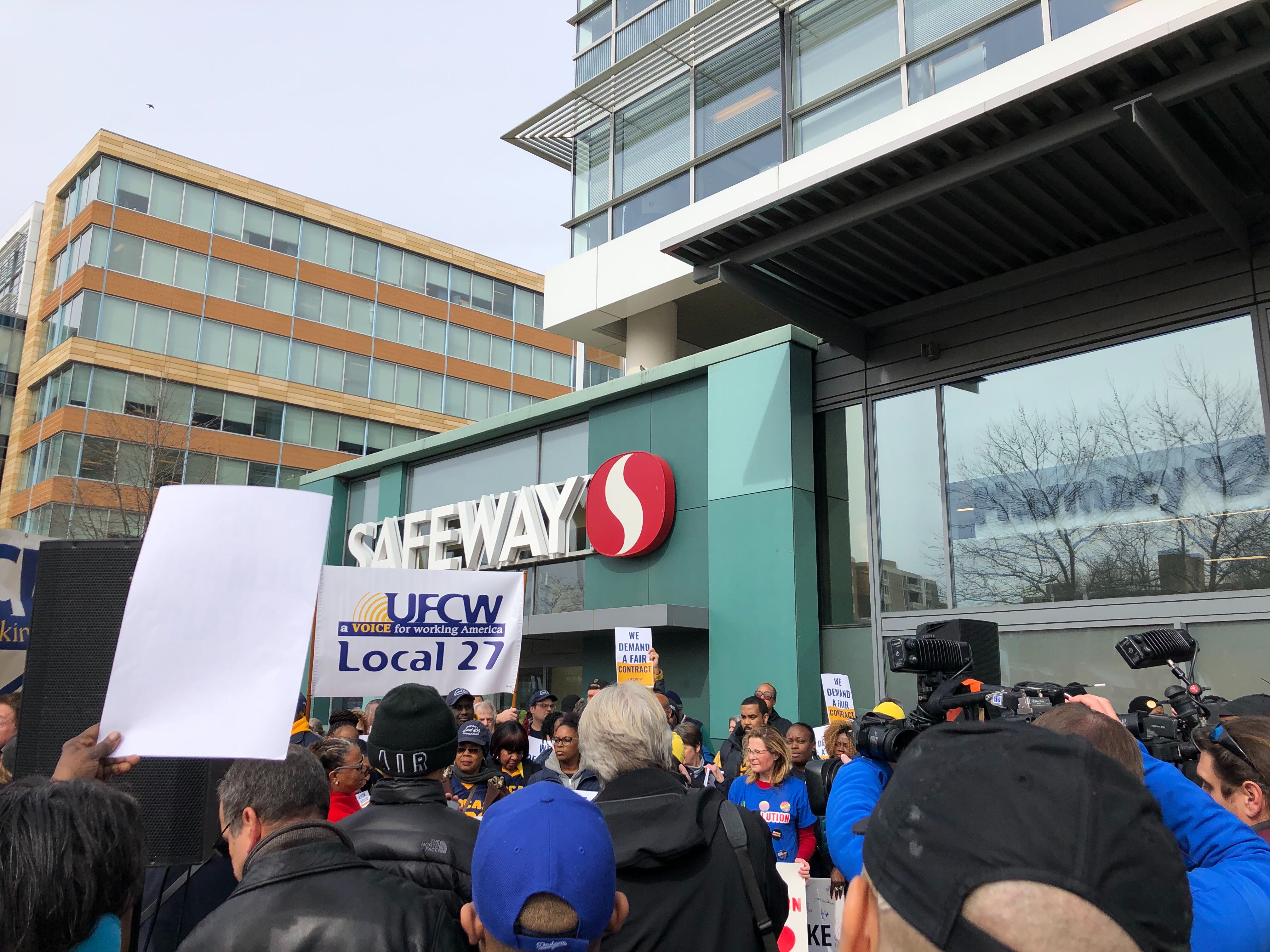
In an email last month, a Safeway spokesperson told WAMU that the company would continue to operate its stores in the event of a strike.
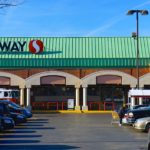
That means that in areas like Ward 7 in D.C., where there are two Safeways and no other large grocery stores, grocery shoppers could face a choice between crossing the picket line or traveling outside their neighborhood for fresh food.
“In the case of a strike, we’re looking at working with community organizations, churches, and even our own members to figure out how we can provide for those neighborhoods in the event of a strike,” said Williams from Local 400. “So when we’re asking people not to shop at Safeway, we’re helping to provide alternatives.”
Williams says the union is looking into arranging shuttles and having workers on the picket line provide customers with transportation to other union grocery stores.
Most grocery stores in the Washington, D.C. region are non-union. Costco is partially unionized. Shoppers, whose workers are unionized, announced last year that it would close or sell 17 of its D.C.-area stores. Aldi and Lidl, two non-union grocery store chains, are expanding their presence in the region.
Retail labor expert Burt Flickinger III, managing director of Strategic Resource Group, told WAMU last month that Safeway and Giant workers match or beat many of the region’s grocery stores when it comes to wages, but the companies’ benefits packages are what really distinguish them from their competitors.
It is rare for non-union retailers to have pension plans. Plus, Flickinger added, “Giant and Safeway have the best medical benefits by far of anyone in the marketplace.”
In an annual financial report last year, Albertsons wrote that the company’s success depended on its ability to manage operating expenses—including health care and pension costs.
“Several of our primary competitors are larger than we are, or are not subject to collective bargaining agreements, allowing them to more effectively leverage their fixed costs or more easily reduce operating expenses,” the company wrote.
“If … we are unable to negotiate acceptable contracts with labor unions, it could result in strikes by the affected workers and thereby significantly disrupt our operations,” Albertsons went on. “As part of our collective bargaining agreements, we may need to fund additional pension contributions, which would negatively impact our free cash flow.”
Unionized grocery workers elsewhere across the country have been at odds with management over recent contract proposals that they say proposed dramatic cuts to benefits. In July, grocery store workers across southern California threatened to strike after months of negotiations. One of the companies at the bargaining table was Albertsons.
Last April, workers at Stop & Shop stores in New England went on strike for 11 days before reaching an agreement with the Dutch conglomerate Ahold Delhaize. Giant Foods is a subsidiary of Ahold Delhaize.
Jeff Metzger, publisher of the trade publication Food World, told WAMU Stop & Shop has yet to recover fully from that strike.
“Their customers shopped elsewhere,” he said. “So it’s very difficult to return to the same traffic counts, but more importantly, the same per-basket spending levels.”
“The people that I hear from—they’re willing to strike,” said Natalie Bolling, a longtime Safeway employee and a shop steward with Local 400. Bolling, too, says she is prepared to strike to ensure a contract that protects part-time workers and imminent retirees like herself, who are counting on long-promised pensions.
But Bolling knows a strike would be difficult for many employees to weather, so it’s an outcome she desperately wants to avoid.
“When we go into stores and people are telling us that they have to take care of a sick parent, or their child is in college … you never know what the circumstances or situation might be,” said Bolling. “So you really have to be understanding.”
This story originally appeared on WAMU. It has been updated to reflect the outcome of Thursday’s vote.