Martin Austermuhle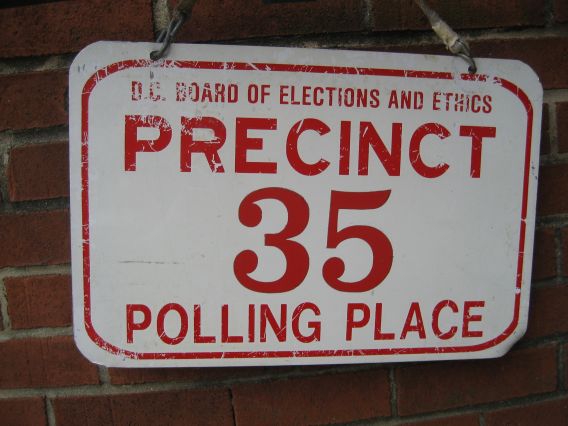
D.C. officials say they plan on encouraging more residents to use absentee ballots to vote by mail and will limit the number of physical voting sites for the June 2 primary. The changes are part of a plan to let the primary proceed as planned, while also addressing concerns raised by the coronavirus pandemic.
“We have two major priorities during this unprecedented emergency. One, make sure D.C. voters and D.C. Board of Elections staff and poll workers remain safe. Number two, make sure voters have an opportunity to vote and every vote is counted,” D.C. Board of Elections Chair Michael Bennett said on Friday.
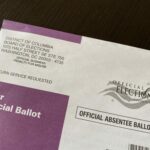
Bennett said they’re asking as many voters as possible to request absentee ballots, which require no excuse or explanation.
They can be requested online or through the election board’s app, and the city will also open phone centers for anyone who wants to call to request a ballot. Those ballots, which will be ready for distribution by May 1, can be mailed in or dropped off at designated locations.
Most D.C. voters will not go to their regular polling place if they want to vote on primary day.
D.C. usually has 144 precincts, but Bennett said only 20 in-person voting centers will be set up across the city — with at least two per ward — for day-of and early voting, which is scheduled to kick off May 22.
And to minimize chances of crowding at those centers, Bennett said the city is considering staggering access to them, possibly in alphabetical order by voter last name.
Similar steps, albeit on a smaller scale, will be taken for the June 16 special election in Ward 2, when voters will select someone to fill out the remainder of former Council member Jack Evans’ term in office.
The changes resemble vote-by-mail systems in places like Washington state and Colorado, though D.C. won’t proactively be sending every voter a ballot as those states do. (There is a bill pending in the D.C. Council to move toward that.) Bennett said officials from a number of jurisdictions that offer vote-by-mail advised that D.C. phase it in slowly and start by asking more people to request absentee ballots.
“Mailing ballots out to registered voters is a lot more complex process than one would think, and every jurisdiction that actually does that recommended that we take two years to plan the processes, not two months. You could have one mistake and your whole election is failed,” he said.
The only jurisdiction in the Washington region that has successfully implemented vote-by-mail is Rockville, which used it for its municipal elections last year. But the coronavirus pandemic may serve a broader, albeit unexpected, boost for voting by mail, largely because states across the country with upcoming primaries are scrambling to figure out how they can balance democracy and public health.
Earlier this month, Maryland Gov. Larry Hogan delayed the state’s April 28 primary, pushing it to June 2. And this week the Maryland Board of Elections recommended no in-person voting for the primary, opting instead for an expansion of absentee ballots. But the board also previewed some of the possible challenges, which could range from people not having access to ballot request forms to mailed-in ballots being rejected because the voter’s signature does not match the one on file.
“Requesting your ballot by mail and mailing your ballot in is by far the safest way to vote, and will be counted,” Bennett said.
This story originally appeared on WAMU.