Jeffrey Katz
 Ally Schweitzer
 Martin Austermuhle
The coronavirus continues to spread exponentially across the Washington region, and so do appeals from local leaders to residents to stay home.
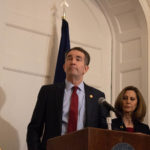
Maryland Gov. Larry Hogan spoke more forcefully about the situation Monday morning than he had just last week. “We are no longer asking or suggesting Marylanders to stay at home,” he said, pausing briefly for emphasis. “We are directing them.” Virginia Gov. Ralph Northam followed a few hours later, similarly ordering residents of the commonwealth to stay put.
But what exactly are the effects of Bowser’s, Hogan’s and Northam’s respective stay-at-home orders, and how do D.C., Maryland, and Virginia’s responses relate to other local jurisdictions? Here are some practical questions and the answers, as we understand them now.
What exactly did Bowser, Hogan, and Northam prohibit?
The orders are essentially a reminder of a message that has been repeated many times in recent weeks: stay home as much as possible. Exceptions are noted for essential activities like grocery shopping, medical appointments or outdoor exercise (while maintaining good distance between yourself and others, of course).
They also stress that any gatherings of more than 10 people are prohibited. Only essential businesses are allowed to remain open. And those that are essential must scale back their operations, limit staff and institute telework as much as possible.
How will this be enforced?
In Maryland, the new restrictions go into effect at 8 p.m. Monday. In Virginia, it’s pretty much the same. In D.C., however, the restrictions go into effect at 12:01 a.m. on Wednesday, April 1.
Hogan said violators would be charged with a misdemeanor and subject to a penalty that could include imprisonment of up to one year and fine of up to $5,000 — or both. In Virginia, violations can be met with up to a year in jail and a $2,500 fine. In D.C., violators could be charged with a misdemeanor, and they could face a fine of up to $5,000, jail time of less than 90 days or both.
But how likely is it that police will patrol the entirety of the two states starting Monday?
Don’t expect to be stopped as you drive to the grocery store or be asked to show any sort of permission slip or proof. Nor will police officers jump from their cruisers with measuring tape to ensure that you’re staying at least six feet away from others when you go for a walk around the block.
But some more enforcement is likely. Hogan’s chief legal counsel suggests that essential businesses that remain open provide employees with a letter saying as much, “in case the employees are stopped by law enforcement.”
LETTERS/PERMISSION SLIPS. Getting a lot of questions about whether essential employees need some kind of paperwork. Here is guidance from our chief legal counsel. pic.twitter.com/n38ygrkOmU
— Michael Ricci (@riccimike) March 30, 2020
That sounds serious.
Yes, that’s the intent. Now, if you host a garden party for 30 friends, you can’t act surprised when police write you a ticket or take you into custody. That’s what happened last week with a man in Carroll County, Maryland who was arrested when he refused to break up a bonfire for 60 people at his home.
Hogan tweeted his “disgust towards such irresponsible, reckless behavior.”
A Charles County man has been arrested after repeatedly violating the executive order banning large gatherings and hosting a bonfire party with 60 guests. I cannot begin to express my disgust towards such irresponsible, reckless behavior. https://t.co/OluflxqEYH
— Governor Larry Hogan (@GovLarryHogan) March 29, 2020
But it’s worth noting that that arrest happened before Hogan’s new stay-at-home order. In a sense, this new order is more about tougher wording than it is about any sort of significant change in policy or practice. Maryland officials wanted you to stay home before and they want you to know now that they mean it.
Will D.C., Maryland, and Virginia residents be able to cross state lines?
While Hogan did say he is urging Marylanders not to cross state lines — and self-quarantine for 14 days if they do — neither Hogan nor Northam’s orders are a travel ban. D.C. residents can still go food shopping in Maryland, Maryland residents can come into D.C. to buy gas, and Virginia workers who have to move across the region as part of their jobs will still be able to.
Does the D.C. area get any special attention being the nation’s capital?
Hogan, Northam, and D.C. Mayor Muriel Bowser would certainly like some additional attention given the region’s workforce and role in staffing the federal government.
Last week, the three leaders jointly asked President Trump to “provide additional financial support to help our jurisdictions maintain the health and safety of the region and the federal workers who serve the American people.”
Read the stay-at-home orders issued in Maryland, Virginia, and D.C.
This story originally appeared on WAMU. It has been corrected to reflect that bicycle shops are considered essential businesses in D.C., Maryland, and Virginia.