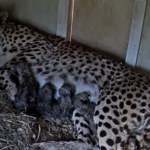
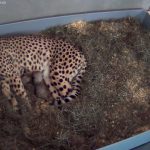
You can get nearly anything delivered these days, from tacos to toilet paper (assuming your local pharmacy has any left). If you’re the Smithsonian National Zoo, that list includes cheetah milk. On Monday, the zoo and the Conservation Biology Institute issued an update on the first cheetah cubs born via embryo transfer at Ohio’s Columbus Zoo in February, in partnership with Smithsonian scientists.
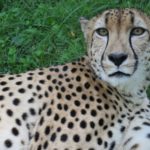
The baby cheetahs are hungry, and while they are being hand-reared by zoo keepers, their surrogate mom, a three-year-old cheetah named Izzy, has donated her milk to the Smithsonian’s milk bank. The sample traveled 400 miles from Ohio so scientists can study and try to recreate it. (Though the zoo is closed to the public, some staff are still working.) While three cheetahs currently call the National Zoo home, this marks the first sample of cheetah milk the repository has received.
In a post on the National Zoo’s website, Jenna Pastel, a research assistant in the nutrition lab, wrote, “It is incredibly important work, because mother animals can’t always care for their young, and every individual is important when we are dealing with endangered and vulnerable species.”
The National Zoo’s milk bank has samples from roughly 200 species—from armadillos to zebras—making it the largest milk repository in the world. The National Zoo’s own animals and those from other zoos have contributed to the collection, which is used to produce more milk appropriate for young animals to feed on. Previous recipients of the lab’s homemade milk have included the Cincinnati Zoo’s famous hippo, Fiona. Her formula was a mix of protein, sugar, fat, and minerals meant to simulate the milk she would’ve gotten from her mother had she not been born premature and too small to nurse, according to National Geographic.
Most cheetahs won’t allow humans to milk them, but Izzy has been trained to cooperate with medical procedures. She is so comfortable with her keepers that she let them milk her by hand with a pump. The Columbus Zoo then sent a sample to Washington in a cooler filled with dry ice, where scientists placed it in a freezer. They will then analyze it to help generate a substitute for cubs that don’t have access to milk, sometimes because their mother is sick or having difficulty nursing.
The news comes a week after the National Zoo announced that it may soon welcome some newborns of its own, having recently artificially inseminated giant panda Mei Xiang.
The milk formula made from Izzy’s sample is expected to help feed the cubs she gave birth to and the zoo’s three cheetahs, as well as future generations of cheetahs. Just don’t expect to see it on Postmates.