 Rachel Sadon
 Elliot C. Williams
 Jenny Gathright
The number of fatalities related to COVID-19 in D.C., Maryland, and Virginia have more than doubled from a week ago, crossing 800 confirmed deaths.
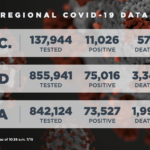
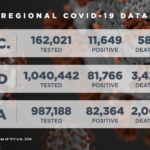
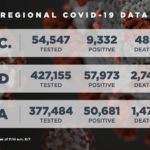
In total, D.C. has reported 91 fatalities and another 2,666 positive cases; Maryland has seen 463 deaths and 12,308 cases; and Virginia has registered 258 deaths and 8,053 cases.
The deaths have not occurred evenly across racial groups in D.C., with black residents composing a disproportionate share of fatalities. The deaths in D.C. also include five Washingtonians experiencing homelessness, four patients at the St. Elizabeths psychiatric hospital, and one inmate and one correctional officer at the D.C. Jail.
In Virginia, Henrico and Fairfax counties have seen the highest number of fatalities. Prince George’s and Montgomery counties have seen the highest death tolls in Maryland. The state is also reporting 71 additional “probable” deaths, which would bring the region’s total to nearly 900 fatalities.
Across the three jurisdictions, the number of new cases has consistently risen by between 6 and 8 percent each day this week, reaching a total of more than 23,000 confirmed cases by Saturday morning.
There are some bright spots. Maryland Gov. Larry Hogan said Wednesday that hospitalization rates are showing signs of stabilizing in the state and that surge capacity and testing capability have increased. “There are some very real reasons for hope and optimism right now and there is clearly a light at the end of this tunnel,” Hogan said, “but exactly how and when we will get to that light is going to be up to each and every one of us.”
But despite those promising signs, it’s still not clear when different parts of the region will hit their “peak” of cases—the surge that officials have worried will strain the healthcare system beyond capacity. In D.C., different models predict a range of peaks, and a lack of testing capacity has made it difficult to get a full picture of the current situation.
“The reality is we are still seeing an increased number of cases, if you look day by day,” said Dr. Amanda Castel, a professor with George Washington University’s Department of Epidemiology. “I think we’re probably still several weeks out before we will be able to tell whether or not we’ve peaked and whether or not we have been successful in using social distancing and other measures to flatten the curve.”
Mayor Muriel Bowser has extended the city’s state of emergency order to May 15, and the academic school year will remain entirely remote before ending three weeks early. Virginia’s stay-at-home order remains in effect until June 10 and a separate directive ordering nonessential businesses to close has been extended until May 8, while schools have moved to remote instruction for the remainder of the year. Hogan has not announced an end date for Maryland’s stay-at-home order, but schools will remain closed until at least May 15.
Despite the increases in both case counts and deaths, small groups in Virginia and Maryland have protested business closures and lockdowns in recent days, echoing conservatives in other parts of the country.
But local leaders have not signaled that they will bow to pressure.
“No one wants to get back to business more than I do … but we have to make sure we can be safe,” Bowser told NBC4 this week. “We have to be careful about how we turn it on so we don’t find ourselves having lost all of the gains that social distancing has allowed us to achieve.” The mayor said earlier in the week that she sees the May 15 date as a checking-in point that could be extended if necessary.
Hogan said this week that he has seen “hopeful and encouraging signs,” but that the state isn’t ready yet to reopen. The governor called this the “worst possible time to try to put more people out there” on the Today show on Thursday. He laid out four major conditions of a return to normalcy: increased testing capacity, improved contact tracing, sufficient PPE for medical professionals, and increased hospital capacity.
The D.C. government has suggested a late June or early July peak using Penn Medicine’s COVID-19 Hospital Impact Model for Epidemics (CHIME), which is based on the number of infected patients and projects when the city will need the highest number of hospital beds and ventilators. The Institute for Health Metrics and Evaluation (IHME) model paints a rosier picture. It says D.C. has already hit its peak, and peaks in Maryland and Virginia will be past us by the end of April.
A projection from the University of Virginia, meanwhile, says that Northern Virginia could hit its peak of cases as late as mid-August.
But experts say a dearth of tests has stymied our ability to understand the extent of the virus’s spread, and large-scale studies of the wider population are needed to account for milder or asymptomatic cases, or “silent carriers,” to provide the most accurate insights.
“We’re not where we need to be as of today, but each day that gets better,” Virginia Governor Ralph Northam told reporters this week.“We’ll need that information as we make these decisions to ease the restrictions.”
Even with limited data, though, it is clear that black communities in the D.C. area have been hit hard.
Across the country, a survey from Pew Research Center found that 27 percent of black adult respondents personally knew someone who had died or been hospitalized because of COVID-19. In comparison, 13 percent of white respondents and 13 percent of Hispanic respondents to the Pew survey said they knew someone who had suffered from the virus to the same extent.
Black people represent about 46 percent of the population in D.C., but composed 78 percent of COVID-19 related deaths as of April 18. In Maryland, black people are overrepresented among confirmed COVID-19 cases — and majority-black Prince George’s County accounts for more than a quarter of the cases in the entire state.
The number of Hispanic or Latinx people in D.C. with confirmed cases of COVID-19 tracks closely with the D.C.’s overall population: representing 11 percent of both the city’s overall population and virus-related deaths. In Maryland, just over 14 percent of patients are Hispanic or Latino, four percentage points higher than the share of the total population. Virginia is not tracking how many Hispanic or Latino residents have tested positive for the virus.
The picture is incomplete in other ways. The data does not include people who have symptoms but who are not tested, or people who avoid seeking medical care out of fear because they are undocumented. And race and ethnicity have not been identified in 16 percent of cases in D.C., 22 percent of patients in Maryland, and 36 percent in Virginia.