Colleen Grablick
With at least 70% of the D.C. region’s population partially vaccinated, coronavirus case and deaths counts in D.C., Maryland, and Virginia are at the lowest they’ve been since the beginning of the pandemic.
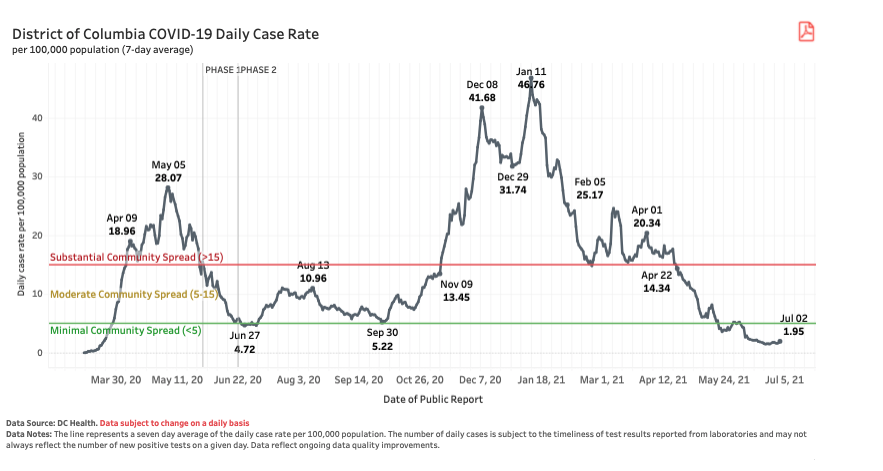
D.C.’s daily case rate, which peaked at almost 47 cases per 100,000 residents a day in January, is now just below 2. The positivity rate, which measures the average number of positive cases out of total tests administered, has stayed near 1% for the past few weeks, and only 1.5% of the city’s hospitalizations are COVID-19-related, an all-time low.
Deaths from the virus have also drastically fallen in the city. Over the Fourth of July weekend (July 2-July 5), the city reported one death from the virus. For most of the spring and into the summer months, D.C.’s average death toll has hovered between 1-2 per day — compared to the spring 2020 surge, when daily death tolls crept into the teens. According to D.C.’s COVID data, six residents died from the virus between June 1 and June 29. By comparison, in June 2020, 83 people died from the virus.
In Maryland and Virginia, the trends look similar. Maryland’s daily case rate per 100,000 residents is now just above 1. In January, the case rate peaked at nearly 52. Both Montgomery and Prince George’s counties, Maryland’s hardest-hit jurisdictions, are recording case rates similar to that of the state.
Like in D.C., COVID-related deaths have drastically decreased in Maryland. In June, 92 residents died of the virus; in December 98 deaths were recorded in just two days. But of the 92 residents who died of the virus in June, all of them were unvaccinated, according to Gov. Larry Hogan’s communications director Micheal Ricci. Unvaccinated residents made up 95% of the state’s new cases last month, and 93% of its COVID hospitalizations, demonstrating how the worst effects of the virus are now impacting mainly people who have not gotten a shot.
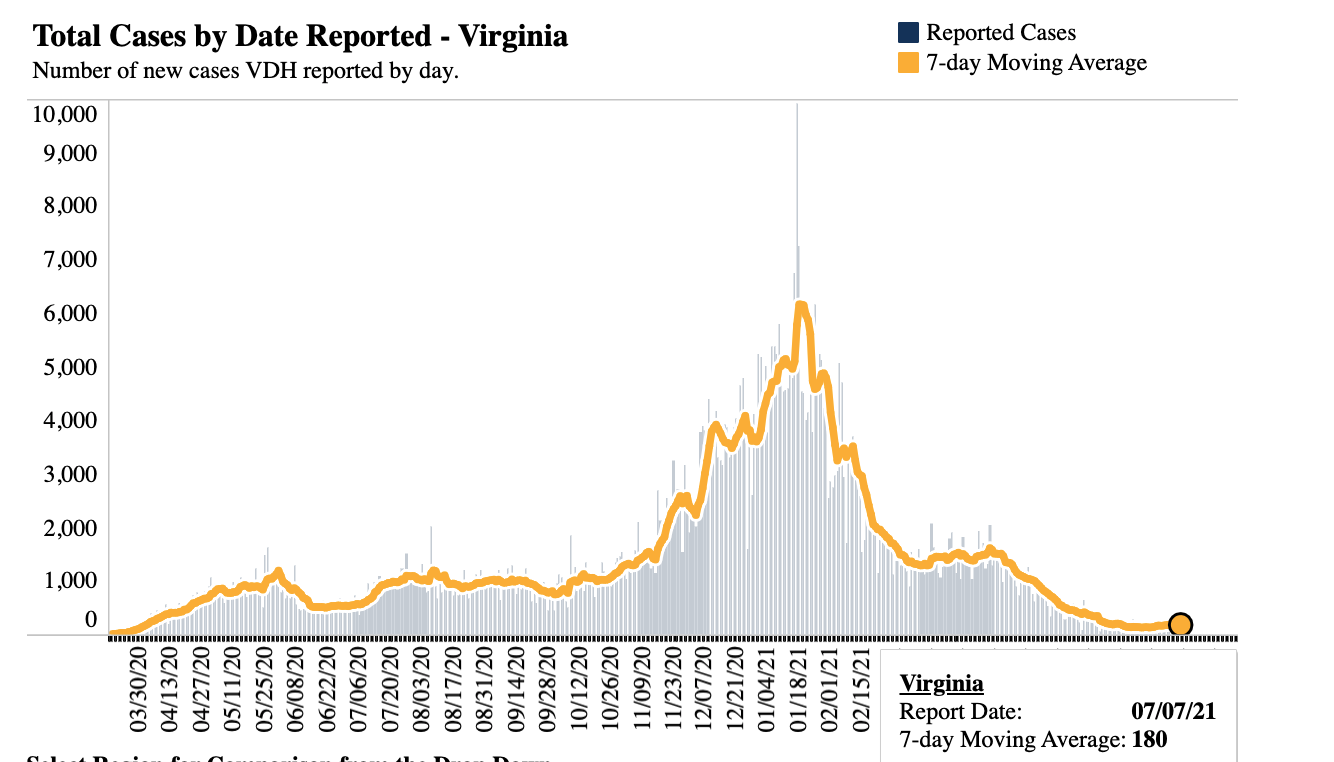
Virginia’s numbers are similarly low. As of Wednesday, Virginia’s average daily rate per 100,000 residents was 2, according to the New York Times coronavirus tracker. The commonwealth is reporting a seven-day average of 180 new cases a day, a slight increase from the average reported in June, when that metric dropped below 130. The commonwealth’s seven-day average death toll has also dipped in June and July, after remaining in the mid-teens for most of the spring months, according to the Washington Post’s regional coronavirus tracker. As of Wednesday, Virginia reported an average of 3 deaths per day — in February and March, that number climbed towards an average of 200 deaths per day.
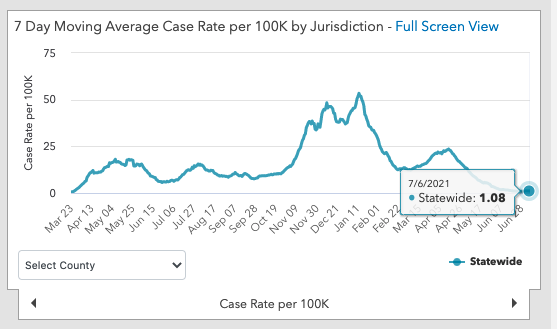
While the trends point in the most positive direction any of the jurisdictions have seen in the past 15-plus months, new variants and pockets of unvaccinated residents are cause for concern. As Maryland’s data for June revealed, and as public health experts have warned, the coronavirus may continue to ravage groups of unvaccinated residents, leading to pockets of outbreaks.
In D.C., vaccinations in predominantly Black wards 7 and 8 still lag behind whiter, wealthier wards in the city — as has been the case since the early days of the vaccine rollout. According to a Washington City Paper report in late June, this trend is playing out in the teen vaccination rollout as well. In late May, the Washington Post reported that eight in 10 new COVID-19 cases in D.C. were Black residents – revealing the persistent racial gaps in who is getting vaccinated and who is continuing to get sick with the virus, as the city lifts mask mandates and restrictions on business operations.
There’s also the emerging Delta variant, which according to early evidence may be more transmissible and may cause more severe infection. Vaccines still provide strong protection against the variant right now, but scientists have identified the strain as a “variant of concern.” At the end of June, 65 cases of the Delta variant had been identified and reported to the Maryland Department of Health. In Virginia, the health department is reporting 67 known cases, including 17 in the Northern Virginia area, as of last week. DC Health did not respond to multiple requests for information from DCist/WAMU. While local officials have not walked back any of the restrictions that ended earlier this summer (Maryland’s state of emergency just expired on July 1 after more than a year), they say they’ll continue monitoring case trends and the presence of the Delta variant in the region.
As of Wednesday, D.C. estimated that at least 72% of its adult population has received at least one dose of the vaccine. Maryland reports that 75% of its 18 and older population is partially vaccinated, and Virginia records 71.5%.
This story was updated to accurately reflect the D.C. region’s vaccination rate.