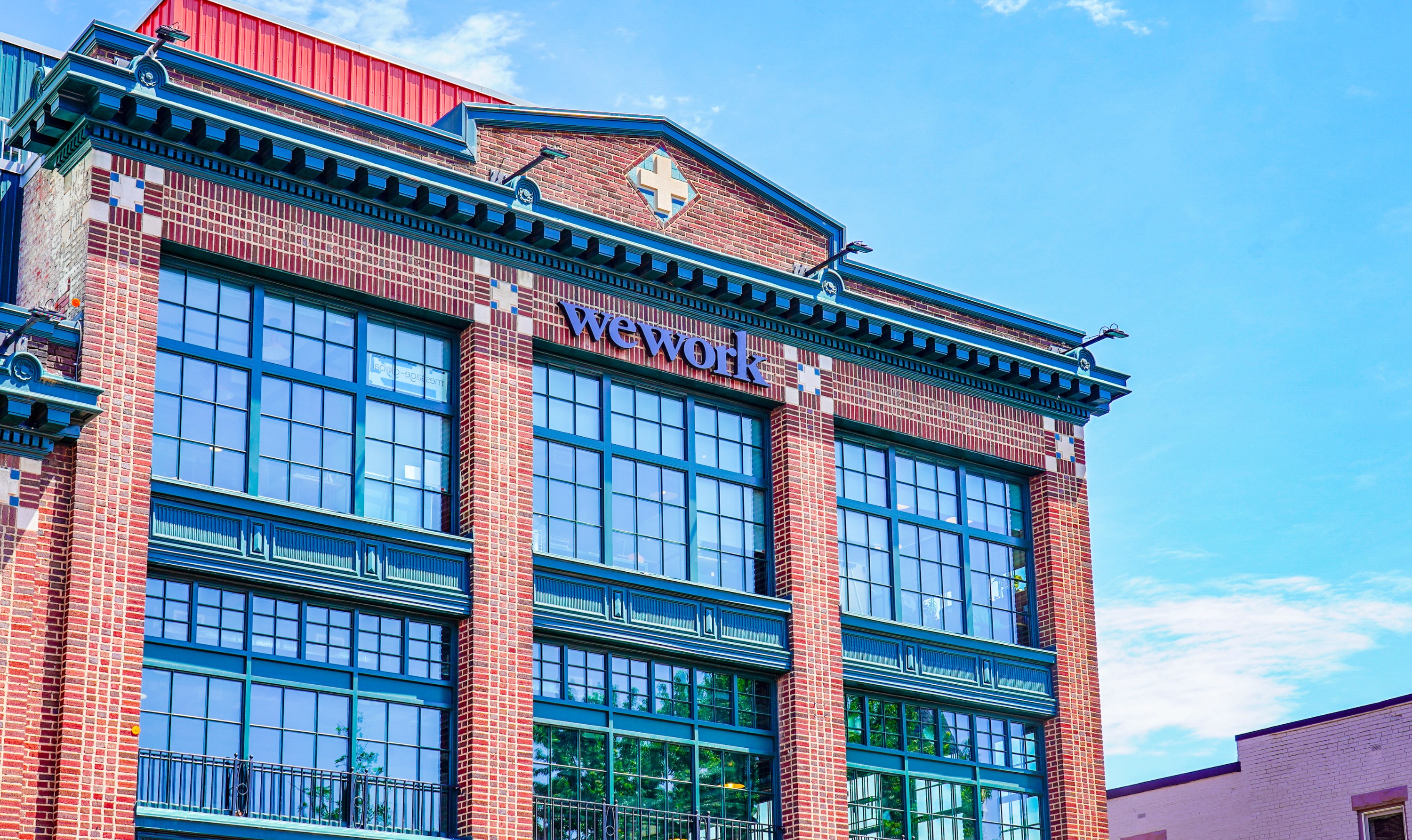
While downtown buildings have mostly emptied out amid the COVID-19 outbreak, the District’s largest private office tenant, WeWork, remains open for business. The New York City-based co-working giant is keeping all of its D.C. locations open during the pandemic, according to the company, and charging many of its members their usual fees.
Three WeWork members who spoke to DCist expressed frustration that the company is still requiring fees under their existing membership agreements, even as guidelines from public health officials discourage working in communal settings and the region’s governments have directed “nonessential” workers to stay at home as much as possible to stop the coronavirus from spreading. Two people with annual memberships said WeWork offered to postpone their payments but wouldn’t cancel or work out alternative arrangements for their fees.
“It became clear their goal was to keep collecting money,” says Lisa Kaneff, a freelance copywriter who pays $450 a month to access the WeWork space near her apartment in Kalorama and has used WeWork since 2017. “I’m one person, at one desk, in one building, in one city. But $450 a month means something to me.”
Kaneff adds that she’s filed a complaint against WeWork with the D.C. attorney general’s office. A spokesperson for Attorney General Karl Racine confirms the office has received roughly half a dozen complaints related to the company and is currently reviewing them.
As of March 2019, WeWork operated more than 30 locations in the District that comprised a total of 1.2 million square feet. It has faced rocky financial straits of late, including a failed initial public offering last fall, the ousting of its former CEO and chairman, and the pullout of a prospective $3 billion stock purchase by investor SoftBank this month. (A special committee to WeWork’s board has sued SoftBank over the unrealized deal for alleged breach of contract.)
The company says it provides critical space for members who are considered “essential” amid the coronavirus crisis, such as organizations that support healthcare providers, food banks, and delivery services. In late March, WeWork also launched a new initiative, “WeWork for Good,” to give space to entities that are directly working on the public health response to COVID-19, including D.C. chef José Andrés’ nonprofit, World Central Kitchen.
Although WeWork has a work-from-home policy for its community employees, who tend to members’ needs, the company was reportedly offering them $100 daily bonuses to physically staff its locations. WeWork also says its co-working spaces are now cleaned more frequently, and it’s put off all employee and member events until further notice.
Still, other co-working companies in the city, including Cove and The Wing, have temporarily suspended their operations. Cove is letting its members cancel their memberships without any cancellation fees and delay their expected renewal dates. The Wing stopped collecting dues from its members and, on April 3, announced that it had laid off or furloughed most of its employees.
“Since the onset of the COVID-19 outbreak, WeWork has taken a number of measures to protect the health and safety of our employees and members,” a spokesperson for WeWork says in a statement. “Where we believe we can operate our buildings safely, and in accordance with government policies, our locations remain open. While this situation continues to evolve, we are committed to speaking with our members individually and working to find solutions that support them during this time.”
That’s not enough for some WeWork members, who say the company should shut down its co-working locations during the pandemic. Jill Raney, the founder of Practice Makes Progress—a local business that offers inclusivity training—started an online petition calling for exactly this about a month ago.
So far, more than 670 people have signed the petition. Raney, who recently cancelled their month-to-month WeWork membership after communicating with the community manager at the Manhattan Laundry location they’d used near U Street NW, contends that the company has a “basic moral obligation” to shut its doors. (The spokesperson for WeWork declined to comment on the petition.)
“What motivated me to start the petition and what motivates me to spend my time on it is, it’s gonna be people who work for ourselves, who selfishly or out of an intense sense of focus to keep your business alive, who continue going to WeWork,” says Raney. “Those choices could be lethal for the cleaning staff and others.”
Asked whether providing co-working space is considered an “essential activity” under the District’s coronavirus shutdown order, a spokesperson for Mayor Muriel Bowser says it is. “Co-working spaces that may host essential businesses may stay open as essential businesses that offer professional services to assist in compliance with other essential businesses or legally mandated activities,” the spokesperson says in an email. “However, these spaces shall comply with Social Distancing Requirements and individuals hosted in the space must take all reasonable steps to work remotely and deliver services by telephone, video, and internet.”
Meanwhile, WeWork has sought rental relief from some of the landlords from whom it leases space and held back April rent for some locations, Bloomberg reports. The company told the outlet that it was contacting its more than 600 landlords across the world “to work in good faith towards finding asset-specific solutions that benefit all parties involved.”
For WeWork users who have annual memberships, though, potential solutions don’t seem so simple.
“They’ve ruined the relationship,” says Nick Solheim, the director of business development at digital marketing firm Nativ3 and the founder of the nonprofit Wallace Institute for Arctic Security, which both use a WeWork location on K Street NW. “Even if they waived our rent from now to September, I don’t think they could do anything that would make me want to work with them again.”