Matt Blitz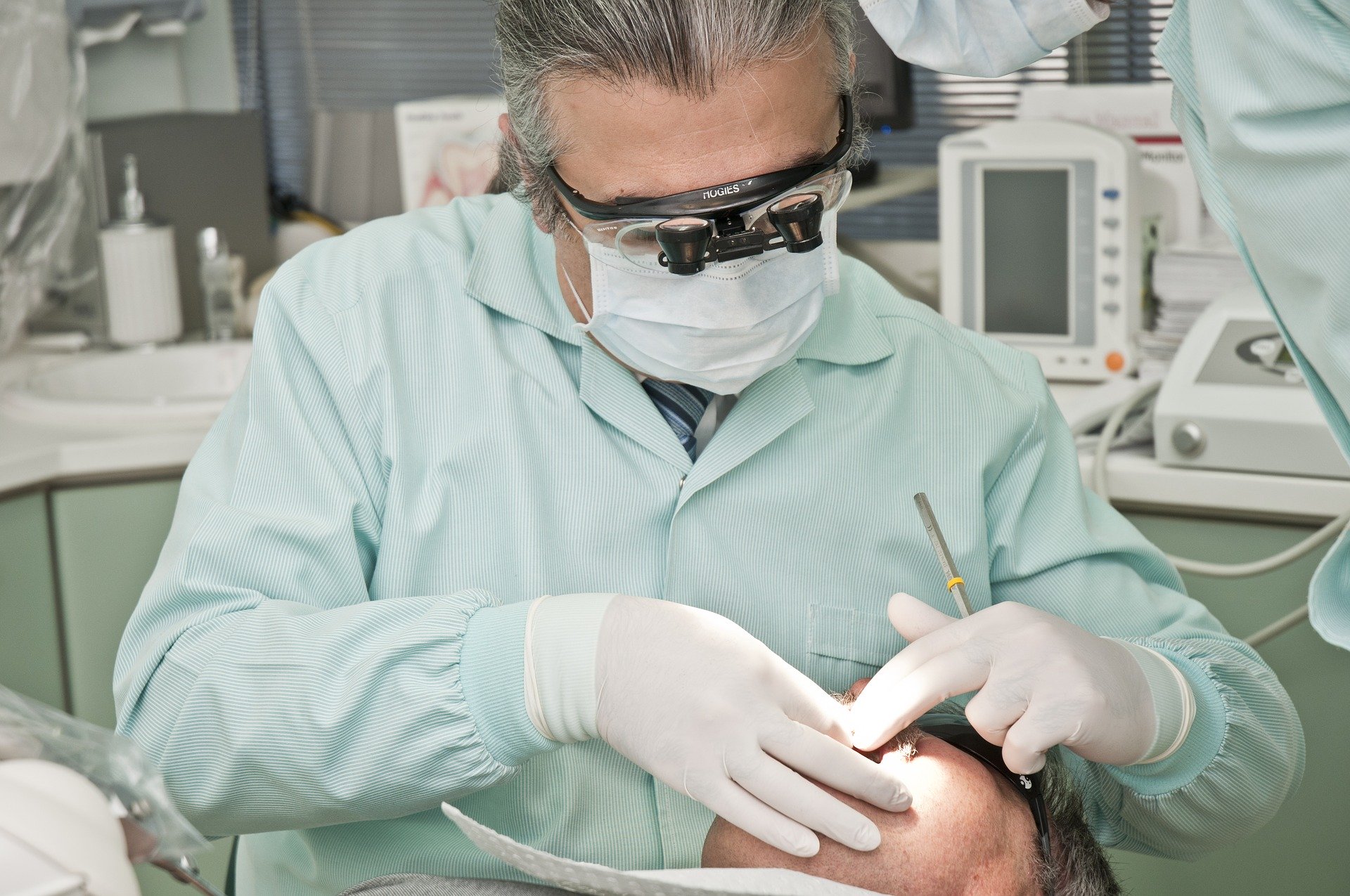
In late April, when Virginia Governor Ralph Northam announced that elective medical procedures would be able to resume May 1, many in the medical community agreed with the decision.
But some in the dentistry field, which was included in the announcement, haven’t embraced the decision and are remaining closed for most procedures. Of the 18 Northern Virginia dental practices reached by DCist, 11 have decided not to fully reopen right away. Some are planning to start taking patients again in the coming weeks for routine procedures like cleanings, root canals, and crown repairs. Others do not have a timeline yet.
By the very nature of their jobs, dentists and dental hygienists are thought to be among the most at-risk of contracting the coronavirus, which spreads in part via respiratory droplets. The CDC says that dentists and their staff have a “high potential for exposure” to the virus no matter what precautions are taken. That risk exists even if offices decline to treat people experiencing symptoms, given that an unknown number of people infected with the virus are asymptomatic.
This has left a number of local dentists spending heavily on protective equipment and making tough decisions about reopening.
“Of course, there are concerns because of the aerosols being created,” says Dr. Malika Kohli of Columbia Pike Family Dentistry in Arlington. “But, at some point, we need to start seeing our patients again.”
Kohli’s practice is reopening on May 11 with a number of protective measures in place, including PPE for staff, making patients wait outside or in their cars until they are ready to be seen, and taking the temperature of every patient who enters the office. She says they are following every recommendation put out by the American Dental Association and Virginia Dental Association.
Kohli says the main reason she is going to start to start seeing patients again is because of the fear that folks will end up going to the emergency rooms with dental issues that could be easily managed by her and her staff. “Going to the ER is not the right to do,” says Kohli, “It could overwhelm [the ER] when they need to deal with other stuff.”
Six other dental practices DCist spoke to via call or text are currently open, with several saying they have full schedules. However, most declined to comment on why they immediately decided to start seeing patients again.
Dr. Sam Cappiello in McLean says he doesn’t agree with Northam’s decision to allow dentists to reopen their practices for routine procedures, and has his own major reluctance about reopening. A practicing dentist since 1986, he admits the closure has been tough on him and his practice—they had to furlough their staff in mid-March, he says. However, he and his partner are planning a “soft reopening” (meaning fewer patients and only hygiene appointments) on June 11. Yet, he still has a nagging fear. “There’s a lot of conflicting information out there. It makes it all very confusing,” says Cappiello, “Both my partner and I have concerns. We still don’t know enough about how the virus spreads.”
Cappiello says he’s invested in an “aerosol suction unit” that acts like a vacuum near a patient’s mouth to suck up aerosols. “It’s got this circular tube that attaches… and comes right up to the patient’s face.”
While this equipment (and all the other additional PPE) was expensive, Cappiello says it was worth it to soothe fears. “We wanted to make sure we were adequately protecting our patients and team from exposure,” he says.
The Virginia Dental Association, which represents about 3200 practicing dentists, doesn’t agree that this type of machinery will actually provide protection. In late April, the association supplied members with updated guidelines for reopening practices, and they did not include anything about aerosol suction equipment.
Incoming president of the association Frank Iuorno says there’s a reason for that: there’s no real hard data to back up the effectiveness of this type of equipment. “There’s really no evidence to prove that any of those fancy suction filter apparatus that people are investing in are effective at decreasing transmission rates,” says Iuorno. He knows it sounds like a good idea, but thinks it actually may be counter-productive. “Until there’s science that it actually works, we are sending mixed messages to patients and staff,” he says.
Iuorno says that, in general, the VDA membership agrees with Northam’s decision to allow for dentists to reopen for elective and routine procedures.
There are also dentistry practices that don’t have any timeline for opening back up. For them, the risks outweigh the necessity. An office manager at a Falls Church dentist practice said the office would not be reopening “because we are trying to stay alive.” The non-profit Northern Virginia Dental Clinic, which serves low-income residents across the region, say they have no timetable for their reopening. Their executive director Tom Wilson responded to DCist via email that “dental practices do present a unique challenge due to the creation of aerosols during dental procedures.” When asked if he agreed with Northam’s decision, he responded with “no comment.”
Other jurisdictions are grappling with similar decisions. On Thursday, after an order from Governor Hogan on Wednesday, Maryland dentists were allowed to resume elective and non-urgent procedures as well. D.C. remains closed.
Even for those who are attempting to at least partially re-open, fears exist. Gina Truvan, the office manager for Dentistry of Alexandria, says her practice has decided not to do deep cleans and other procedures that could lead to a significant amount of aerosol production, but she understands the balance of risk and the need to be open.“Dentists are at much higher risk than other medical practices. They are not dealing with aerosols and saliva like we are,” says Truvan, whose husband is the dentist. “But we also need to make a living as well.” She also complained of suppliers inflating the prices of face masks and other PPE, making purchasing difficult and expensive.
In the end, Truvan is resigned to the fact that there will be risk in working and going to the dentist’s office in the near future. “It’s not a huge difference if we open now or a month,” says Truvan, “the coronavirus will still be around.”