Martin Austermuhle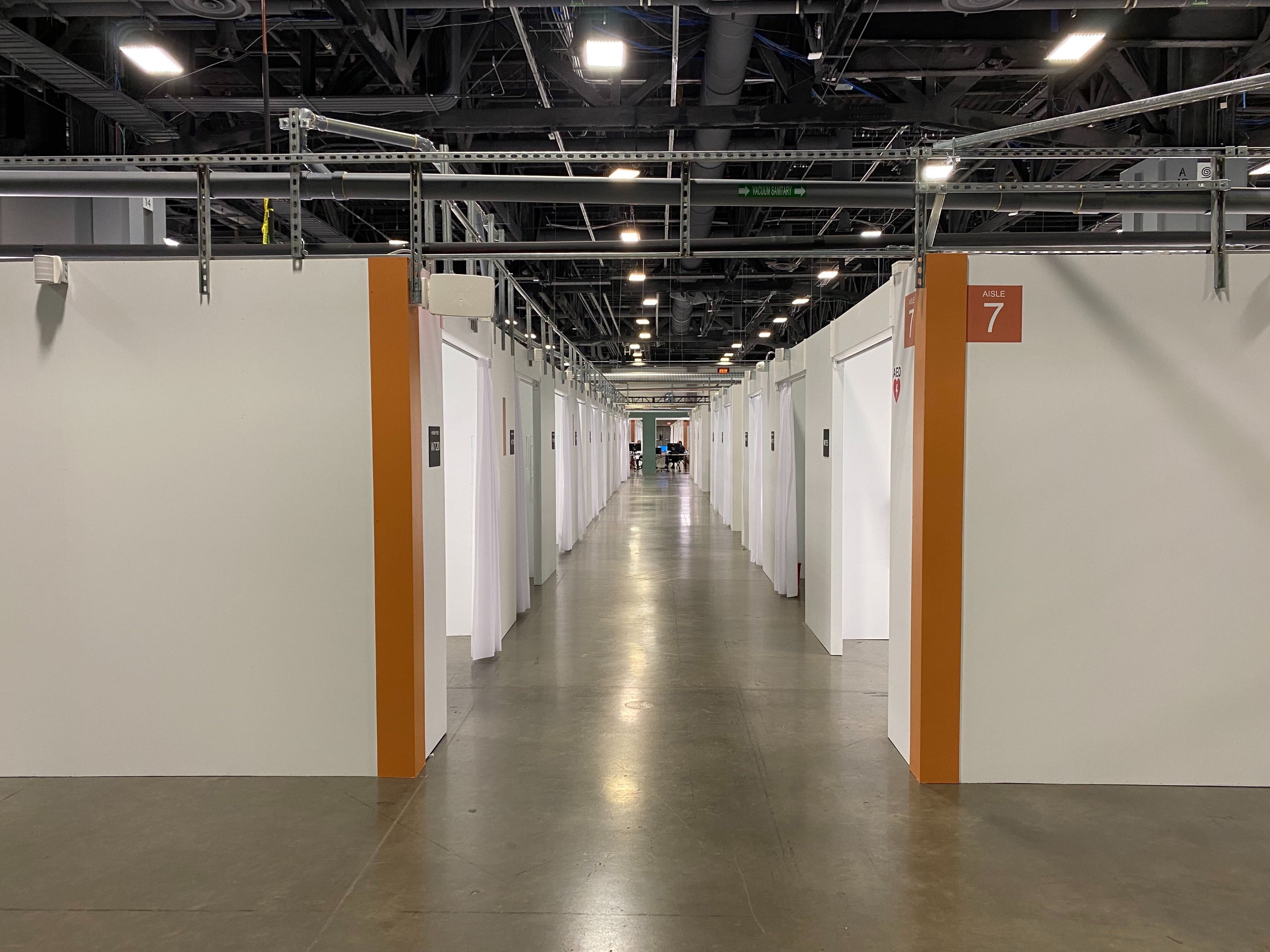
A new 443-bed field hospital in the Washington Convention Center is ready to start taking COVID-19 patients if the city’s hospitals become overwhelmed with cases.
Funded largely by FEMA and built by the U.S. Army Corps of Engineers, the new temporary hospital — which took 22 days to finish — is located in a cavernous room otherwise used to host large scale conferences and conventions. While the city’s nine hospitals are currently operating at 71% of their normal capacity and are adding 1,632 beds for a possible surge of COVID-19 cases, officials say the Convention Center field hospital was built to allow the city to be ready if worst-case scenarios come true.
“An insurance policy, so if needed, this will keep people alive,” said Lt. Gen. Todd T. Semonite of the U.S. Army Corps of Engineers on Monday.
In early April, Mayor Muriel Bowser said worst-case scenario projections showed 93,000 possible COVID-19 infections and between 200 and 1,000 deaths in D.C. before the pandemic subsides. (As of Monday, there have been 6,389 reported positive cases and 328 deaths.) City officials now say that social distancing and other measures may have decreased the number of potential overall infections, but they are still expecting a peak in late May and a possible spike in hospitalizations at some point in June.
And when D.C. starts to loosen restrictions and allow some businesses to reopen, there could be another increase in cases that city officials say they want to be prepared for.
“Without a cure and without a vaccine … phased openings will mean we see more cases in our city and region,” Bowser said.
If local hospitals reach capacity, low-acuity patients in D.C. will be brought to the Convention Center, where they will be placed in one of the 437 hundred-square-foot makeshift hospital rooms, many of which will be supplied directly with oxygen and will include tablets for patients to remain in contact with family or entertain themselves while they recover.

The field hospital has 437 100-square-foot rooms where COVID-19 patients can be brought if local hospitals run out of beds. There are also six specialized rooms for patients who need specialized care.
“We are going to use the maximum we have of hospital space and then we’ll look at bringing patients in here,” said Chris Geldart, director of the D.C. Department of Public Works.
The hospital — which will be operated by MedStar Health — also includes six specialized beds for patients who deteriorate rapidly and need more intensive care, and has a specialized negative-pressure showering facility built into a shipping container.
The hospital is one of 37 similar facilities nationwide the Army Corps of Engineers is helping build to augment local health care systems struggling with an influx of COVID cases. It’s similar to a 250-bed facility built in the Baltimore Convention Center last month to help expand Maryland’s number of hospital beds.
But more than a dozen of the facilities have gone unused and have started closing, raising concerns about proper planning in response to the pandemic. However, many elected leaders and health officials defend the construction of the field hospitals, saying it’s better to have them and not use them than run out of hospital beds in a crisis and have nothing to fall back on.
Bowser said it was too early to know if and when patients would start arriving at the field hospital, or how long the facility would remain open.
“We’re going to use it as long as we need it,” she said.
This story originally appeared on WAMU.