 Jenny Gathright
New reporting of coronavirus infections has revealed high rates of COVD-19 among D.C.’s intellectually disabled — and an ongoing staffing crisis among the people who care for them.
The District began publishing the data on April 27, nearly a month after it began publishing data on residents of city homeless shelters and the public psychiatric hospital, St. Elizabeths. The information shows that the rate of infection among people being supported by the city’s Developmental Disability Administration (DDA) programs is seven times what it is for the general population.
DDA manages a network of disability service providers. Of the 2,376 people supported by these providers, just over 6% — about 155 people — have tested positive for the virus, and 20 have died. Three staff members of providers in D.C. have died from COVID-19 as well.
The pandemic has led providers to dramatically shift their operations, but disability advocates want to see more action from the D.C. government to stop the spread. And as the region settles in for what could be a long road back to reopening, providers are concerned about how long they will be able to sustain 24/7 support for the intellectually disabled with dwindling staff.
“There is no magic bullet for the coronavirus,” DDA deputy director Winslow Woodland said on a call with advocates and community members Friday. “But every day people are working to mitigate this virus.”
Several advocates on the call pushed for the creation of a “crisis team” to respond to the alarming data, though the agency does have teams of doctors and nurses working with providers to address the issue.
“There really needs to be a group of people, experts, infectious disease experts, doctors, nurses … really to come together and say, ‘This is what we think we need to do to stop the spread,'” says Sandy Bernstein, Legal Director for Disability Rights DC with University Legal Services
“If we don’t do that, I really fear there will be many more deaths involving people with intellectual disabilities in D.C.,” Bernstein says.
‘I’m Right Here’: What Care Looks Like In A Pandemic
People with developmental and intellectual disabilities who get sick with COVID-19 face unique challenges. First, screening for the virus is different for those who are nonverbal or unable to explain their symptoms or how they are feeling. It can take direct knowledge and experience with an individual to know when something is off, says Berhanie Tessema, Clinical Director for RCM of Washington, which is part of D.C.’s network of disability service providers.
People with developmental disabilities are now allowed to have a designated support person with them in the hospital, but hospitalization can present challenges, too, since some individuals have multiple people who help support them in various ways.
Tessema says his team at RCM of Washington, which provides care to about 100 people in various residential settings, will call the hospital “6 to 10″ times a day to advocate for the people who were hospitalized. (As of last week, three people supported by RCM of Washington had been hospitalized with COVID-19, and all were either recovering back at home or preparing to be discharged.)
“Imagine you are not able to communicate your wants, desires, what’s going on,” says Maheni John, director of nursing for Wholistic Services, which supports 80 people with intellectual or developmental disabilities. “You don’t have anybody that you know in sight, any familiar face. And anyone who comes into the room is fully gowned … It’s definitely a scary situation. So behaviors will tend to escalate because of that … and it really prolongs the hospitalization. But what choice? You know, what can we do?”
Tessema also worries there may be a bias against people with intellectual disabilities. Nationwide, at least two states’ plans for rationing care in the event of shortages specifically placed people with certain disabilities at a lower priority for ventilators, which in turn prompted an outcry from advocates and investigations from the federal health department’s civil rights office. There have been no such complaints about potential rationing of care for those with intellectual disabilities in D.C., and D.C. Health says it does not have such a policy.
Additionally, D.C. has not gotten to the point of rationing care, since its hospitals are at 71% of their bed capacity and there are still ventilators available.
“There tends to be a trend where people with intellectual disabilities would have a less chance of being on a ventilator, or being specifically given an option of resuscitation in case of cardiac arrest. And this is primarily with my experience over the past five years working in this field,” Tessema says.
Even for those who have not gotten sick, quarantine has been difficult. People supported by services from DDA providers are used to going to work, learning job skills, going out shopping, going to the movies and seeing loved ones.
“They’re really cut off from their friends, from their family who’s not allowed to come visit them,” Bernstein says. “And it’s something that some of them don’t understand.”
For the care workers tasked with guiding D.C. residents with disabilities through this period of isolation — and, in some cases, through illness — the pandemic has meant working long hours for little pay.
‘This Was Fragile To Begin With’
Michael Anderson, a direct support professional who works for RCM of Washington, volunteered to support two men who lived in a home together and tested positive for COVID-19. Both are in recovery; One of the men went to the hospital and has since returned.
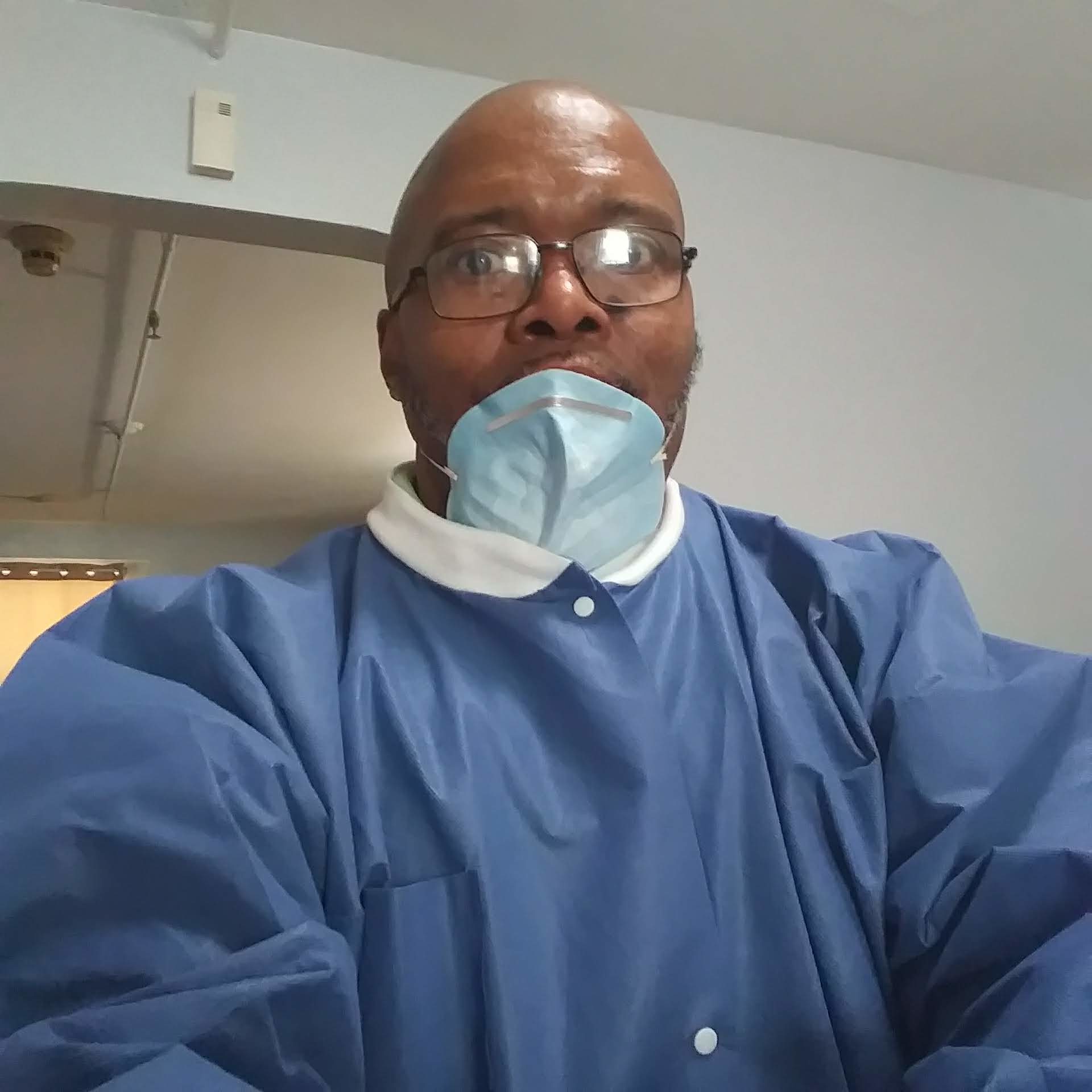
Anderson says he used to worry that the mask he wears all day in the home would offend the men he cares for, or make them feel less connected to him. But that has not been the case.
“They just enjoy my company,” says Anderson. “That gives me a bit of relief.”
Anderson has been working 15-hour shifts on weekdays, and 12-hour shifts on the weekends. He says he is “prepared for the long haul” and finds the work rewarding, but providers say this kind of staffing is stretching their resources thin, and the battle against coronavirus is also a battle against exhaustion.
Danielle Darby, the chief operating officer of RCM of Washington, says they have significantly pared down their staff and put people on 12-hour shifts, 7 days a week to limit the number of people coming in and out of homes, and to stop workers from going to outside jobs, where they might risk further exposure.
Darby says many of the direct support professionals on her staff have second jobs, and sometimes even third jobs. Wages start out around $15 dollars an hour, which will be the city’s minimum wage come July. The pay is based on how much DDA reimburses providers for their care.
Providers say that while DDA has upped its reimbursement rates, they are still spending more on staffing than they are taking in. On a call with providers on Friday, Reese from D.C.’s Department on Disability Services said the increased rates will allow providers to raise the wages of frontline staff by 15%.
Darby says D.C. is also reimbursing overtime costs in certain cases. Still, she projects that a “large percentage” of her increased staffing costs will not be covered by the D.C. government’s reimbursements. RCM of Washington is offering hazard pay and overtime for those actively working in homes, with higher pay bumps for those who are working directly with people who have tested positive for COVID-19.
“A lot of these staff have worked for us two, four, six, eight, 10, 20 years — and so we felt it was important to show our loyalty to them,” Darby says. For her, continuing to pay staff competitively is also about retention — because “the industry was already in a workforce crisis” before the coronavirus, she says
“This was fragile to begin with,” says Ian Paregol, Executive Director of the D.C. Coalition of Disability Service Providers, which includes 50 of the city’s service providers. “Those workers are worth more than a minimum wage, but that is what they are funded at in D.C.”
Paregol says the bumps in reimbursements from the D.C. government have helped, but do not go nearly far enough to cover the pay that service providers will need to offer to retain their staff. The city’s reimbursement currently covers a $16.85 base hourly wage for direct support professionals.
“Until there’s a vaccine or somehow the coronavirus is eliminated, workers are going to still have to keep putting their own lives in jeopardy. And is a dollar and half enough? I don’t think so,” Paregol says.
Anderson, who spends at least half of every day working, says the compensation he gets from RCM — an additional $6 dollars per hour in hazard pay for working in a home with confirmed cases of COVID-19 — is helpful, but he did not get into this field for the money.
“It’s God’s work,” he says. He says his clients have taught him “about seeing people through the lenses of humanity,” and they have helped him grow.
For now, Anderson and his clients are confined to their home, spending the days watching TV, sitting on the porch and enjoying the weather when it’s nice out. They play board games. One of the men has a karaoke machine, and he likes to sing.
Anderson finishes work each day at 11 p.m. when a colleague takes the overnight shift. He has a habit of self-criticism, where he’ll go through the day in his head and think about what he could have done better and how he could have handled various situations differently. But ultimately, he has one main metric of success.
“If I go out of here at the end of the day and they are in good spirits, I’ve done my job,” Anderson says. “Regardless of what I had to go through.”