Colleen Grablick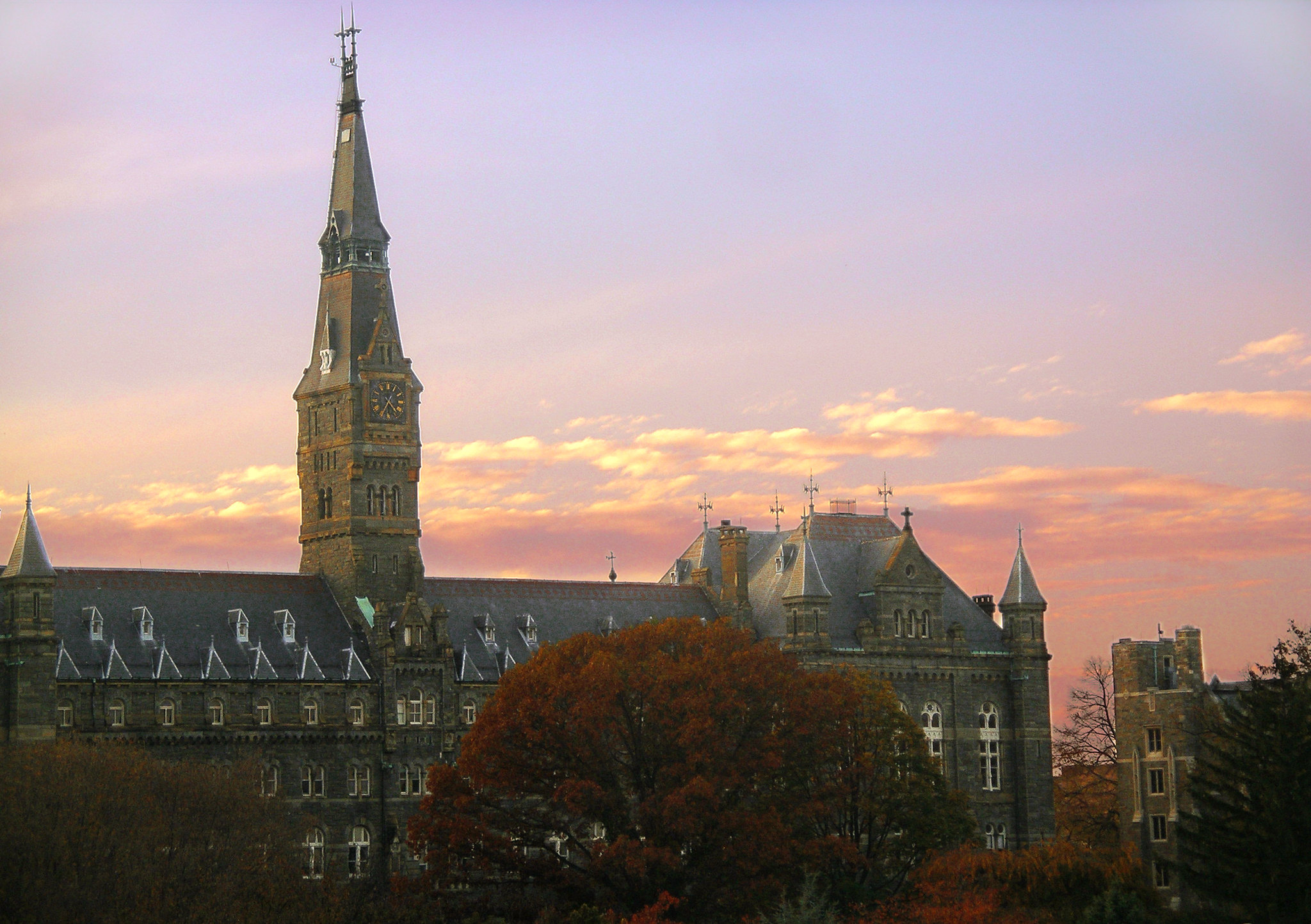
For college students, late spring is a time to bask in the joys of another school year wrapped up: relief as finals draw to a close, pride in reflecting on accomplishments, and excitement for summer— and fall—plans. Dorms get packed up, in preparation to start fresh again come August.
But as threats of the coronavirus pandemic persist, local universities are now working through difficult decisions for the fall semester, weighing public health risks of reopening campuses against the financial fallout of another semester online.
So far, Catholic University is the only D.C. school to announce a seemingly confident decision to hold in-person classes this fall. “Even if we can’t resume life exactly as we knew it just eight weeks ago, we can take the necessary steps to deliver a fully open campus at the earliest possible opportunity. This is where we are focusing our energies,” President John Garvey said in a statement.
American, Howard, Georgetown, and George Washington have expressed their hopes to reopen campus operations in some capacity, but are waiting to make final calls with recommendations from internal task forces (Disclosure: American Unviersity holds the license for DCist’s parent company, WAMU.) Gallaudet University says it is monitoring the situation, and University of the District of Columbia plans to be fully operational in “whatever mode may be required.” Trinity College of Washington—which was the last D.C. school to end in-person instruction this spring–told its students at the beginning of this month that the school’s degree of in-person learning will “depend entirely” on the city’s readiness to reopen, and administrators are considering various scenarios for instruction.
The uncertainty at local universities mirrors that of institutions across the country. While some like California State University have announced plans for a majority online fall semester, many others are still holding out amid an air of uncertainty. And without solid plans in place, the District’s college students are considering different options for their education in the months to come.
Grace Cabuena, a rising senior at American University, believes that spending half (or potentially even more) of her final year of undergraduate education online could impact her potential career path. As an international relations major who hopes to work in D.C. after graduation, Cabuena worries that remote learning might squash future job opportunities without the in-person networking and connection-building provided through AU’s campus. It’s those opportunities, she says, that informed her decision to attend the school in the first place.
“I think anyone that goes to a school in D.C. has that same career driven mindset, regardless of what your major is,” says Cabuena. “I went to AU because I wanted [those opportunities] in D.C., I didn’t sign up for a $34,000 tuition just because I like spending money.” (Tuition at American is $27,000 a year, though fees and the cost of housing can bring that close to $50,000 a year.)
Cabuena — who signed to take over a lease in August — says she plans to move back to D.C. even if AU continues remote learning, in order to hopefully return to her retail job and continue preparing for her career. But without the campus operating fully, she doesn’t know if she could justify paying the cost.
“If I’m still able to qualify for all of my financial aid and grants from AU, I think I might be alright,” says Cabuena. “But at the same time, I’m not paying to go to online class, especially if the campus isn’t operating at full capacity, but I’m still expected to pay as if it is. I don’t know if I feel comfortable paying price for not what I expected to be getting out of AU.”
The cost of remote learning is a concern shared by many students across the country, and has already led to class-action lawsuits filed against American University and George Washington University by a student and parent, respectively, seeking reimbursements for tuition. According to a recent survey by Arts & Sciences LLC, a financial consulting firm for education institutions, 62 percent of high school seniors planning to attend four-year universities expect to pay significantly less if their institutions go remote in some capacity this fall. About half of respondents also said that a parent or guardian had been laid off or furloughed.
AU, which reported a $27 million shortfall in mid-April, has amassed three different task forces to plan for the fall, with the hopes of establishing a solid plan by early June. Right now, options include in-person, online, and hybrid learning models.
George Washington University is weighing the same options and following a similar timeline. Originally the school expected to make a decision by May 15, but it recently pushed that date back to June 14.
Rising sophomore Jin Huagland — who was just about finished with her first year on GW’s campus before the coronavirus closed the school — says that while she wishes the university could give her a clearer idea of what the fall will look like, she understands the inability to plan almost anything in a pandemic.
“This is through no fault of their own,” Huagland says of the university’s current indecision. “Nobody knows what’s going to happen, nobody has a crystal ball. We really have no choice, administrators and students alike, than to play it by ear. No one’s trying to make this any more difficult, it won’t be good for anyone if the universities stay closed for too long.”
Huagland is considering community college options or gap year possibilities if GW stays completely remote, saying she’s not willing to pay GW’s tuition, which runs upwards of $58,000 a year, for online classes. If the school created some sort of hybrid model between remote and in person classes, though, she’d return to campus in a heartbeat.
“Some campus experience is better than no campus experience,” says Huagland, who is currently living at home in Houston. “I feel like my first three quarters of the year at GW really helped me learn how to be an adult, and that’s not something I can get remotely. I learned how to get a job, how to join clubs, how to have my first real relationship.”
For incoming students, the anxieties revolve around all of the what-could-have-beens during their first semesters. I’ziane Frazier, an incoming freshman at Howard University, fears she may not be able to have those formative moments of growth on Howard’s campus that Huagland misses about her first year at GW.
Frazier, who currently lives in Italy due to her mother’s job for the U.S. Army, says she wasn’t expecting to get into Howard, so what should’ve been a celebratory moment is now filled with disappointment and worry.
“All of these sleep-deprived years through high school, working hard to get into Howard, it kind of feels like it may be for nothing,” says Frazier. “Even though this is the time that everyone says should be these fun moments celebrating your accomplishments, you feel like you might not even be able to reap the benefits.”
Frazier says Howard has instructed students to apply for housing under the assumption the campus will reopen, and President Wayne Frederick, also a member of Mayor Muriel Bowser’s Reopen DC task force, says that the school plans to resume in-person learning as a “best case scenario,” so long as it aligns with D.C. and public health guidelines. But as the city extends the stay at home order to June 8, and infectious disease expert Dr. Anthony Fauci cautions against reopening campuses without a vaccine on the market, Frazier suspects her first moments at Howard may yet be delayed.
“I’m so stoked to be going to Howard, and I was so excited to indulge in D.C.’s culture,” says Frazier, who plans to enroll in a community college in the D.C. area if Howard keeps its campus shut down. “Now it’s hard to see the light at the end of the tunnel, and it’s discouraging because everything is so chaotic right now.”
This story has been updated to remove language indicating that American University task forces will release their recommendations publicly on May 15. There are no plans to make those recommendations public.
More:
An Army Of Interns Usually Helps Keep D.C. Running During The Summer. Not This Year
Without In-Person Classes, George Washington And American Universities Are Facing Lawsuits Over Tuition