Rachel Kurzius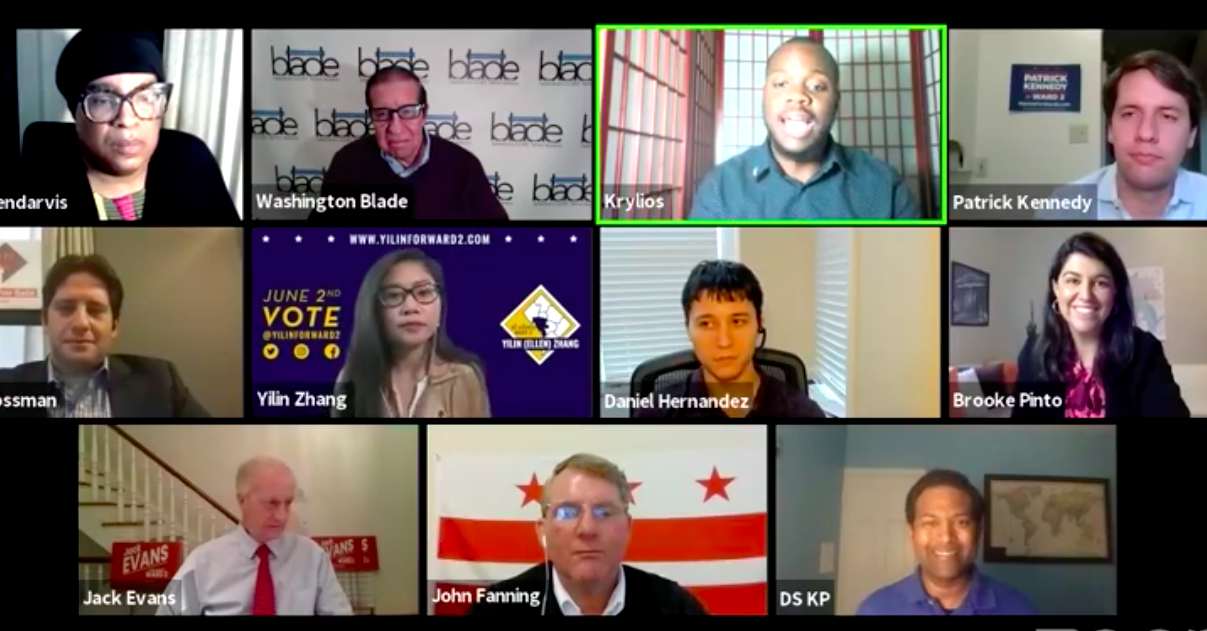
Normally, local D.C. politicians bemoan the meddling of federal lawmakers in District affairs. But in the case of the Ward 2 D.C. Council primary race, some candidates are welcoming the opinions of senators, members of the House, and even a former surgeon general.
Endorsements are generally a part of any election, and most of the usual groups have already voiced their preferences for the crowded June 2 primary, which is the first competitive race that the ward has seen in more than a decade. Ward 2 is among the city’s wealthiest wards, and it includes Georgetown, Dupont Circle, and much of downtown D.C., as well as the land surrounding the White House and much of the National Mall.
The race isn’t just unusual because it’s unfolding during a pandemic—though that has certainly complicated campaigning. Much of the oxygen around the election has been taken up by Jack Evans, who was first elected in 1991. The city’s longest-serving councilmember resigned in January right before his D.C. Council colleagues were set to expel him amid an ethics scandal. Ten days later, he announced he would be throw his hat in the ring to run for another term representing Ward 2 (he also decided to use the District’s new public financing program to fund his campaign). There will be an additional special election held two weeks after the primary to determine who will fill the rest of the current council term, which all of the Democratic candidates aside from Evans will participate in, as will Republican Katherine Venice.
Shortly after his announcement, Evans scored an unusual anti-endorsement. All twelve of the remaining members of the D.C. Council issued a stinging statement in their “personal capacity,” sent from Council Chairman Phil Mendelson’s AOL account: “His decision to run for Ward 2 Councilmember again, which we do not and cannot support, shows a willful and arrogant disregard for ethics and is not in the best interests of the District,” they wrote.
Though it’s rare for the entire sitting council to unite in opposition to a candidate, it’s commonplace for local politicians to make endorsements. Mendelson, for instance, has come out in support of Patrick Kennedy, an Advisory Neighborhood Commissioner in Foggy Bottom, whereas At-large Councilmember Elissa Silverman endorsed former Obama administration staffer Jordan Grossman. D.C. Attorney General Karl Racine, meanwhile, has publicly backedBrooke Pinto, who worked on policy issues in his office until shortly before she announced her candidacy, as has D.C. Shadow Senator Michael Brown.
What is less common, however, is some of the other endorsements we’ve seen in the Ward 2 race.
Who thought, for instance, that Democratic senators Richard Blumenthal, of Connecticut, or Amy Klobuchar, of Minnesota, would decide to make their opinions about the tight Ward 2 race known? Blumenthal supports Pinto, while Klobuchar backs Grosssman. Both used to work for the senators in question.
Pinto and Grossman also scored support from Democratic members of the House of Representatives: Pinto from Joe Kennedy III of Massachusetts, and Grossman from Henry Waxman, a former California representative who now lives in Ward 2. Pinto says she met Kennedy when she was a student at Georgetown Law and organized a charity basketball game, while Grossman says he has worked with a number of Waxman’s current and former staffers.
Their competitors are wary or dismissive of the endorsements from the Hill. “Here in D.C., we usually try to have the federal government be less involved than more,” says Daniel Hernandez, a first-time candidate.
“*yawn*,” writes political newcomer Yilin Zhang over email. “I’m sure our residents experiencing homelessness and those whose lives are affected by COVID-19 are electrified by this new information.”
But in addition to touting the local backing they’ve gotten, the candidates who have received the federal endorsements say they demonstrate tangible benefits they would offer in office.
Grossman says that Klobuchar has been “really supportive throughout the campaign,” and touts her reputation as an effective legislator—a reputation he wants to emulate. He also admires Waxman’s oversight prowess. He adds that both back D.C. statehood, an issue that has seen “so much more attention and progress” of late, at least among Democrats on the Hill.
Republicans, meanwhile, have used Evans’ scandal as a grounds to oppose more autonomy for the District. While he thinks “it’s absurd to link Jack Evans to statehood,” he says that “the stakes are we need a clean break from Jack Evans, we need a clean break from special interest, insider politics.”
Evans has not responded to a request for comment on the race’s endorsements.
For her part, Pinto says that these federal endorsements show that she has strong relationships on Capitol Hill, which will ultimately benefit Ward 2 residents. As an example, she brought up the federal coronavirus recovery bill, which ultimately shortchanged D.C. by $750 million in funding by categorizing it as a territory rather than a state.
“We aren’t going to get what we are owed as a jurisdiction without relationships with existing members of Congress,” she says. “Partnerships on the Hill are a great step to provide the relief to Ward 2 residents and businesses that they need.”
Competitor Patrick Kennedy doesn’t buy that argument. “That’s why we have a delegate to Congress,” he says. “Realistically speaking, I think that a first-year councilmember in Ward 2 is not going to be the point of contact for the District of Columbia government in negotiations with Capitol Hill over a federal relief package.”
One historical exception he notes is David Catania, a former at-large councilmember who, as a Republican, was able to talk with GOPers on the Hill. “Democrats aren’t the problem [for D.C.] on Capitol Hill,” Kennedy says.
Georgetown ANC Commissioner Kishan Putta, meanwhile, says that “it’s nice to have big endorsements, but I think it’s most important if they are actually voters who can vote in this election. Do you live in D.C.? Do you live in Ward 2? Are you a registered voter?”
His big-name endorsement, former Surgeon General Vivek Murthy, happens to be all three of those things. The two met years ago, when Putta was involved with Murthy’s Doctors for America organization. Now, Murthy sits on Putta’s campaign coronavirus advisory team, alongside other local doctors.
“I’m very blessed to have their advice because this is the top issue right now,” says Putta. “I don’t think there’s going to be a bigger issue for the entire term of the next councilmember we’re going to elect.”
There are so many unknowns about the this year’s primary race, which D.C. officials are hoping will largely be conducted through mail-in ballots. As of this week, about 5,555 Ward 2 residents have requested a mail-in ballot, though that doesn’t necessarily mean they’ll send them in. (By way of comparison, a total of 8.260 Ward 2 voters cast a ballot for the June 2018 primary.)
The effectiveness of endorsements in political races is a big question, and largely depends on both the race and the person making the endorsement. In a close race like Ward 2’s, candidates are hopeful for anything that can push them over the finish line.
“People are just leveraging their networks—for fundraising, for endorsements,” says Kennedy, noting his own network has skewed local. He thinks the unusually high number of feds who have spoken in the Ward 2 race is because it’s one of the wards with “the highest concentration of people who work on Capitol Hill or have a federal background.”
Grossman says that it “reinforces that the District is an incredible place.”
John Fanning, a Logan Circle ANC representative running in the race, says that he has no idea if any of those endorsements will hold sway. “This race is pretty unpredictable,” he says. “The only endorsement that really matters is the voter’s endorsement in the end.”