 Dawnthea M. Price Lisco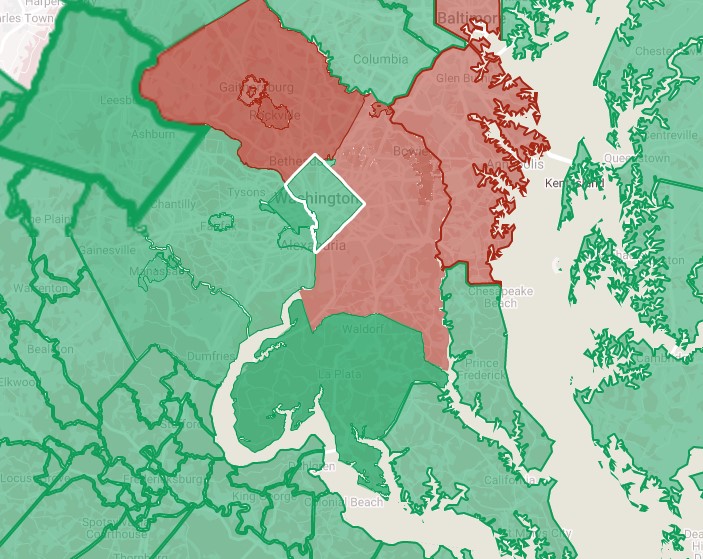
This story was last updated on Oct. 1.
Across the region, reopening has continued to slowly march on as leaders in Maryland, Virginia, and D.C. have lifted restrictions on their jurisdictions.
In Maryland, most of the state is in Phase Three, though some D.C.-area suburbs remain in a modified Phase Two.
Virginia entered Phase Three on July 1. Several D.C.-area localities will resume in-person jury trials in October.
Mayor Muriel Bowser launched D.C.’s first phase of reopening by lifting her stay-at-home order on May 29. The District began its second phase on June 22. As of Bowser’s Sept. 30 situational guidance, there is still no concrete timeline for D.C. to enter its own Phrase Three, though area institutions are cautiously reopening for the fall.
School has started. Their reopening requirements have varied widely based on state, local, and even school-specific restrictions and precautions in order to ensure the safety of students and staff. Visit your school district’s website for the most up-to-date information.
Each new phase brings its jurisdiction closer to regular operations, but it’s still not a full return to normalcy. Here’s the current status of what kinds of businesses can open — and what’s not— and the requirements they must meet in order to safely operate.
D.C.
The stay-at-home order lifted on Friday, May 29, replaced by the first phase of the city’s reopening plan, which has been dubbed “stay-at-home lite.” Phase Two began on June 22. Restrictions on gatherings are now capped at 50 people (formerly 10), and mask and social distancing guidelines continue to be strongly encouraged.
On Sept. 30, Mayor Muriel Bowser released updated situational guidance that tentatively extends Phase Two restrictions through the end of 2020, continues to restrict large gatherings and sporting events until a vaccine is widely available, and cancels major conventions in the District through 2021.
Retail: Nonessential retail may open at 50% capacity for indoor business. Some D.C. public libraries are reopening on June 29, while others will remain closed until July.
Personal grooming: Cryotherapy, electrolysis, facial, nail, tanning, tattoo, threading, and waxing salons are permitted to open in the second phase with an appointment. Businesses are being encouraged to record which customers saw specific stylists for contact-tracing purposes.
Restaurants: Restaurants may open for indoor dining in addition to patio service, capped at 50% and with social distancing safeguards. Tables must still be 6 feet apart. The mayor’s office confirmed to DCist that licensed rooftops and beer gardens may reopen for outdoor seating. Patrons are still encouraged to wear a mask while not eating or drinking.
Entertainment: Bars and nightclubs that already have a permit to serve food from ABRA will be permitted to reopen under the same guidelines as restaurants. Remaining bars and nightclubs, and entertainment venues like sporting arenas will remain closed. Museums in the District are slowly reopening as Smithsonian and other institutions evaluate conditions and implement new safety measures.
Religious Services: Breaking away from the general 50-person cap on gatherings, houses of worship can operate at 50% capacity — up to 100 people indoors.
Fitness centers: Gyms and workout studios may open through DC Health guidance.
Outdoor activities: The District will reopen some 29 recreation centers on Oct. 13 with new guidelines. Registration and reservations on the D.C. Department of Parks and Recreation open on Oct. 1.
Here’s what the full reopening plan for D.C. looks like.
Virginia
The entire state moved into Phase Three on July 1. Northam’s guidelines for this third phase lift restrictions on indoor dining entirely (though bar seating is still not permitted) and ease for gyms, and allow the limit on social gatherings to increase from 50 people to 250. Teleworking and physical distancing are still strongly encouraged, and wearing a mask in indoor public places is still required by law. Here’s what else is allowed.
The Supreme Court of Virginia is permitting several Virginia localities to resume jury trials, including the City of Alexandria, Fairfax County, Prince William County, and Stafford County.
Retail: Capacity limits on nonessential retail are removed. Fitting rooms and meeting rooms appear to remain closed.
Restaurants: Capacity limits for restaurants and bars are lifted for indoor dining areas, including food courts, breweries, cideries, food trucks, distilleries, wineries, and tasting rooms. Bar seating remains closed, as are game areas and dance floors. Buffets are allowed to open for service. Performing musicians must be at least 10 feet away from patrons. Phase One cleaning and disinfectant regulations still apply; takeout and delivery are still highly encouraged. Establishments must use disposable menus.
Personal grooming: Barber shops, hair, nail, massage, and tanning salons, and tattoo parlors are permitted to reopen without capacity limits, but must maintain a 6-foot distance between stations; service providers must wear masks. Services are limited to what can be provided while the customer maintains a face covering.
Worship: Capacity limits are lifted on religious meetings, but guests must be spaced at least 6 feet apart (though families may be seated together). Any items used to distribute food and beverages must be single-use and disposable.
Fitness centers: Gyms and other indoor fitness centers can open at 75% occupancy. Indoor and outdoor swimming pools may also open at 75% occupancy as long as 10 feet of distance can be maintained between patrons not of the same household; free swimming is now allowed. Facilities should temperature screen patrons before entry in addition to implementing several disinfecting rules on lifeguard chairs, general seating, and on pool decks. Hot tubs, spas, saunas, splash pads, spray pools remain closed. All exercise and instruction requires 10 feet of distance between participants not of the same household, as does deck seating.
Outdoor activities: Indoor recreational sports will be permitted at up to 50% of building occupancy (max 250 people), and 250 people are allowed on a field. Restrictions on spectators are lifted; however, instructors, participants, and spectators should maintain 10 feet of distance from each other. Daily screening of players and coaches should be conducted prior to entering a facility. No additional guidelines were provided for the state’s beaches, which reopened on May 29 with bans on tents, alcohol, and group sports.
Entertainment: Most indoor entertainment, amusement parks, fairs, historic horse racing facilities, and carnivals are allowed to reopen with restrictions, joining museums, zoos, aquariums, and botanical gardens. Outdoor concert, sporting, and performing arts venues will also reopen up to 50% capacity, up to 1,000 people. Ten feet of social distancing between patrons not of the same household is expected to be maintained. Overnight summer camps remain closed.
Maryland
The state began Phase Three on Sept. 4. According to Gov. Larry Hogan, local jurisdictions have the authority to make their own decisions about moving into Phase Three. Baltimore, Frederick and Howard counties entered Phase Three with the rest of the state on Sept. 4. Anne Arundel County remains in Phase Two but will allow tackle football to resume per Phase Three guidelines.
County Executive Angela Alsobrooks said in early September that Prince George’s County is not ready to move to a modified Phase Three yet, either; it remains in Phase Two. Montgomery County also remains in a modified Phase Two. Visit Montgomery County’s COVID-19 information portal for more specific guidelines.
The Baltimore Sun reported that Baltimore City will not be joining the state in Phase Three, though it has relaxed some restrictions.
In the state’s “Roadmap to Recovery,” this new phase of reopening is referred to as “high-risk.”
Maryland courts will begin resuming jury trials on Monday, Oct. 5, as reported by the Baltimore Sun.
Retail: All businesses in Phase Three Maryland localities are permitted to reopen at up to 75% capacity.
Personal grooming: Tattoo parlors, barber shops, and tanning, nail, hair, and massage salons remain at the 50% capacity mark and by appointment only. Services will still require mask-wearing for staff and customers.
Fitness centers: Gyms, health clubs and spas, aquatic centers, fitness centers, and self-defense schools are permitted to reopen at 50% capacity.
Outdoor activities: Outdoor venues for live performances or movies may open at 50% capacity (250 max) with health and safety protocols in place.
Religious services: As of Sept. 22, Montgomery County is allowing up to 40% occupancy for indoor religious services. In-person worship services elsewhere can take place indoors at up to 75% capacity.
Restaurants: Most of Maryland moved to expand indoor dining to 75% capacity on Sept. 21, per Gov. Larry Hogan’s announcement, though D.C.-area localities are evaluating on a county-by-county basis. Montgomery County and Baltimore City have capped indoor dining at 50%. On Oct. 1, Anne Arundel County permitted mall food courts to reopen up to 50%.
Entertainment: Indoor theaters for live performances or movies may open at 50% capacity (100 max) with health and safety protocols in place. Bingo halls, bowling alleys, pool halls, skating rinks, and social clubs are allowed to reopen but limited to 50% capacity. Anne Arundel County moved to reopen theaters and performance venues up to 50% capacity on Sept. 25.
Separately, certain casinos and “simulcast betting facilities” are permitted to open to the public at up to 50% capacity. These include MGM National Harbor, Live! Casino & Hotel, Horseshoe Casino Baltimore, Hollywood Casino Perryville, Ocean Downs Casino, and Rocky Gap Casino Resort. Racetracks — Laurel Park, Pimlico Race Course, Timonium Race Court, Fair Hill Races, Rosecroft Raceway, Ocean Downs — are permitted to reopen for racing and general operations, but they are not open to the public.