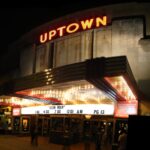
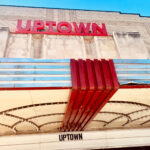
For generations of Washingtonians, Cleveland Park’s Uptown Theater was already a D.C. landmark. But now, there is an effort underway to make that status official.
The D.C. Preservation League has officially taken up the effort to secure a landmark designation for the theater. Executive Director Rebecca Miller says they began discussing the project after the theater closed in mid-March. They have been working on the nomination for the past couple of weeks, and it is nearly finished, per Miller.
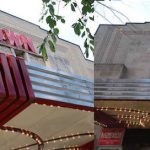
The building is currently a protected as a “contributing building” within the Cleveland Park Historic District, but Miller says landmark status from the D.C. Historic Preservation Review Board brings a higher level of scrutiny to the property, and ensures that the defining characteristics of the building’s exterior, like its iconic red Art Deco sign, are kept intact. (A 2017 kerfuffle over operator AMC’s plan to replace the sign illustrates how strongly many local residents feel about it.)
A Change.org petition to secure the building’s historic standing gained momentum in the wake of its closure., earning more than 10,500 signatures since mid-March towards its goal of 15,000.
Miller says landmark status would primarily protect the “envelope” of the building, as the interior was redone in the 1990s. She also says it wouldn’t necessarily prevent another kind of business, like a drug store, from taking over the space.
“A historic landmark status doesn’t deter that,” she says. “The preservation law just looks for a compatible use.” Miller says the building is unlikely to turned into apartments, though, given its mid-block location and the challenge of adding windows and other necessary residential features.
The league said a landmark designation would “highlight the importance of the building not only as a neighborhood resource, but also as a gathering place for people across D.C.” in its May newsletter.
The group noted the distinct architectural style of the theater, which was built in 1936 and designed by architect John J. Zink, who designed roughly 30 theaters across D.C. and Baltimore, including H Street NE’s Atlas Performing Arts Center and the Newton Theater in Brookland, as well as its contribution to the “development of motion picture exhibition in the District.”
The theater famously hosted a series of world premieres, including Stanley Kubrick’s 2001: A Space Odyssey in 1968 (many audience members reportedly didn’t care for the film and left midway through) and Jurassic Park in 1993. The sold-out showings of Star Wars in 1977 led to crowds and chaos in the neighborhood. More recently, the cast of Downton Abbey made an appearance at the theater last September for the D.C. premiere of the film version of their hit show.
Miller says neighborhood theaters were especially important at the time “because people weren’t traversing the city to go out on the town, so to speak. They were going out in their neighborhoods.”
Rumors had periodically circulated about the theater’spotential demise before AMC Theatres, which operated the Uptown, closed it down on March 12. AMC confirmed the news to DCist at the time, but did not respond to a request for an explanation.
AMC also gave no explanation to the Pedas family, who have owned the building since the late 1970s, the Washington Post reported, though AMC was nearing the end of its lease, which was up on March 31, and ticket sales had long declined.
Bill Durkin, a lawyer who has worked with the Pedas family’s management company, told the Post that the family hoped to lease the 800-seat space to another theater, but Ted Pedas, who first purchased it with his brother, said he doubted they’d be able to do so, as streaming services have eroded movie theaters’ profits: “Right now you couldn’t give it away to anyone,” he said.
Miller says the league plans to file its nomination to the D.C. Historic Preservation Review Board as soon as its offices reopen (they have temporarily moved operations offsite due to COVID-19). Both the relevant Advisory Neighborhood Commission and the owner of the building are then notified, the league does its own community outreach, and the board typically hears the case about two months later.
She says the effort is not meant to prevent the building from changing at all, but to help protect the parts of the structure that locals love. “Historic preservation isn’t meant to retain something in amber,” she says. “It’s meant to evolve … I think this is a great opportunity for the community to have a discussion with the owner as to what the future of that building will be.”