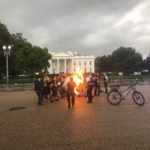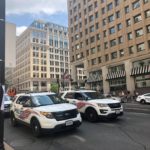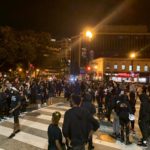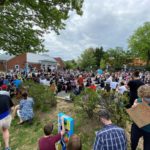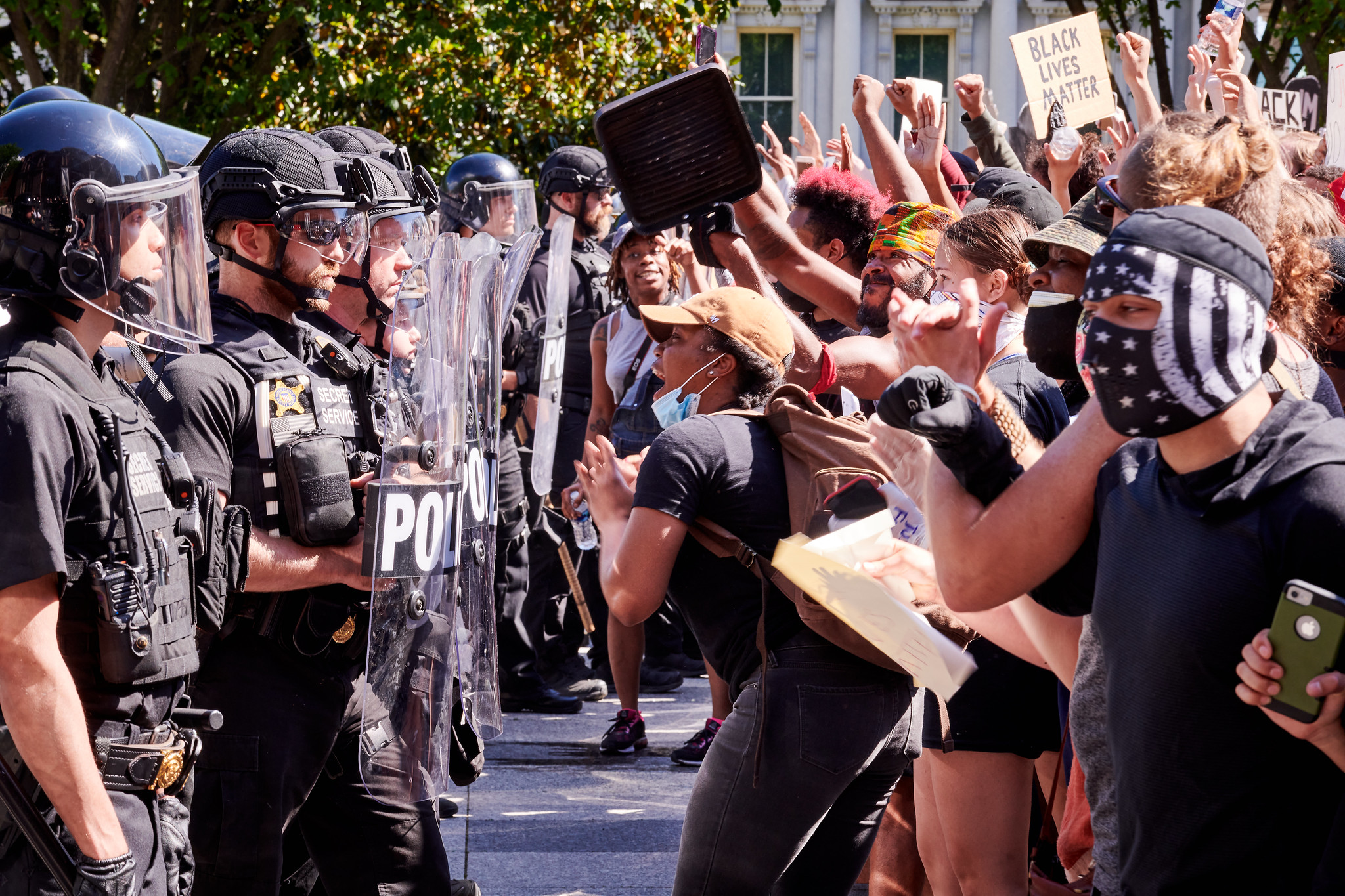
Ford Fischer, chief multimedia editor for the digital wire service Zenger, has been covering protests in D.C. for more than seven years. He says the clashes between police and protesters over the weekend looked different than any other he has covered in recent memory.
“The last three days has been a drastically different policing style and tone, and to be fair, protest style, than I think we’ve seen in D.C. during that time,” Fischer says.
Sunday marked the third night in a row of protests in the District and across the country, after the murder of George Floyd by a Minneapolis police officer. Fischer is a number of journalists who noted a shift in tone from past demonstrations they’ve witnessed on the job.
Tim Craig, a national reporter for the Washington Post, tweeted on Friday that he had never seen protesters behave so forcefully toward Secret Service protection at the White House. Craig, who covered the Occupy D.C. protests in 2011, says he was watching the story unfold on TV, and had never seen that before.
“I was just surprised from the beginning at the level that people were willing to challenge the Secret Service,” he tells DCist in a short interview.
Fischer believes the White House became a focal point because President Donald Trump is “emblematic of the systematic problems they’re trying to fight against.”
Trump threatened the protesters in a series of tweets on Saturday, writing that, had they breached the fence, they would have been met by “vicious dogs” and “ominous weapons.”
Alejandro Alvarez, digital editor at WTOP, tweeted early Saturday morning that protesters had ended up in a standoff with Secret Service and added, “I have never seen Lafayette Park like this in the eight years I’ve lived in D.C., and I’ve covered more protests than I count.”
Another Post reporter, Marissa J. Lang, posted a video of protesters moving away from a cloud of tear gas on Saturday night, and wrote, “I’ve covered a lot of protests in DC. I’ve never seen police so liberal with the projectiles.”
Fischer reported on the protests all weekend. He says the only other event struck him as similar was President Donald Trump’s inauguration in 2017, where protesters threw rocks at officers in riot gear and set cars on fire, and police arrested more than 230 people. That day, police surrounded a group of people, including journalists and observers, and conducted a mass arrest, which spawned multiple ongoing lawsuits.
However, he says this weekend’s demonstrations were even more violent. On Sunday, police used tear gas and flash-bang grenades on protesters, fires broke out, and a number of businesses across the city were looted. Police arrested 88 people between Sunday and Monday, according to D.C. Police Chief Peter Newsham.
Fischer attributes the difference in protest style to a combination of factors. He says that he saw a number of unfamiliar faces during the demonstrations, and what seemed like a lack of coordination in some cases, signaling that many participants may be new to this kind of activism. Fischer says it was even evident in the speed at which protesters made their way from the White House to the U.S. Capitol on Friday night, some walking and others running, with little apparent cooperation.
He thinks that new wave of participants can be traced to a shared nationwide anger. “I think the thing that’s driving it is they see how quickly the country has responded in protest, and so people are just eager to get out there,” he says. Large-scale demonstrations took place in a number of cities, including Minneapolis, Atlanta, Los Angeles, Nashville, and others.
Fischer himself was hit by projectiles three times in as many days, including once in the forehead by what he believes was a rubber bullet, late Sunday night. He says it was unclear whether he was targeted or just got caught in the crossfire.
Other journalists reported similar incidents during D.C.’s demonstrations, including a CNN cameraman who was reportedly struck by an officer with a baton, even though he was holding a camera and had press credentials, according to reports from the network.
WAMU and DCist reporters were also on the scene for all three nights of demonstrations; none were injured.
The Metropolitan Police Department did not immediately respond to DCist’s request for comment on the tactics used or whether police had knowingly targeted members of the press. During a press conference on Monday, Newsham said the department would review any claims of officer misconduct, but declined to speak on any particular cases.
Newsham said Monday that the police are aggressively following up on crime stemming from the protests, adding that the department is “not going to rest until we hold everybody who’s involved in this behavior accountable for what they did.” Police have released stills from surveillance footage captured on Saturday, asking for the public’s help in tracking down suspects.
The protests are expected to continue Monday night, and Mayor Muriel Bowser has issued a curfew of 7 p.m. for the District on Monday and Tuesday.
Fischer says that, in addition the other recent murders of unarmed black people, the coronavirus pandemic may have played a role in how this weekend’s demonstrations unfolded.
Fischer says that “whether it’s because of the things that the virus makes people do or whether it’s just anxiety over catching the virus, America [has probably been] in a little less of a stable place over the last two months.”