Rachel Kurzius
 Dee Dwyer
Last updated at 11:30 a.m., June 3
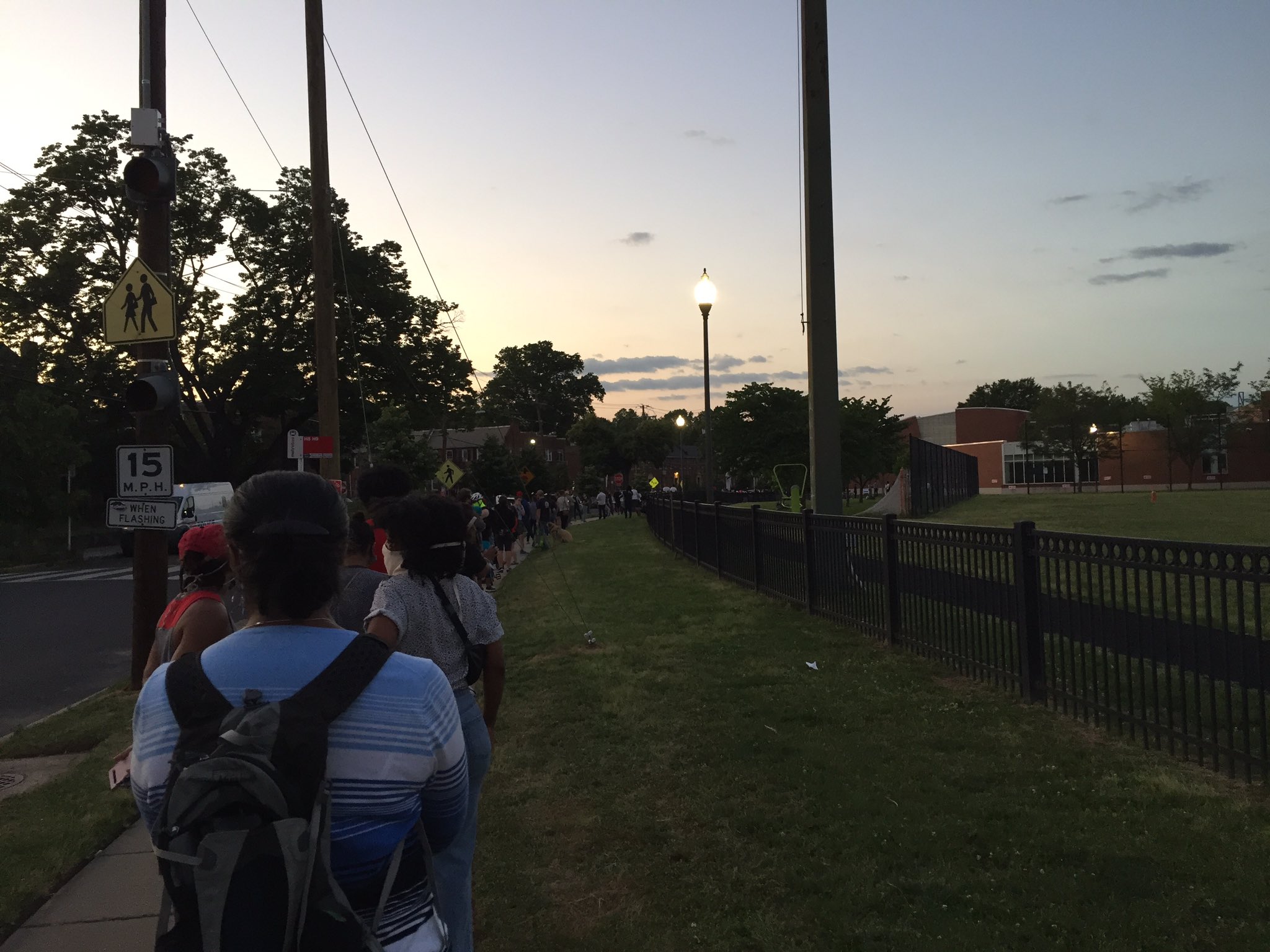
More than four hours after polls closed for D.C.’s primary election, some District voters throughout the city were still waiting in line to cast their ballots, as the June 2 primary stretched into June 3.
At Ida B. Wells Middle School in Ward 4, more than 100 people remained in line to vote as of 11:15 p.m., per Andrea Crooms, a volunteer for the campaign of Ward 4 candidate Janeese Lewis George. Crooms, who voted by mail, says that most people at the polling center are sticking it out—many have been on line since 7 p.m.—and “people are really positive and patient.”
The precinct is one of many across the District where people waited upwards of four hours to vote.
“I’m livid,” said At-large Councilmember Elissa Silverman at 12:45 a.m. from Emery Heights Recreation Center in Ward 4, where dozens of voters had yet to cast their ballots at that time. She said that, of 60 voters in line there, at least a quarter of them had requested absentee ballots from the city and never received them. “We had this two-step process and, apparently, the first part of it didn’t work,” she said. “The board should have realized there was a problem.”
Earlier this week, the Board of Elections warned the D.C. Council that things might be messy. “I’ll admit, it’s not perfect,” Alice Miller, the board’s executive director, said of election preparations at a hearing Monday. “We have what we have, we’ve tried to take a very sharp last turn from what we had in place at the very last minute without any planning for it so it’s gone as well as it could. Putting this kind of an operation in places takes years to perfect.”
While there aren’t any contested citywide races on the ballot, political parties will nominate their candidates for seats in wards 2, 4, 7, and 8, in races that could shift the ideological makeup of the D.C. Council to the left.
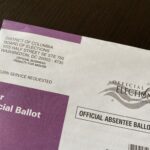
District officials encouraged residents to use early voting and mail-in ballots to prevent the novel coronavirus from spreading, though many people reported that they never received those ballots and ultimately chose to vote in-person on primary day. Nearly 90,000 voters had requested mail-in ballots as of May 30, according to the D.C. Board of Elections, though it’s unclear how many residents have or will return their ballots. More than 12,600 voters voted in person, per the elections board, including about 3,500 in Ward 4, which has one of the most competitive races in the Democratic primary.
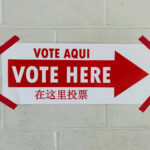
A limited number of polling places—20 total, as opposed to the more than 100 normally in use—were open from 7 a.m. to 8 p.m. As long as people are in line by 8 p.m., they can vote. Elections administrators have promised to enforce social distancing rules throughout, and same-day voter registration is available. (This year, voters can vote at any polling place in the city, regardless of where they live.)
Darryl Martin, a Southeast resident voting at Anacostia High School, said this afternoon that the turnout there was good “despite the virus,” and that he wanted to make his voice heard. He was one of a few voters at the Ward 8 location who brought up the ongoing protests in the wake of George Floyd’s death in the custody of Minneapolis police.
“Voting is our rights, it’s us taking part in democracy,” said Uron Brown, another resident who was voting at the school Tuesday afternoon. “If we want police brutality to end, we must vote the right people in office.”
Even though Mayor Muriel Bowser instituted an official 7 p.m. curfew tonight in light of expectations that anti-police brutality demonstrations will continue for a fifth consecutive day in the District, residents were allowed to cast ballots in person in the final hour of voting. (Essential workers and journalists are also exempted from the curfew.)
But some elected officials worried that the overlap with the curfew will dissuade people from voting at the polling places, especially in heavily policed communities. More than 40 Advisory Neighborhood Commissioners called on Bowser to postpone the curfew until 8:30 p.m., so it wouldn’t coincide with voting hours.
Early Tuesday afternoon, Ward 6 Councilmember Charles Allen, who has oversight of the D.C. Board of Elections as chair of the Council’s judiciary committee, tweeted that the 7 p.m. curfew “will disenfranchise voters, especially black voters wanting to avoid a police encounter. And poll workers, election observers, & volunteers will be scared to get home.”
The mayor didn’t budge on the curfew’s start time. She said at a press conference Tuesday morning that residents “won’t have any problem going to vote in the District of Columbia through 8 p.m. today.” The mobile alert for the curfew spelled out the voting exception.
After 8 p.m. hit, there were multiple reports on social media that police told voters in line at at least one polling center, Hardy Middle School in Ward 2, that they were violating curfew. Deputy Mayor for Public Safety and Justice Kevin Donahue responded, saying he was in touch with police commanders “to emphasize voting is exempt from curfew.”
The curfew isn’t the only thing that’s causing confusion during the primary. A number of voters who requested absentee ballots say they never received them. Local elections officials say voters whose ballots never arrived can still vote, including through a last-minute vote-by-email option.
However, it appears that many of the voters who never received their absentee ballots chose to vote in-person, as the board of elections initially suggested. During the day, wait times at many precincts were upwards of 90 minutes and lines stretched for blocks. Even after 8 p.m., when some voters had been in line for hours, many expected to wait more.
Stuart Davison arrived at Ward 5’s Turkey Thicket Recreation Center at 5:30 p.m., and by the time DCist spoke to him at 8:40 p.m., had been waiting in line to vote for more than three hours.
“I definitely was not anticipating waiting this long,” said Davison. Ward 5’s ballot is full of uncontested races but “I’ve voted every election since I moved to D.C. and I figured I wouldn’t break the streak.” He says poll workers told voters earlier on that they were expecting four-hour wait times, and suggested possibly heading to a different precinct, but people on the line had heard that other voting centers were just as crowded. Indeed, he says he’s surprised by how few people have left the line, despite the long wait times.
Davison said that heading to the polls is “one of the first times I’ve gone out in 10 weeks, but I’ve got a mask and everyone’s doing a good job of keeping some distance between them and the next person.” He added that he didn’t expect to be out after curfew when he headed to the polls. During the interview, he arrived at the part of the line where a funnel cake food truck had set up.
Ultimately, Davison voted at 10:16 p.m., about four hours and 45 minutes after he arrived at the voting center.
“I have lived in D.C. all my life and never had to wait this long to vote,” Herrera said. “Having to wait four hours just to do my God-given right is a lot. It’s stressful. I don’t think [the city] thought it through. Because obviously people want to vote, people aren’t happy with the political issues, with the big orange guy in charge. So if you knew people were going to vote, you should have had more than just these 20 sites open. Even with the pandemic you can be smart about it.”
Herrera didn’t even know about the absentee ballot option. “That information was not given out efficiently enough,” she said. “I would have done the absentee ballot because it’s way easier than waiting in line. For four hours.”
Because of the increased use of mail-in ballots, which must be postmarked or dropped off at a voting center by today but have an additional week to be delivered, the primary winners might not be known by the end of the night. That’s particularly true in close races or those with multiple candidates. The D.C. Board of Elections says it likely won’t certify the results until June 20, “though that date has not been finalized yet,” according to a board spokesperson.
Another aspect makes this year’s primary different than those in past years: the debut of D.C.’s public financing program. But in that respect, too, it remains to be seen how much of an impact the program will have on the final results.
Among politically active residents, the emphasis on absentee voting is widely seen as a dry run for the November general election. Allen says he plans to hold a public roundtable to debrief about the primary election.
This story has been updated throughout, and includes reporting from Martin Austermuhle.