Martin Austermuhle
The tone was set early, and it came from the top.
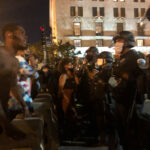
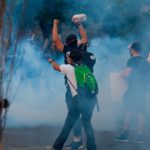
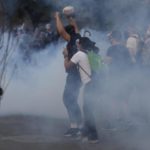
It was only minutes after President Donald Trump delivered a speech where he pledged to use military resources to restore law and order in American cities awash in protests against police violence. Police in Lafayette Park suddenly — and violently — cleared out a crowd of peaceful protesters. And with the tear gas only starting to clear, Trump walked across the park to St. John’s Episcopal Church, where he held up a Bible and briefly stood alongside senior aides. (Church officials were unaware the visit would happen.)
“Peaceful protesters near White House gassed, shot with rubber bullets so Trump can have church photo op,” read a CNN television caption.
A photo op it was, a cinematic and expertly staged show of force (with an official White House video set to dramatic music to boot) from a president who promised a stern hand in the nation’s capital to quell what had been three consecutive days of protests — both peaceful and violent — in the city.
“The chaotic and violent scene that unfolded outside the White House yesterday was the visual Trump wanted, sources tell me,” tweeted NBC reporter Shannon Pettypiece on Tuesday morning. “It was intended to be a sign of strength and taking back his space, countering reporting of Trump in a bunker Friday night.”
And it was only the first of many staged visuals to come, with D.C. serving as a backdrop for an administration ready to go on the offensive. As the evening progressed and police closed in on protesters, a number of senior federal officials appeared on city streets or tweeted out photographs and messages echoing Trump’s message of no quarter for looters and curfew-violators.
Shortly before police stormed towards the peaceful protesters in Lafayette Park (who weren’t yet breaking the city’s 7 p.m. curfew), Attorney General William Barr was seen standing behind police lines, almost as if a general surveying his troops. He later walked to 16th and K streets with his security detail to observe police actions there.
And an actual general also came out to survey the troops: Army Gen. Mark Milley, chairman of the Joint Chiefs of Staff, appeared on a D.C. street as evening fell. “We’ve got the D.C. National Guard out here, and I’m just checking how well they’re doing,” he said.
Secretary of Defense Mark Esper and Army Chief of Staff Gen. James McConville also publicly visited with the D.C. National Guard.
Other federal officials also got in on the action. Late in the afternoon on Monday, Acting Customs and Border Patrol Commissioner Mark Morgan tweeted out a picture of at least 100 police officers standing in the lobby of the Ronald Reagan Building.
“CBP personnel have deployed to the National Capital Region to assist law enforcement partners. These “protests” have devolved into chaos & acts of domestic terrorism by groups of radicals & agitators,” he tweeted. “[CBP] is answering the call and will work to keep D.C. safe.”
Later in the evening, U.S. Border Patrol Chief Rodney Scott tweeted out images of his officers standing watch alongside monuments. “D.C. curfew is now in place – peaceful protesters are home! USBP along with hundreds of our Law Enforcement & DOD partners are securing various national treasures & maintaining law & order,” he wrote.
Just as it was on Monday night, the District has long been a useful backdrop for national politicians and federal officials, often because city officials who enjoy a limited version of home rule have little authority to object.
Presidents, first ladies, Cabinet secretaries, and members of Congress from both parties have for years used their outsized power over the city to implement new initiatives regardless of local concerns (charter schools, to name just one). Federal figures have for decades attempted to impose their policy preferences (in the early 1990s Congress forced city residents to vote on whether the death penalty should be reinstated), and have frequently overruled local leaders when they made decisions on controversial issues (needle-exchange programs, legal medical marijuana).
Like on Monday, sometimes those federal interventions have come with a cinematic, made-for-Hollywood flair. In the midst of the crack wars of the 1980s, President George H.W. Bush gave a national speech where he dramatically recounted a drug sale that happened right outside the White House in Lafayette Park. (It only later came out that the drug deal had been somewhat manufactured for political purposes.) A few years later, in a less extreme version of political theater, President-elect Bill Clinton walked along Georgia Avenue as part of his campaign to help revitalize inner-city neighborhoods.
Of course, D.C. isn’t alone in this. Just about any city, town, county, or state can be used by presidents for political purposes. But what differs here is that the District is literally a block away from the White House, and the federal government has always held outsize sway over what happens within city limits.
That was certainly on display on Monday, when Trump’s threat to flood the city with federalized police forces became a reality. But some local officials, including D.C. Del. Eleanor Holmes Norton, criticized it for what they said it really was.
“We know a publicity stunt when we see one,” said Norton.