Martin Austermuhle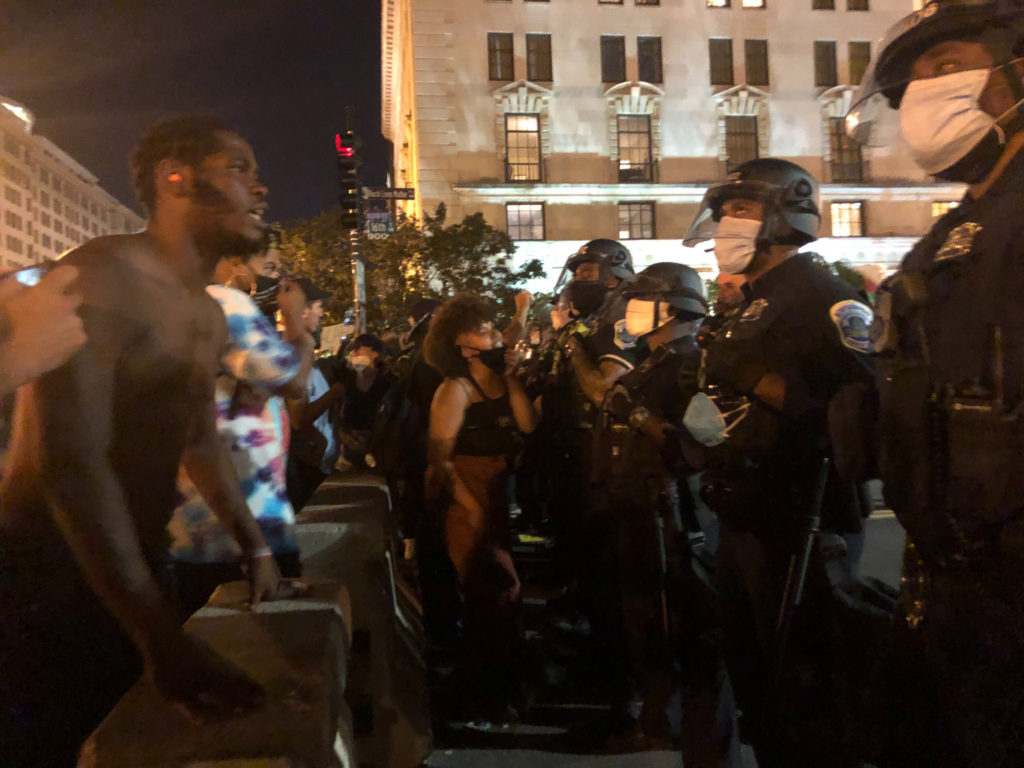
Three protesters are suing the Metropolitan Police Department over its alleged use of non-lethal weapons and projectiles like stinger grenades, rubber bullets, and flash bang devices against racial justice protesters in the summer of 2020.
In the lawsuit filed Wednesday in federal court, the three protesters — a D.C. resident, a Virginia resident, and a Connecticut resident — say they were injured by those weapons during different protests stretching from the end of May to August, causing injuries ranging from bruising and contusions to mental anguish and emotional damage.
“MPD and its officers intentionally and repeatedly, over many months, opened fire on peaceful protestors with barrages of maiming munitions, deployed into crowds of people indiscriminately and causing injuries to persons engaging in constitutionally protected First Amendment activities,” reads the lawsuit, which was filed by the Partnership for Civil Justice Fund and its Center for Protest Law & Litigation on behalf of the three protesters.
The lawsuit centers on incidents that took place during the sometimes-chaotic months following the 2020 killing of George Floyd by police officers in Minnesota. Tens of thousands of people took to the streets in cities across the U.S., including in D.C., where isolated incidents of property destruction and violence accompanied largely peaceful demonstrations.
D.C. and federal officials alike issued warnings against violent protesters, with Mayor Muriel Bowser imposing a nighttime curfew and then-president Donald Trump separately calling in federal police as a show of force. City officials, including Bowser — who spoke out against Trump’s aggressive moves — said they respected the right of people to protest peacefully, but also warned against “people among them… who are creating chaos and violence.”
In late August 2020, Bowser again accused isolated groups of sowing chaos amidst broadly peaceful protests.
“What we saw were agitators who descended on the city,” she said. “It sounds like many of them came… armed for battle with fireworks, baseball bats, laser pointers, and they were looking for the police to confront. They set fire to local newspaper boxes, accomplishing absolutely nothing.”
But the lawsuit alleges that over that summer D.C. police officers indiscriminately used non-lethal weapons against protesters, sometimes doing so without giving them an order or time to disperse. (Around the same time, the D.C. Council banned the use of tear gas and other chemical sprays against peaceful protesters.)
“The D.C. MPD has operated with impunity, violently attacking peaceful protesters demanding police reform,” said Mara Verheyden-Hilliard, the executive director of the PCJF. “The MPD will continue to injure the residents of and visitors to the nation’s capital as long as they think there are no consequences. People engaged in free speech activities in D.C. remain at high risk. This lawsuit exposes a pattern of violent, cruel, and indiscriminate use of weapons against peaceful protesters clearly indicating that the MPD saw their ‘targets’ as ‘enemy combatants’ rather than people engaged in First Amendment protected activity in pursuit of police reform.”
MPD did not respond to a request for comment; city agencies rarely speak about pending litigation. The D.C. attorney general’s office, which would defend MPD, said it had not yet received the lawsuit and thus could not comment. The three protesters are seeking damages for medical expenses they incurred, and a ruling declaring the use of non-lethal projectiles against protesters to be unconstitutional.
The 2020 protests and the police reaction to them have sparked numerous legal battles, including around the forced clearing of protesters around Lafayette Square Park for a Trump photo-op. And many of those lawsuits are similar to prior legal fights around the 2017 presidential inauguration, where more than 200 anti-Trump protesters were arrested and charged with rioting. (D.C. ended up paying $1.6 million to settle those lawsuits.)
But lawsuits over MPD’s responses to protesters stretch even further back. Verheyden-Hilliard sued the department over mass arrests made at anti-globalization protests in the early 2000s, leading to years of litigation and tens of millions of dollars in settlements paid by the city to protesters. Those mass arrests also prompted the D.C. Council to write a new law governing how police respond to peaceful protests.