Martin Austermuhle
This story was updated at 12:50 p.m.
It was an inauspicious start to an election season: Only days after the D.C. Board of Elections announced in late March that it would try and conduct a majority of the June 2 primary by mail, a number of staff members developed COVID-19 symptoms, forcing the board to quickly shutter its offices.
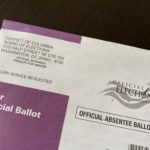
And in the two months that followed, the city’s independent elections office scrambled to piece together a vote-by-mail election that many states implemented over the course of years. It received some 90,000 requests for absentee ballots, a tenfold increase over the prior election cycle.
The electorate responded the way officials hoped: They mostly voted from home, good news as the city continues fighting a stubborn pandemic that has already infected more than 9,000 Washingtonians and taken almost 500 lives. According to initial statistics reported from the board on Wednesday, more than 60% of the 84,000 ballots cast in the primary had been mailed in. (That number is expected to go up in coming days.) In the 2016 primary, it was less than 7%.
According to unofficial election results posted shortly before 3 a.m., Janeese Lewis George appears to have overtaken incumbent Brandon Todd in Ward 4, while Brooke Pinto has an extremely narrow lead in Ward 2 over Patrick Kennedy, with thousands of special and absentee ballots still to be counted. Incumbents Vincent Gray and Trayon White handily bested challengers in wards 7 and 8.
But the election wasn’t without its challenges — some of them significant. The board’s app, which offered the easiest way to request an absentee ballot, worked poorly on Android phones. Some voters said they never received an absentee ballot even after requesting it, and others said they could never determine whether their completed ballot had been received and would be counted. Overall absentee ballot requests in predominantly black and low-income neighborhoods lagged far behind other parts of the city.
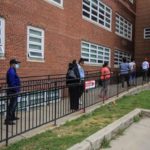
And long lines were reported at many of the 20 vote centers on Tuesday; in some cases, voters waited five hours to cast their ballots, and polling places didn’t close until after midnight. Communication breakdowns and other hiccups created the very type of crowded election officials had hoped to prevent in the first place. (The saving grace was that many voters kept the requisite distance from each other and wore face coverings.) One D.C. Council member called the waits “completely unacceptable,” and another swore they were “livid” with the elections board and called what happened a “debacle.”
Mayor Muriel Bowser, who herself voted in person at a polling place in Ward 4, said what she saw across the city “is nothing short of failed execution.”
That now leaves the city with the task of addressing some of the election’s shortcomings in hopes of avoiding them come November’s balloting, which generally sees larger turnout and could coincide with a second (or third) wave of COVID-19.
“I’ll admit, it’s not perfect. We have what we have, we’ve tried to take a very sharp last turn from what we had in place at the very last minute without any planning for it so it’s gone as well as it could,” said Alice Miller, the city’s director of elections, during a D.C. Council hearing on Monday. “Putting this kind of an operation in places takes years to perfect.”
An unexpected election
Advocates of vote-by-mail probably could never have expected that their preferred method of voting would so suddenly be adopted in many states holding primaries in recent months, but in early spring the emerging COVID-19 pandemic forced election officials across the country to quickly shift to a system that’s widely used in western states like Colorado, Oregon and Washington state. Suddenly the idea of replacing crowded polling places with mailed ballots seemed not just attractive, but necessary.
But while Maryland officials — who not only moved to vote-by-mail, but also had to delay the state’s primary by a month — opted to send ballots directly to 4 million registered voters, their counterparts in D.C. decided to ask that voters request absentee ballots instead.
Michael Bennett, the election board’s chair, said in late March that as much as sending everyone a ballot would be best, there were too many variables at play to safely overcome the logistical feats of actually doing so.
“Mailing ballots out to registered voters is a lot more complex process than one would think, and every jurisdiction that actually does that recommended that we take two years to plan the processes, not two months. You could have one mistake and your whole election is failed,” he said.
But some election officials countered that moving to vote-by-mail can be done more quickly than many people assume. Speaking in late April, Judd Choate, Colorado’s director of elections, hailed Maryland’s decision to just jump fully into vote-by-mail and said D.C. officials were overthinking how to pull it off.
“You can do a vote by mail election with the equipment you have and without the long runway that some people have in their heads to do a perfect election,” he said.
But Maryland’s experience still somewhat shows the challenges of rapidly changing how an election is run. Hundreds of thousands of ballots in the state’s most populated jurisdictions were mailed out late, according to reporting by the Washington Post.
Absentee ballots not received
D.C. voters did largely seem to respond to the city’s call; some 90,000 absentee ballots were requested, representing a large proportion of the voters who usually turn out for the primaries during presidential election years. But some voters say they never received their absentee ballots after requesting them, even after making multiple requests and following up over phone and email.
“I tried calling the Board of Elections several times but could never talk to a live person,” said Catherine Dill, a Ward 6 voter who requested — but never received — her absentee ballot. And because of health concerns, she said she would not feel comfortable voting in person.
Matthew Wibbenmeyer, a voter in Ward 5, ran into technical issues using the elections board’s app.
“I tried to request an absentee ballot through the Vote4DC app but received an error message. I tried multiple times, on multiple devices, using both a cellular and Wi-Fi connection, and was not able to request a ballot. I called the helpline, but it connected me to an ‘out-of-office due to the pandemic’ voicemail,” he said.
In the days leading up to the primary, At-Large Councilmember Elissa Silverman’s office tried to connect voters who had not received their ballots to the elections board, but by Tuesday the requests were piling up. “I am averaging an email a minute from D.C. voters who requested an absentee ballot & never received one,” she tweeted.
For now, it remains unclear exactly how many absentee ballot requests went unanswered — and whether that may have dissuaded any number of people from voting at all in the primary.
Another shortcoming came east of the Anacostia River, where requests for ballots from wards 7 and 8 — both of which had competitive D.C. Council races — trailed far behind other parts of the city. The wards accounted for just 10,320 of the 86,145 ballot requests made by the May 26 deadline, less than every other individual ward in the city except Ward 5. (Turnout east of the river has generally lagged in recent years.)
Some residents and political activists east of the Anacostia say the problem stemmed from lack of communication. Crystal Herrera, a Ward 7 voter, said she didn’t even know requesting an absentee ballot was an option. Instead, she stood in line for four hours at a vote center on Tuesday.
“That information was not given out efficiently enough. I would have done the absentee ballot because it’s way easier than waiting in line. For four hours,” she said.
And there was an additional problem: spotty mail service east of the river, prompting an intervention from D.C. Del. Eleanor Holmes Norton and a lawsuit filed by two Ward 8 voters. According to initial counts on Wednesday morning, 1,737 Ward 8 voters cast absentee ballots and 5,216 voted in person, the only ward in the city to lean more heavily on traditional voting.
Speaking to a Fox 5 reporter on Tuesday night, Ward 8 Councilmember Trayon White said the elections board “completely dropped the ball in so many areas.”
For some voters who did receive, fill out and send back their absentee ballot, another problem emerged: the election board’s online ballot tracker did not update to tell them if the ballot had been received and would be counted. It happened to Ashley Baker, who returned her ballot on May 21 for Ward 4’s competitive Council race but by Tuesday still did not know if it had been received and would be counted.
Miller, who was not available to speak to DCist/WAMU, told the Council on Monday that the board did its best with limited manpower and aging technology.
“All of this is done by hand. There is not one machine that’s doing this,” she said of the absentee ballot requests that had to be filled.
“We have trays and trays and trays [of ballots]. We have to scan them all in, and the manpower and the capacity of the technology we have cannot keep up with the ballots as quickly as they are coming in,” she added about processing ballots and updating the online ballot tracker.
Election officials also say they did their best to work with voters under punishing circumstances, which included long hours and family members of staff coming down with and dying from COVID-19. In a small number of cases, they emailed voters their ballots, which could then be filled in, scanned and emailed back. (The option has been used in the past, but only for overseas and military voters.) And Bennett, the board chair, himself said Monday he would be hand-delivering three ballots to voters who had not received them by mail.
Long lines at polling places
Knowing that absentee ballots would not be enough, election officials said in late March they would offer in-person voting options — but at a vastly reduced scale.
While a normal election day will see 144 precincts open across D.C., officials opted for 20 vote centers instead for Tuesday’s primary. They figured that since fewer people would vote in person, fewer polling places would be needed. Also, a small physical footprint would mean avoiding hiring the hundreds of volunteer poll workers it takes to staff all the usual precincts.
They were right that fewer people would cast in-person votes — 33,194 during a two-week period for early voting and on Election Day, which was down from more than 90,000 in 2016. But a confluence of factors led to long lines on Tuesday: confusion about undelivered absentee ballots, crowd limits, voters delaying the return of their ballots and choosing to vote in person. (There were also long lines at Maryland polling places.) In some cases, the vote centers didn’t close until after midnight. At one Ward 4 center, the last voter cast a ballot at 1:25 a.m.
Ward 5 voter Keshia Brown waited for five hours in a socially distanced line to cast a ballot at the Turkey Thicket Rec Center after her request for an absentee ballot went unfulfilled. As she approached the door of the polling place, she expressed relief.
“I’m trying to stay positive. Frustration is not even in my vocabulary, my head, my mood. I’m almost at the door and happy to get it over with,” she said.
Herrera, the Ward 7 voter, also cast her ballot at Turkey Thicket, and waited more than four hours to do so. She says election officials erred in not opening more polling places.
“I don’t think [the city] thought it through. Because obviously people want to vote, people aren’t happy with the political issues, with the big orange guy in charge. So if you knew people were going to vote, you should have had more than just these 20 sites open. Even with the pandemic, you can be smart about it,” she said.
Jordan Grossman, a candidate for the Ward 2 seat on the Council, tweeted: “It simply should not be this difficult to vote.
And there were yet more complications: The election board’s online line tracker inaccurately claimed the longest waits were only 90 minutes, and city officials scrambled to reassure voters that Mayor Muriel Bowser’s 7 p.m. curfew would not apply to people standing in line to vote. There were isolated claims of police telling voters standing in line after 7 p.m. they had to go home.
Beyond that, there was also reality — some people just didn’t get their absentee ballot requests in on time. “I’m a procrastinator,” admitted Ward 5 voter Ebony Dixon. And while vote centers were crowded on Tuesday, they saw far fewer people use them during the two-week early voting period that started on May 22.
“The bad news is everyone decided to vote on the last day that vote centers are open and they decided to do it in person, and that just created an incredible logjam,” Bennett, the elections board chair, told a Washington Post reporter.
Looking to November
With the primary now done, D.C. election officials are likely to come under intense scrutiny from lawmakers demanding answers on unanswered absentee ballot requests and the long lines at vote centers. And these questions will likely take on additional urgency given the upcoming November general election — which could similarly happen in challenging circumstances.
“I am very concerned about it,” said Bowser.
Ward 6 Councilmember Charles Allen, who oversees the elections board, says there will be a public hearing or roundtable discussion on what worked, what didn’t, and what’s left to be done ahead of November.
“This certainly isn’t the election process that was planned for, but it’s the one that we got. We have tried to troubleshoot every challenge we had, but I remain concerned that the app didn’t work well, that the tracker can’t keep things updated,” he said. “I understand why there is so much anxiety. We’re not talking about an optional nicety, bit a fundamental civic right. We take our enfranchisement very seriously, and it’s not something to be messed with.”
On Monday, Miller told the Council that the board did the best it could given the significant obstacles it faced — and the short timeframe it had to overcome them.
“The work requires physical presence. Individuals have been here, individuals have been sick, and they have had their families beg them not to come in but they have continued to do it,” she said. “Tired is putting it mildly. There have been a lot of 18-hour days, and we will have a few more to go.”
And those long days are another part of the process voters may have to get used to. While traditional election results can be expected the same day, mailed ballots can take days to receive and process after Election Day. Of the roughly 90,000 absentee ballots that were sent out for the primary, some 50,000 were returned and counted by Tuesday. Any ballot postmarked by June 2 and that gets to the board by June 9 will be counted, thus leaving at least one Council race — in Ward 2 — undecided for the time being.
“There are a lot of things we can learn from this process,” said Bennett earlier this week, discussing preparations for November, which he hoped could happen under more normal circumstances. “Hopefully we don’t have a pandemic.”
This story was updated with comments from Mayor Muriel Bowser.