Martin Austermuhle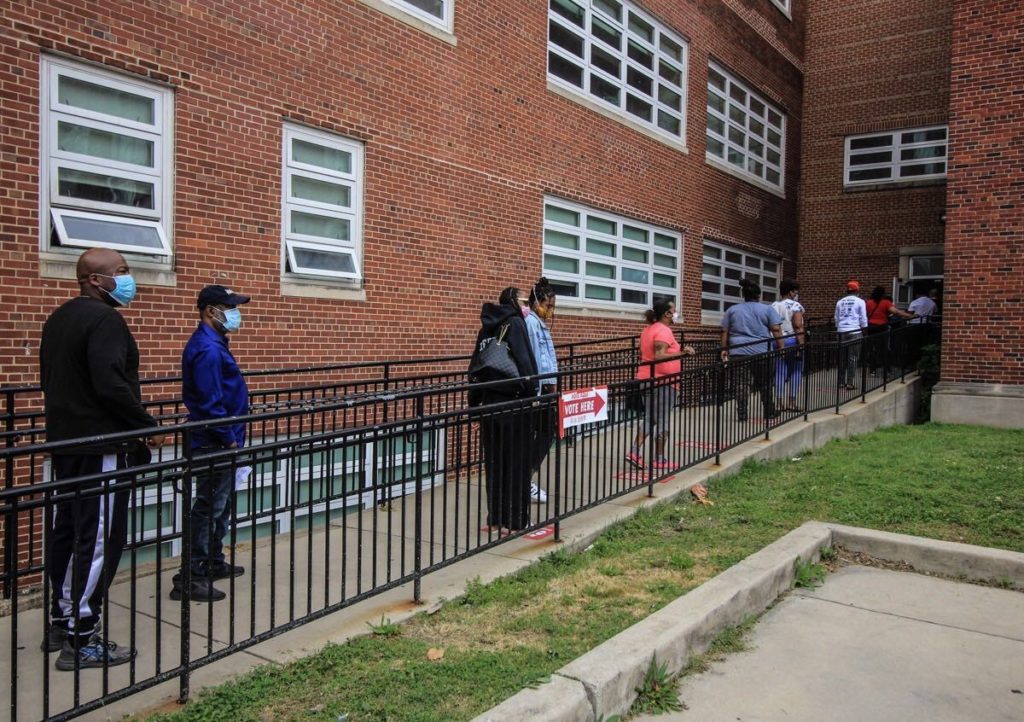
At least 1,100 requests for absentee ballots were lost by the D.C. Board of Elections ahead of the city’s June 2 primary, forcing hundreds of voters to cast ballots in-person while others apparently did not vote at all.
The revelation came during a D.C. Council hearing on Friday, where members of the public complained about multiple problems ahead of and during the primary — from missing absentee ballots to hourslong waits at polling places on Election Day — and election officials tried to explain to exasperated lawmakers why things went wrong and how to prevent a repeat during November’s general election.
The officials conceded that the execution of the primary wasn’t perfect, but they also said that they did as best they could with an election whose planning was completely upended in late March by the pandemic. What would have normally been an election with 144 polling places across the city instead turned into an election conducted almost entirely by mail, with voters encouraged to request absentee ballots. Twenty vote centers were opened for a two-week-long early voting period and on Election Day.
“Time was our biggest enemy, along with the pandemic,” said Michael Bennett, the chairman of the elections board.
And that perspective received some support from other elections administrators, who told the Council that shifting to all-mail elections has taken years of work in other states and that the pandemic presented a challenge that no election official had ever before experienced.
“We have never, never seen an election like this before,” said Lance Gough, the executive director of the Chicago Board of Election Commissioners. “Something like this … we have contingency plans, but have never seen anything like this before.”
“D.C. had to make the best of a very bad situation,” said John Lindback, director of the Center for Secure and Modern Elections and a former elections official in Oregon, which implemented vote-by-mail over the course of many years.
But those sympathetic views were lost on many voters and lawmakers, who complained during the hearing of a cascade of problems, including undelivered absentee ballots, an app that didn’t work well on Android phones, an online ballot tracker that didn’t work well, poor communication with the public, curbside voting that wasn’t properly staffed and left senior voters with few options to cast ballots, and waits approaching five hours at some of the vote centers on Election Day.
Under questioning from At-Large Councilmember Elissa Silverman, elections director Alice Miller provided some answers on one issue that bedeviled many voters: absentee ballot requests that went unanswered.
“We had a lot of requests that came in through our email system that were lost,” she said.
Asked for more details, Miller conceded that the elections board lost at least 1,100 absentee ballot requests. Of those, she said 700 voters ultimately voted in person on Election Day. But that could have left at least 400 who didn’t. More than 114,000 votes were cast during the primary—more than 70 percent of them by mail.
Election officials were also asked about the board’s app, which could be used to request absentee ballots but did not work well on most Android phones. They conceded that they had been aware of problems with the app, but were overwhelmed with the troubleshooting requests from voters as absentee ballot requests spiked tenfold from normal election cycles.
Bennett said that because of the short timeframe it had to work with, the board was forced to make adjustments on the fly instead of pushing for new platforms altogether. “Making all those changes… can be even more disastrous than sticking with what you have,” he said.
Responding to questions from Ward 6 Councilmember Charles Allen about lack of widespread communication to voters on how the election would run, Bennett conceded that a robocall to voters never happened — in part because the board couldn’t find a celebrity to record it.
“It kinda got lost in the sauce with a bunch of other stuff,” said Bennett. “It should have been done.”
Turning to the November, lawmakers pressed the officials what they would do differently with an election that is expected to see double the turnout. Earlier this week, the board announced one big change: instead of encouraging voters to request absentee ballots, it will send a ballot to every registered voter in the city before the election.
That’s what Maryland did ahead of its June 2 primary, but Miller said she hadn’t felt that D.C. could have contracted with a vendor quickly enough and avoid problems with ballots. In Maryland, there were cases of delayed and misprinted ballots.
“There is a lot of planning going on now to make sure November is as smooth as operation as possible,” said Bennett, highlighting a new vendor to build another app, new IT hires to help address existing problems, and a broader communications campaign to let voters know of how the November election will run. The board also said this week that it will double the number of in-person polling places for early and day-of voting.
Allen, who chairs the committee that oversees the elections board, asked Bennett and Miller to ask other city agencies to help them ensure the November election can happen smoothly.
“There is great value in having an elections board that is independent,” said Allen. “But we can’t let independence mean isolation.”
And Silverman — who called on the board’s leadership to change — said she remained concerned with preparations for November.
“Voting is sacred, and our voters who were not able to vote because they did not receive their ballot have a right to be angry about it,” said Silverman. “We have to make sure it doesn’t happen again.”
Miller ended by warning that she and lawmakers need to have “realistic expectations” about what could happen in November, especially as people still opt for voting in person — no matter how many ballots are mailed out ahead of time.
“It is not going to be perfect,” she said. “We know there are going to be long lines. People are still going to show up on Nov. 3 and vote. It’s not going to matter [how many ballots we send out]. What we need to do is figure out how we get in front of that.”