Elliot C. Williams
An annual count of the region’s homeless population, released this week, shows broad improvements. But the report, taken from a single-day count in January, doesn’t reflect the current reality impacted by COVID-19—and, in fact, forecasts a large increase in homelessness going forward.
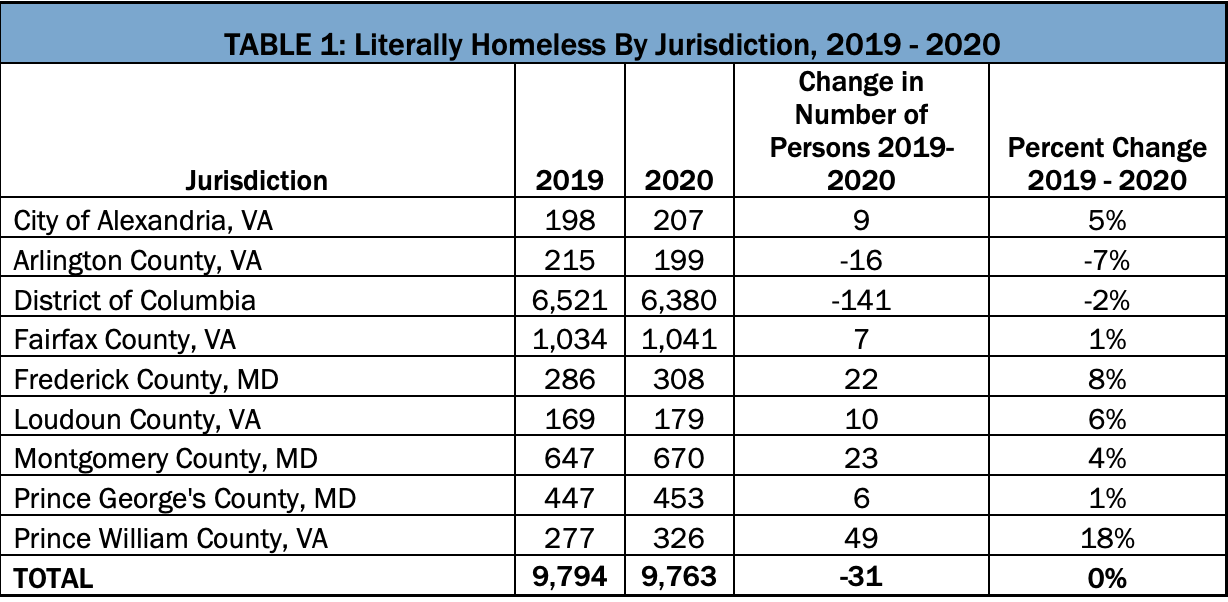
The report, by the Metropolitan Washington Council of Governments, is a one-day snapshot of the number of residents experiencing homelessness across nine local jurisdictions. This year’s total of 9,763 individuals marks the fewest people counted since the council did its first tally in 2001. The report also shows a 20 percent decrease in homelessness across the region over five years. (The report defines those experiencing homelessness as people who are unsheltered or reside in temporary conditions including emergency shelters, transitional housing, domestic violence shelters, and safe havens.)
The number of people experiencing homelessness in D.C. is down 2 percent from last year, according to the annual count. The District recorded a total of 6,380 people experiencing homelessness, down 141 from last year. This marks the fourth year in a row that the District has reported declines in its point-in-time numbers.
Conducted on January 22, the count doesn’t take into account the affects of COVID-19, though it’s clear the pandemic impacted the council’s mindset in writing the report.
“According to those working to address the challenges facing people experiencing homelessness, the housing crisis has grown significantly as a result [of the pandemic], the report notes, adding that “this year perhaps more than ever, it is apparent that housing is health care.”
The region’s net reduction since last year does not mean that all jurisdictions involved saw decreases. While 31 fewer individuals experienced homelessness than in 2019 overall in the region, only two of the jurisdictions — D.C. and Arlington County — saw a drop in homelessness. The rest saw an uptick, with the highest in Prince William (18 percent), Frederick (8 percent), and Loudoun counties (6 percent).
Children account for 59 percent of all people in homeless families and represent nearly a quarter of all persons experiencing homelessness in the metropolitan Washington region in 2020.
The data also show continued racial disparities, as most respondents were black or African American. Of the nearly 6,000 adults who responded to demographic questions during the January count, 73 percent said they were African American, despite making up only 25 percent of the region’s population; meanwhile, 21 percent of the respondents were white, 3 percent reported multiple races, and 1 percent who responded were Asian.
Since 2016, the District also reported the greatest reduction across jurisdictions in the number of chronically homeless single adults (defined as experiencing homelessness for at least one year or four times over the past three years and having a mental or physical disability). D.C. reported 37 fewer chronically homeless individuals than last year, and 164 fewer than 2016’s count.
The report shows that concerted efforts to tackle family and chronic homelessness have made a significant impact since 2016, when the District reported the highest per-capita increase in homelessness in the United States. The District has seen a 24 percent drop in individuals experiencing homelessness since 2016, when the city’s count reached 8,350 people.
For the third year in a row, the number of families experiencing homelessness across the region declined — it’s down 4 percent from last year. In D.C. specifically, 2,431 people in families still experience homelessness — that number is 215 people fewer than last year and 48 percent less than 2016.
During the pandemic, however, D.C.’s homeless population has faced increasing danger in the city’s shelters, where there’s been a disproportionate rate of COVID-19 infections and deaths.
The city rented out hundreds of hotel rooms at five locations across the city for people who have tested positive for the virus or have possibly been exposed to someone with it. Still, the Washington Legal Clinic for the Homeless says Mayor Muriel Bowser isn’t doing enough to mitigate risks people face, reporting that more than 300 people experiencing homelessness have contracted the novel coronavirus.
Bowser heralded the report on Twitter, citing her “Homeward DC” pledge just months into her first term. The plan included goals to eradicate family homelessness by 2018, make homelessness “rare, brief, and nonrecurring” by 2020, and eliminate it altogether by 2025. She also promised to close family shelter D.C. General, which she succeeded in doing in 2018.
“The region’s dedication to addressing its pervasive issue of homelessness has resulted in measurable progress,” said Prince George’s County Councilmember Derrick Davis, chair of the Council of Governments board. “However, COVID-19 has only exacerbated the region’s housing challenges, and we’ll need to double down on our commitment to identify housing solutions, among other critical actions, to continue to meet this growing need in our communities.”
Homelessness could increase by as much as 40 percent nationwide in 2020, according to the report’s analysis of federal unemployment forecasts. The council’s report says the lack of affordable housing for low-income households, rising rents, and stagnant wages are “the greatest barrier[s] to ending homelessness.”
“Homelessness was a serious challenge in our region pre-pandemic, but the COVID-19 impact brings new urgency to addressing the crisis,” said Tony Turnage, Prince William County assistant director of the Homeless Services Division and co-chair of the COG Homeless Services Committee. “It’s clear, housing must be central to the conversations about the region’s recovery plans.”