Martin Austermuhle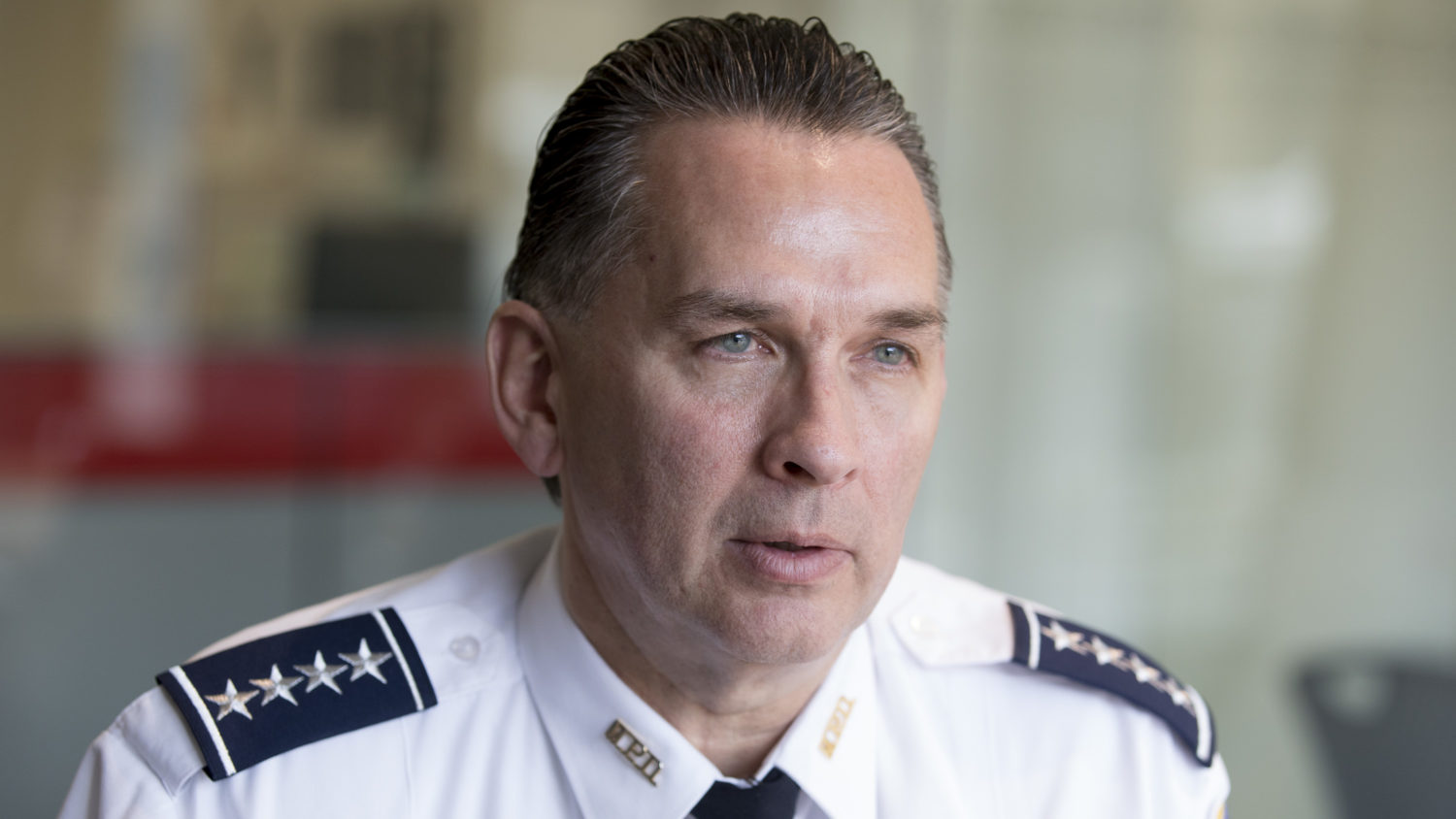
What was supposed to have been a pep talk to D.C. police officers over the weekend has instead renewed tensions between Police Chief Peter Newsham and members of the D.C. Council over how much the Metropolitan Police Department has changed over the years — and how much more change may be needed.
In a private address last week — which was first reported by Fox 5 — Newsham accused lawmakers of having “completely abandoned” officers by passing emergency police reform legislation last week. The legislation, which passed unanimously, bans the use of chokeholds, speeds the release of body camera footage and names of officers involved in fatal shootings, stiffens disciplinary procedures, expands training requirements for officers and prohibits police from using tear gas or riot gear to break up protests, among other provisions.
While Newsham said before the June 9 vote that he only had technical concerns with the bill, he more broadly attacked the need for reform legislation at all in his address to officers.
“I think the most disheartening thing for me and maybe for some of you is that the city council forgot our history in this critical moment in our history. They completely abandoned us,” said Newsham in the address. “They forgot about our 20 years of reform, and they insulted us by insinuating that we were in an emergency need of reform. They insinuated that somehow the Metropolitan Police Department would be involved in an act of murder like we saw in Minneapolis.”
The statements have stirred anger inside the Wilson Building, and have been seen by some councilmembers as insensitive and poorly timed. Speaking at a hearing on MPD’s budget on Monday, At-Large Councilmember Robert White accused Newsham of creating divisions between the lawmakers and law enforcers.
“I think it is dangerous to put a dividing line and put on one side our police force and the other side the Council. What this does is it creates really a false narrative and a division, in a time where that is the thing that we need the least,” White said. “But I will say this: to so thoroughly miss the importance and the necessity of this moment that you use it to divide and get defensive is frightening and sad.”
The anger continued during an administrative meeting and separate budget hearings on Tuesday, where multiple councilmembers chimed in with their own frustrations over Newsham’s comments.
“We’re in leadership positions,” said Ward 6 Councilmember Charles Allen, who chairs the committee that oversees MPD. “I get blasted all the time by people who are going to disagree with me. And it would be wildly inappropriate for me to take that verbal barb that might hit me or sting me and turn it around and try and tell my staff, ‘These folks have abandoned me.’ The moment of leadership was really missed.”
Allen also called the comments “dangerous,” a point echoed by Ward 7 Councilmember Vincent Gray. “What he did is dangerous and could endanger the health and welfare of the Council. It was an incredibly disrespectful treatise he engaged in that is completely uncalled for,” Gray said.
In an interview on Wednesday, Ward 5 Councilmember Kenyan McDuffie — himself a former attorney in the Department of Justice who investigated police departments — called Newsham’s comments “inflammatory” and said they “undermine public confidence in his leadership.”
Newsham was not immediately available to respond to questions from WAMU/DCist, but Deputy Mayor for Public Safety and Justice Kevin Donahue told the Council that the police chief was merely trying to reassure officers the importance of the work they do.
“He was speaking to his patrol officers … he was trying to acknowledge a belief he had that those officers were having their hard work questioned or lumped in with the worst aspects and elements of their profession nationally. He was trying to acknowledge their feelings,” he said.
Reforms Past, And Reforms To Come?
The emerging tension between Newsham and city lawmakers comes amid growing political pressure for the Council to push forward on further reforms within MPD, or even consider cutting the department’s budget and scaling back from its current 3,800 officers. It also highlights a fundamental change in the debate over policing; while years ago residents may have been satisfied with internal reforms, activists are now broadly pushing for a wholesale rethinking of how policing happens and how the departments operate.
Newsham has largely fallen back on his own experience, having joined the department in 1989 and seen how it has undergone significant internal changes and improvements — which he referenced in his message to officers. “You have participated in reforming this police department for over the last 20 years. It’s one of the reasons that we’re recognized as a law enforcement leader in this country,” he said.
In 2001, D.C. voluntarily signed an agreement with the Department of Justice committing the police department to broad reform. That agreement was prompted in large part by a series of Washington Post reports in 1998 that exposed MPD as one of the deadliest departments in the country.
Policing experts say the department’s turnaround since has been dramatic; what was once a police force no other city wanted to emulate has become one seen as a model of reform. “I think it’s fair to say that not only is it among the five best departments now, but I think it was one of the worst departments in the mid 90s,” says Michael Bromwich, who from 2002 to 2008 served as the independent monitor to ensure that MPD complied with the terms of the agreement signed with DOJ.
While in the 1990s MPD led all other cities in use of deadly force, it is now much more restrained — and a system exists to investigate cases where force is employed. In 2017, fewer than 1% of uses of force by officers involved firing their service weapons. After Officer Brian Trainer shot and killed motorcyclist Terrence Sterling in 2016, Newsham had him fired.
More than 3,200 officers are now outfitted with body-worn cameras. And while many police departments nationwide are whiter than the communities they serve, MPD is 60% Black. In late 2018, D.C. kicked off a first-of-its-kind training program for officers and civilian employees in the National Museum of African American History and Culture.
But critics say there are still problems within MPD. While fatal shootings may be rare, overall use of force incidents increased 83% from 2015 to 2018, according to the D.C. Office of Police Complaints. Footage from the body cameras is rarely made public after high-profile incidents, highlighted by the 2018 shooting of 22-year-old Marqueese Alston by two officers. His mother has viewed a portion of the footage herself, but has demanded Mayor Muriel Bowser release it fully to the public. (Last week, Alston’s mother filed a $100 million lawsuit against the city.) And data from the department itself shows that more than two-thirds of people who are stopped and frisked by police are Black, even though they make up less than half of the city’s population.
“Of course we should have more reforms. The problem here is that reforms have not totally worked. And in some cases, especially when it comes to MPD, they don’t even follow those reforms unless, you know, sued by an outside agency,” says Monica Hopkins, director of the ACLU of D.C., referring to the fact that her organization had to sue the police department to comply with a 2016 law requiring it to collect and publicize stop-and-frisk data.
Hopkins supports continued changes to how MPD operates, but also more significant changes to how the department is funded and staffed. That aligns with the “defund the police” chant that has become more widespread during protests since the killing of George Floyd, and reflects a growing impatience with past and future reforms like the ones MPD has already gone through.
“Throwing money at police under the pretense of reform has failed time and time again,” said Jacob Smith, a Ward 5 resident and member of the Black Youth Project 100, during Monday’s hearing on MPD’s budget. “Why would we keep funding an organization that needs a law to remind them that choking people is bad?”
Chuck Wexler, the executive director of the Police Executive Research Forum, says there’s a middle ground to be had, but it starts with recognizing that even “model” police departments haven’t reached the end of reform.
“Any department that stands still and thinks, ‘I’ve got it’ is one bad car stop away from disaster. You just can’t do enough,” he says.
Wexler says that he conceives of the idea of defunding the police as peeling back some of the additional responsibilities officers have been assigned that they may not be equipped to properly handle. People in crisis, for one.
“That’s an area traditionally that the police handled by themselves, because at three o’clock in the morning, who else is around? But could you team up police with mental health workers or social workers? Absolutely,” he says. “But I do think people have to think twice before they say defund the police because, you know, when you’re in crisis, there’s nothing better than a good cop and there’s nothing worse than the bad cop.”
Councilmember McDuffie agrees that changing policing will require a broader look at other structural inequities — in schools and jobs, for example. And he says that reform isn’t a one-time thing. “He keeps talking about 20 years of reform,” he says, referring to Newsham. “To me, 20 years doesn’t mean you have a perfect office, a perfect department.”
Speaking to this issue during Monday’s budget hearing, At-Large Councilmember Robert White tried to connect what may MPD has already accomplished by way of reforms to what it — and the government at large — still have left to do. And he directed his comments at Chief Newsham.
“We have had 400 years of reluctant, incremental progress,” he said. “We have, for the first time in the history of this nation, reached a point in history where we can make significant progress and we have to get not from A to B, but from A to Z before the moment passes. And anybody who is standing in the way of that progress, who refuses to be a part of that progress, is part of the problem.”