 Eliza Tebo
Last week, six staff members at Old Town Alexandria’s Killer E.S.P. abruptly quit their jobs over the coffee shop’s Twitter activity and allegations that the owner sexually harassed employees.
The tweets and likes, which number more than a dozen and were criticized as early as June 6, appear to embrace a far-right ideology. In one post liked by the Killer E.S.P. account, a Twitter user who frequently uses the #QAnon hashtag asks why George Floyd’s casket was closed at his funeral, seeming to suggest Floyd’s body was not in it. A tweet posted from the account reads, “Liberalism is an incurable disease of stupidity and a closed mind.”
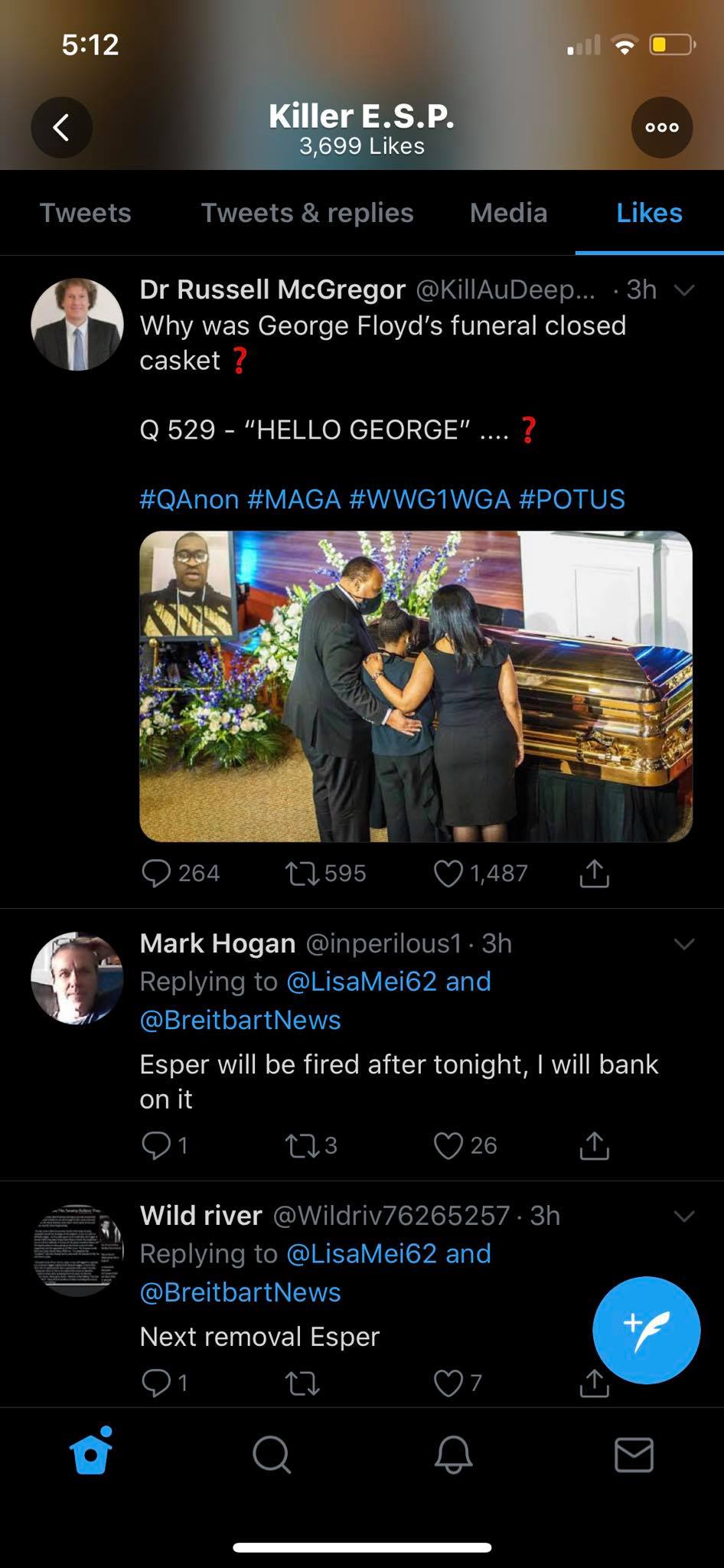

Killer E.S.P. owner Rob Shelton tells DCist that he was not behind the tweets and that at least two dozen employees or former employees have had passwords to the shop’s social media pages in the past several years.
“I haven’t used Twitter in years,” he says.
As the furor over the tweets erupted on social media last week, former staff members of Killer E.S.P. spoke up with allegations about Shelton, including that he sexually harassed some of them. Washingtonian was the first to report on the allegations.
Shelton, 51, says he recently took down the Killer E.S.P. Twitter and Facebook accounts and says he was in a state of “shock” at the online backlash.
“How did this happen? What happened?,” Shelton says. “I’ve just been a rollercoaster of emotions trying to figure this all out.”
In conversations and emails with DCist, eight ex-employees describe a toxic workplace at Killer E.S.P., in which Shelton engaged in sexual harassment, was hostile toward employees, was late on or withheld payment, and exhibited a disregard for the health of employees and community members during the coronavirus pandemic.
‘So Embarrassed And Ashamed’
Sarah Lore didn’t have to submit an application for her role as a Killer E.S.P. barista. She was offered the job “on the spot” in August 2017, she says, after petting Shelton’s dog in the store.
“I had makeup on and my hair was straightened and I was wearing a cute top, like a pretty tight top. So I would not be surprised if he just saw me looking my best and wanted me to work there,” says Lore, who was 16 at the time. “I had no barista experience; this was my first customer service job.”
Lore, now 19, says Shelton repeatedly made comments about her physical appearance during the two years that she worked on and off at the nearly decade-old Alexandria shop. (The cafe also has a Chinatown location, which opened in 2018, that has been closed during COVID-19 and Shelton says is unlikely to reopen.) On one occasion, when Lore was 17, she says Shelton was reprimanding a male coworker for closing early and Lore was anxiously biting her nails.
“He grabbed my wrists and he said, ‘You’re too fucking sexy to bite your nails,’” she says. “[He] started going on about how this woman can be so hot and she can look great and she can have a great body, but if she doesn’t have nice, well-taken-after nails, then he won’t want to fuck her.”
On another occasion, Lore was in a meeting with Rob toward the back of the store and says Shelton kept smiling at her.
“He said something along the lines of, ‘This is inappropriate, I wasn’t going to say this, but you look so fucking hot right now,’” she says. She was then 18.
Shelton says both those incidents are not in line with things he would say.
“‘Hot’ is a word that I don’t even use,” he says. “For years, I think since I was early 20s, 21 when I first moved out in California, friends advised [me] to not use that word, and I listened to that advice for a long time. And I used ‘cute’ for years.”
Lore had an eating disorder at the time that she says constantly crowded her mind with thoughts about food or her body. When she was focused on the daily activities of work, Shelton’s comments could be triggering, she says.
“It can just put me back in that state and make everything else in the world kind of disappear,” she says.
Shelton also often made unwanted physical contact with Lore, she says. In 2019, she was standing behind the bar and he hugged Lore from behind and kissed the top of her head while customers were present.
“I just remember being so embarrassed and ashamed. Regulars I knew and I saw every day were there and saw it,” she says. “Because I couldn’t speak out against it right there in front of him and in front of everybody, or because I wasn’t brave enough I guess, it felt like something that came across that I wanted, I suppose.”
Of the allegation, Shelton says, “I don’t think so, I disagree.”
That same year, Lore says she began crying one night while afflicted with an overwhelming headache (she says she deals with chronic headaches). Lore was scheduled to close the shop alone but Shelton decided to stay with her, she says. After closing, around 11 p.m. or later, she says he hugged Lore behind the bar.
“Then he picked me up onto his chest, like you do if you’re cracking somebody’s back,” she says, adding that Rob is more than 6 feet tall.
“I guess that made me more uncomfortable and more scared than anything had because he can do that—he is that physically overpowering that he just picked me up without me asking and there was nothing I could do about it,” she says.
Shelton says he was “never told” that a hug was unwanted.
“I’ve hugged lots of employees. We just have a loving place, a loving caring place,” he says. “[I’m] happy to see one of them when they come back from school or when they come back in town from moving or going on a vacation … and I see them for the first time in a long time—you give somebody a hug.”
Other former employees have similar stories. Ally Rigoli, one of the former employees who spoke out about her experiences at Killer E.S.P. on Facebook last week, worked at the cafe for several months in 2017. She says Shelton was “constantly making inappropriate sexual remarks” about her appearance.
He often hugged her from the front or from behind, or picked her up and hugged her, and whispered things that were sometimes of a sexual nature in her ear, she says. On a couple of occasions, he also referenced his genitals, she says. She recalls him touching her hips, her stomach and her underarm area—which she says put his hands in contact with part of her breasts. When he hugged her, she says, it was “really close and for a really long time.”
Shelton denies the allegations that he picked women up, whispered sexual things to them or mentioned his genitals.
“That’s just not me. … I wouldn’t do that. I don’t talk like that,” Shelton says.
Rigoli is also one of two former employees who told DCist that Shelton had asked them to use drugs with him. He asked her to join him outside and inside of the workplace to “do drugs,” including marijuana, Rigoli says. At the time, she says she was very interested in art.
“He knew that and was like, ‘Oh well you should stay here late; we can have an all-nighter painting and doing’ whichever drug,” she says.
Shelton denies allegations that he asked employees to use drugs with him.
“You know what I do when I go home? If I’m not with my daughter, I go home,” he says. “If I’m with my daughter, my daughter and I spend time with each other. … I don’t drink, I don’t do drugs.”
Several former employees also say Rob told them he “forgot” to file payroll paperwork on multiple occasions. There also were “multiple times” that checks bounced, says Taylor, a former employee who asked that DCist use her middle name to protect her family, friends and herself.
Rigoli remembers receiving at most one paycheck in her roughly four months of work at Killer E.S.P. When she hadn’t received a paycheck, she says she brought the issue to Shelton. He paid her in cash, a sum of about $400, and told her to pay him back once she received her paychecks, she says. Yet when it was time for subsequent paychecks to arrive, she says he told her she wouldn’t get them until she paid him back.
“I was constantly texting him, constantly calling him, constantly trying to get the manager to get him so I could just pay him back,” she says.
She did eventually get cash to Shelton, she says, but says she “never saw a check” after she paid him back.
Shelton says issues with payment are the fault of companies Killer E.S.P. uses for payroll who are “not really concerned with us” as a small business.
“I haven’t handled our payroll in probably seven or eight years,” Shelton tells DCist via text. “If someone didn’t get paid, why wouldn’t they talk to me or whomever handled payroll at the time? … What would I gain in a small town neighborhood by screwing someone over?”
Shelton sent DCist photos of payroll records that paychecks were cut for Rigoli totaling at least $1,943.39 in wages and tips. Shelton says he does sometimes pay employees in cash until they’re able to pay him back.
Rigoli says she did not receive that amount of money.
“That must be an accumulation of the checks that he said were ‘being held’ until I paid him back,” Rigoli tells DCist via Facebook messenger. “I know I certainly never got that amount, and when I returned to the shop after I quit (because he either didn’t respond to my texts or acted like he was clueless) the employee who checked the safe for the checks told me nothing was there.”
‘Tiptoeing Over Eggshells’
On the morning of June 10, Kristyn Crow was working her shift at the Alexandria cafe when a fellow coworker entered the shop and said he was quitting over the posts about conspiracy theories he’d seen on the Killer E.S.P. Twitter page.
“Right after he left, I had probably three or four more customers come in and talk about, ‘What’s going on on social media? Are you guys a part of this?’” Crow says.
Shortly thereafter, a coworker sent Facebook screenshots to their group chat mentioning allegations of a sexual nature from an ex-employee against Shelton, she says.
“I’m a young female, and that just raised an even bigger red flag for me,” Crow says. She quit her job at Killer E.S.P. via a text message to Shelton, effective immediately.
Within a matter of hours, she says, all six staff members who had been working during the pandemic submitted their resignation. Three of them soon established a GoFundMe page to help them stay afloat while they look for other work.
While Crow says Shelton has “never laid a hand on me,” she says his behavior can seem “aggressive.”
When Michelle, who asked DCist to use only her middle name because she says she fears for her safety and wants to avoid retaliation, started working at Killer E.S.P., she says she enjoyed the job at first and acquired many friends. But the “very strong presence” of Shelton made it difficult to relax, she says.
“I definitely had a handle on my anxiety disorder before working there, but then after working there, I noticed my mental health kind of plummeted,” she says.
Shelton could easily become upset, Michelle says, and adds that he would sometimes threaten to fire employees.
On one occasion, Michelle recalls taking a break outside after working for five hours straight. After sitting outside for a couple of minutes, Shelton walked into the store, saw how busy it was and threatened to fire her if she did not return to the store, she says.
If an employee made an error counting cash in the register, Taylor says, Shelton would accuse people of stealing from him.
“That made it very difficult for the staff to deal with because it was tiptoeing over eggshells a lot, because any small mistake … he would freak out,” she says. “Then the whole staff would all go nuts because he would just make it so absolutely miserable trying to fix whatever happened.”
Shelton says he doesn’t threaten to fire employees.
“If they do something wrong, if someone steals something, I take them off the schedule,” he says. “I give people many chances to do things.” He adds that he has not had incidents of theft, but that employees sometimes give away food for free without Shelton’s permission.
A few hours after the exodus of employees June 10, Shelton sent a group text message to staff members saying that he was not behind the tweets in question.
“I am in total shock and concerned for everyones [sic] reputation,” the message says.

In a post made on Killer E.S.P.’s Instagram page Tuesday, Shelton wrote that the “offensive social media postings” were done “without [his] knowledge or authorization.”
“I understand your reactions to those outrageous postings, and I am sorry that you were subjected to them,” the post continues.
Yet several former employees say comments Shelton made in the shop are in line with some of the tweets.
“I definitely don’t think it was anyone else just because a lot of the things that were tweeted out by the account were things that he had either said or hinted at in the shop,” says Nate, one of the employees who quit June 10 amid the social media fallout. He requested that DCist only use his first name as he doesn’t want his name to be attached to the situation via a Google search.
Crow and Taylor both say that they’ve heard Shelton make comments about conspiracy theories during their time at Killer E.S.P.
“He seemed to be rebellious over things that did not make much sense to me,” Taylor says. “For instance, what’s going on right now where he’s thinking that COVID’s not a thing, not to worry about. But it is a thing.”
Shelton says it would be “absolute suicide” to post comments from a business social media account but says he does post questions to his personal Instagram and Facebook pages.
“Some states are totally shutting down and ruining people’s lives if someone can’t open a barbershop in Michigan, can’t open a salon in Texas,” he says. “I just question these things. I can’t sit back and go, ‘OK, I believe the government. I trust them. And CNN and FOX tell me the truth.’ I don’t. I don’t trust them.”
Pie Shop—a pie purveyor and concert venue in D.C. that has sold its products at Killer E.S.P.—tweeted last week that it would be ending its relationship with the cafe after the social media posts came to light. “We are so clearly against their positions that were just brought to our attention,” the business wrote.
‘Never Took Any Precautions for COVID’
Recent former staffers also say Killer E.S.P. didn’t take adequate safety precautions during the COVID-19 shutdown and first stage of reopening.
Crow says she witnessed Shelton telling customers they could remove their face masks inside the cafe on three or four occasions in the past two months. As of late May, masks have been required inside at restaurants and other businesses in Virginia. Former employees say that as recently as late May, Shelton told them they did not have to wear masks at work, a violation of Phase One reopening guidelines. (Northern Virginia businesses entered Phase Two on June 12.)
Shelton says he would have purchased face masks if employees told him they needed them.
Hand sanitizer and cleaning wipes also were not provided, Crow says. And when the store ran out of hand soap, she says employees were told to add water to the containers instead.
“One of the trainees was there, and I looked at her and I was like, ‘This is ridiculous because it’s not going to do anything if we’re just squirting water on our hands to wash with water,” Crow says. “He never took any precautions for COVID.”
While Shelton confirms that the shop did not have hand sanitizer, he says employees could wash their hands at one of many sinks. He calls the claim that he asked employees to refill soap containers with water “absolutely so silly.”
“We run out of stuff every once in a while. If we ran out of soap, they would go get it. Why would I tell someone to put water in it?” he says. “This just gets funnier all the time. I cannot believe this is happening.”
Shelton also allowed customers to sit inside the shop, despite restrictions on indoor seating at restaurants that were in place at the time, Crow says. One day last week, during Phase One, Crow says Shelton told her to allow a regular customer who was not wearing a mask to work on his laptop inside the store for two hours. Shelton says he did allow a friend who “needed to handle some family matters” to sit in the shop, and doesn’t recall him not wearing a mask.
“Rob was always a little bit of a denier of COVID-19,” Nate says.
In early April, a person who told Nate he was an off-duty health inspector and was wearing a uniform jacket saw customers sitting outside the cafe and told Nate that the tables and chairs needed to be stacked away. Nate alerted Shelton in their group chat.
“Health dept. doesn’t work Saturday and they always show an ID badge. Just some Nazi neighbor,” Shelton responded, according to a screenshot of the exchange obtained by DCist.
Shelton says he didn’t tell the employee to dismiss the inspector’s recommendations.
“I didn’t tell them, ‘Don’t tell them not to sit there,’” Shelton says. He added that “no one’s going to die with somebody sitting on an empty patio. … But it’s OK for a million people to riot in the city.”
Shelton says he frequently writes online posts using his personal accounts “questioning narratives.”
“A lot of the science with this COVID stuff, I don’t agree with it. Masks do not help you with COVID,” he says. “This is a patented virus; it’s so much deeper than what anyone is being told. And I don’t trust what they’re telling us.”
He adds that businesses such as his Chinatown location are closing down, while government employees remain employed.
Shelton says he plans to create a video where he can personally address recent allegations, including the sexual harassment.
“It’s really sad,” he says. “Maybe [the young female employees] wanted me to pay a different type of attention to them. And I just can’t, I don’t, I won’t. I have no desire.”
He also says he has replaced his recently resigned staff members.
“I have a brand new fully trained and OPEN MINDED staff that are behind me and understand that questioning any media-pushed narrative is OK and you shouldn’t have your life destroyed because you have a different viewpoint from the masses,” he tells DCist via text.
During a text exchange for clarifications on this story, Shelton shared that he’d recently purchased a new domain, wholetownalexandria.com, and plans to use it to host a public conversation about race.
“I want to get people together to have the difficult race talks that no one is having. I’m not afraid to ask the difficult questions,” he wrote. “What is black lives matter? Why is all lives matter so frowned upon? What is white priviledge [sic] to both sides? Why? Why can’t blacks say cracka? Why can’t whites say n—-? Etc. I want people to feel safe talking about ALL CONCERNS in my shop. We ALL have questions but are so afraid to get beaten down by the online mob. That needs to stop. Same goes with the masks and Covid. It’s not about safety it’s about SUBMISSION.”