Margaret Barthel
The Washington Metrorail Safety Commission has completed investigations into several recent safety incidents, including the crash of two Metro trains outside of the Farragut West station after midnight on October 7, 2019.
While the two trains were not carrying passengers, Metrorail Safety Commission CEO David Mayer underscored the weightiness of the incident.
“This is the most significant collision on Metrorail’s mainline tracks in years,” he said at the commission’s monthly meeting. “If there had been passengers on either of these trains, there would likely have been serious injuries.”
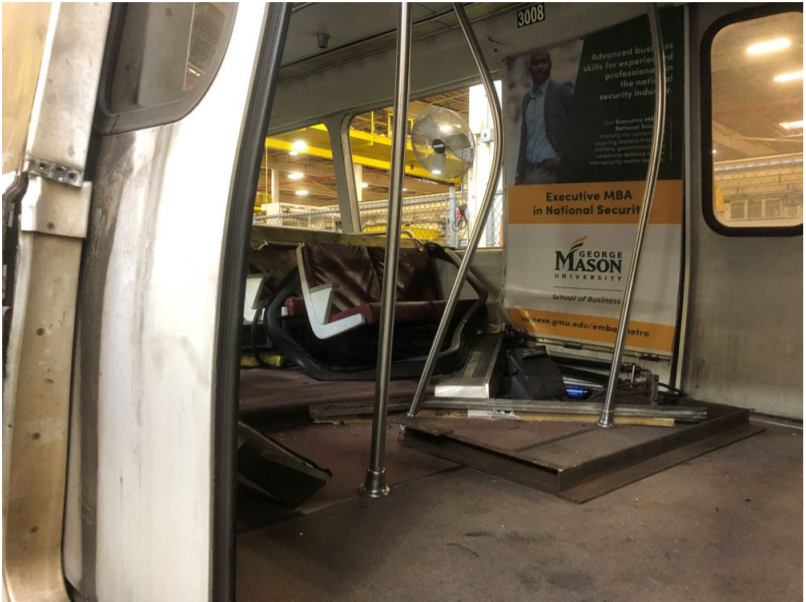
Six of the 12 Metro cars involved in the collision were damaged badly enough that Metro will need to replace them. The replacement cost and cost of repairs to the other cars could be upward of $12 million.
The downtown tracks for the blue, orange, and silver lines were especially busy that night, with trains heading back to the railyards or taking passengers home from a Nationals playoff game.
The crash occurred when one train, moving at 11 miles per hour, struck a stationary train about 600 feet outside of the Farragut West station. Two cars of the stationary train detached from each other. Car floors and ceilings bent and buckled, and ventilation, propulsion, and coupler systems were damaged. At least one train car hit the top of the tunnel.
Both train operators were injured in the crash and taken to the hospital for treatment. It took D.C. Fire and EMS about 20 minutes to arrive on the scene after Metro’s Rail Operations Control Center notified them, according to the commission report.
‘A Preventable Collision’
The commission previously found that the crash happened immediately after the operator of the striking train moved it without permission from the ROCC. At the time, the striking train was under a “zero speed command,” which requires trains to stay put unless given the green light by the ROCC — and then only proceed at speeds less than 15 miles per hour.
The final report says the striking train accelerated three times above the 15 miles per hour limit, which triggered automatic braking. The train was accelerating again when it hit the other train. The operator, whose name has not been released, failed to immediately report the accident.
The operator had been working in the role since August 2005. In 2006, the operator was demoted to driving for Metrobus because of several safety violations, but returned to operating trains in 2010. The operator was suspended in 2011 and twice in 2015 over safety issues like running through a red signal and failing to report a station overrun.
Phone records indicate that the operator’s cell phone was in use during the collision. The train operator made false statements in interviews during the investigation, and has since been fired.
“This was a preventable collision that could have resulted in a devastating outcome,” the report concludes.
The report also raised questions about how fatigue might have affected the train operator’s performance. The operator reported getting less than six hours of sleep the night before, and had been called in to work seven hours earlier than expected that day to help with the train movements following the baseball game. Exhaustion from irregular hours has been a concern raised in other commission safety reports.
Culture And Training Issues
Following the crash, Metro issued an internal document, “Collision Due to Carelessness and Bad Habits,” to share lessons learned, especially what the proper procedure for train operators is under a zero-speed command.
But commission CEO David Mayer said the October 7 crash is illustrative of “a long-term failure to address the unauthorized movement of trains with zero speed commands.”
Metro is in the process of making some improvements to its technology to help prevent such operator errors in the future. Its 7000-series cars include train “mode awareness” software, which requires the train operator to acknowledge that the train is moving under a zero-speed command before proceeding. Metro plans to install the software on the older cars in its fleet.
The safety commission has also looked at other culture and training issues within Metro. A track audit earlier this year identified issues “related primarily to inconsistencies in procedures and forms distributed to personnel, shortfalls in conducting certain types of inspections, and the need for improvements in job-specific training.” The commission has now approved Metro’s plans to correct those deficiencies, but will continue to play an oversight role as Metro implements them.
The safety commission has also been investigating a December 2019 smoke incident on the Red Line, during which “dangerous dysfunction in the Rail Operations Control Center (ROCC) was reminiscent of the major problems during the 2015 smoke event near L’Enfant Plaza that resulted in a fatality,” according to the commission’s 2019 safety audit of Metro.
During the incident, the audit said, “[ROCC] managers appeared to be routinely negating the written procedures that controllers were attempting to follow.” That had consequences: “Choosing not to use required checklists contributed to dozens of riders being stuck in a slow crawl back to a station platform to avoid a fire,” the audit said.
The safety commission says it is still working with Metro to approve plans to fix problems in the ROCC. The commission’s chief operating officer, Sharmila Samarasinghe, said the agency’s fixes so far have not met with the commission’s full approval.
“We remain concerned that their proposed corrective action plans fall short of what is required to create substantive and lasting change,” she said at the commission meeting.
“Both the October 7 collision and December 10 Red Line fire response show there is more work to do – and how important it is that WMATA continue to embrace our oversight and the transparency we seek,” the commission’s 2019 audit read.