Margaret Barthel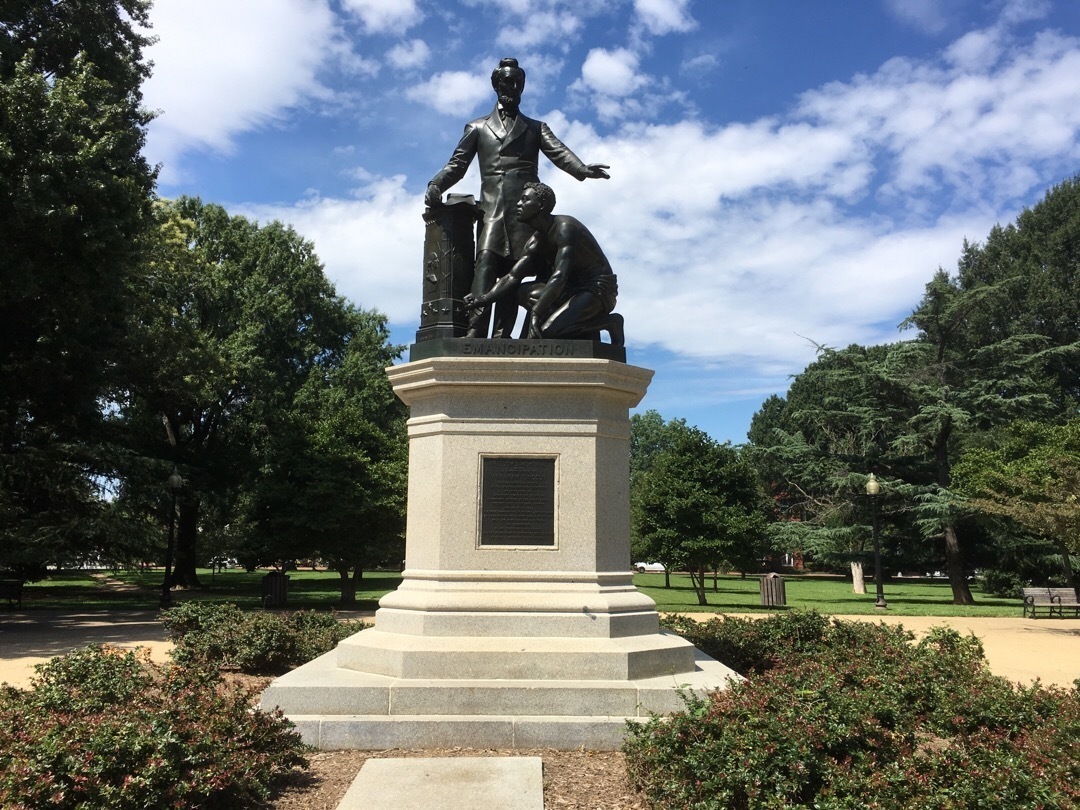
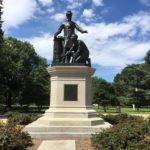
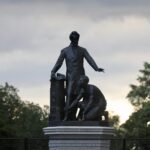
More than 2,000 people have signed a petition to remove the Emancipation Statue from Lincoln Park on Capitol Hill. The statue shows the 16th president towering over a freed enslaved person who is kneeling with broken shackles on his wrists — a depiction with “degrading racial undertones,” the petition said.
While Lincoln is a significant figure and “worthy of memorializing,” the petition said, “This statue … perpetuates the idea that we are beneath white people and should simply be grateful for the scraps that have been thrown our way.”
The petition was started by Marcus Goodwin, a candidate for an at-large seat on the D.C. Council and posted on Thursday. Goodwin says it’s not an accident that he chose this week to get the word out.
“This Juneteenth, I want us to send a message that this type of symbol represents the philosophy of racial superiority that we should be removing from society,” he wrote in the petition.
Juneteenth, which is recognized as a holiday in 46 states and the District, marks the official end of slavery in the United States. It commemorates the day in 1865 that the Union Army arrived in Galveston, Texas, and informed Texans that enslaved people in the state were now free, according to Lincoln’s 1862 Emancipation Proclamation.
This year’s Juneteenth came as protests against police violence and racism continue in D.C. and across the country, and as the impact of the COVID-19 pandemic falls disproportionately on Black people and other communities of color.
Goodwin, who spoke to DCist/WAMU while at a protest at Black Lives Matter Plaza, said he wants reexamination of the Lincoln statue to be part of “this wave that people are riding, of social and economic justice.”
“I don’t think at a time in American history, we’ve had this much time to sit at home, think about our place in the world, what kind of society we’ve created around ourselves and how we operate within it to make it a better place for all people,” he said.
He sees taking down the statue as part of reenvisioning what a more equitable society might look like.
“When we saw the terrible acts a few years ago in Charlottesville, the first action that was taken to make the next step forward in society with taking down the Confederate monument,” he said. “We have that opportunity here in D.C.”
Goodwin and the signatories on the petition are not the only ones who have expressed frustration over the statue’s subservient image of a formerly enslaved person. Goodwin was inspired by a similar petition started recently in Boston, which has a copy of the Emancipation Statue. That petition has more than 11,000 signatures, and Mayor Marty Walsh has said he’s open to moving it.
“I’ve been watching this man on his knees since I was a kid. It’s supposed to represent freedom but instead represents us still beneath someone else,” wrote Tory Bullock, author of the Boston petition.
When he heard about the Boston effort, Goodwin, a native Washingtonian, went to Lincoln Park to examine the original statue for himself. “You really see when you get that close to it … just how terrible the positioning is of the freed slave,” he said.
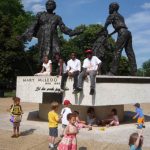
With a boost from a friend, Goodwin stood up on the statue. A photo of him standing tall next to the Lincoln figure tops the petition.
“I took a few photos just signifying the kind of positioning that we think Black people in society today should hold among anyone, even monumental presidents — standing up proud and in a really empowered position,” Goodwin said.
Goodwin’s petition joins another effort by locals to raise the money to change the statue, as NBC4 reported earlier this week.
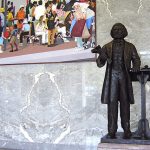
Criticism of the statue isn’t only contemporary, either. Frederick Douglass, who delivered the keynote address to a 25,000-person crowd at the statue’s unveiling in 1876, felt that it “perpetuated negative stereotypes about African Americans,” according to a post on the National Park Service website.
The funding for the statue was raised by formerly enslaved people, many of them Black veterans, after Virginian Charlotte Scott donated the first $5 she earned as a free person to create a memorial to Lincoln after his 1865 assassination. But, ultimately, the money — and artistic direction of the statue — was managed by white people.
That history is significant to Goodwin.
“I struggle to imagine that that’s the best, most positive representation that they could have hoped for,” he said. “So I want us as their descendants — them being my ancestors — to know that in our best interest, we’d like to see a change.”
A statue of African-American educator and leader Mary McLeod Bethune — the first statue of a woman and an African American on public park land in D.C. — also occupies Lincoln Park. Goodwin said he’d like to see the space used to further memorialize her work or the work of countless Black Washingtonians in D.C. history.
“This city has culturally, socially, and economically been built on the backs of the backs of African-Americans, and we should have a city that’s reflected as such” Goodwin said. “For me, for my mother, my father, my grandparents and all other African Americans throughout this country who are the descendants of slaves who don’t forget that — who wake up every morning and see and understand and feel through the actions of others that they are in a position that they need to continue to work twice as hard to get half as far as other people — we need to have positive reinforcing imagery and representation that really pushes us forward in a positive manner.”
When complete, the petition will be presented to the National Park Service, which manages Lincoln Park.
Meanwhile, activists and the District’s lawmakers have been calling for the agency to remove the statue of a Confederate general on federal land in Judiciary Square for years. Because it was authorized by an act of Congress, NPS said that federal lawmakers would need to pass legislation to remove it. But at around 11 p.m. on Juneteenth, protesters pulled it down from its perch. Park Service employees removed it Saturday morning.