 Rachel Sadon
 Christian Zapata
For a period in the early 1990s and again in the wake of white supremacist violence in Charlottesvile in 2017, activists and city officials alike called for the removal of a statue of a Confederate general that stands in Judiciary Square. Those demands, which surfaced again in recent weeks, have been mired in federal bureaucracy—requiring Congressional approval to remove a monument that lawmakers authorized in 1898.
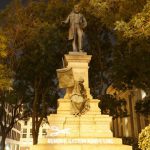
Protesters bypassed the official process entirely on Friday, June 19, scaling the 11-foot bronze statue of Albert Pike, wrapping it in chains, pulling it down, and setting it on fire. It is—or rather, was—the only public, outdoor statue in D.C. that honors a Confederate general (there are a number at the U.S. Capitol, though).
Amid a day of Juneteenth celebrations and continued demonstrations against racism and police brutality, the group of protesters marched past the Metropolitan Police Department headquarters before heading toward the corner of 3rd and D Street NW around 10 p.m.
Dozens of people gathered around the statue, which sits on federal land. As some protesters scrambled up, others guided them on where to attach the ropes, the Washington Post’s Perry Stein reported. Police officers surrounded the area but did not seem to interact with demonstrators, according to social media accounts.
Initial attempts to bring the statue down were unsuccessful. Still, a group demonstrators persisted, chanting “Hands up, fight back.” At 11 p.m., after repeated efforts, protesters managed to topple the monument, which landed with a thunk as demonstrators rejoiced. It was set on fire shortly thereafter. As the statue burned, the crowd chanted “No Justice, no peace.”
And protesters just toppled the Albert Pike statue in DC pic.twitter.com/gEzJm0OYjd
— Perry Stein (@PerryStein) June 20, 2020
BREAKING
🚨
: ALBERT PIKE STATUE TORN DOWN. Protesters converged on Judiciarw Square in the District to tear down this stature of a confederate general @fox5dc pic.twitter.com/CHXucC4Gzi— Ike Ejiochi (@IkeEjiochi) June 20, 2020
In a tweet addressed to Mayor Muriel Bowser, President Donad Trump scolded D.C. police’s response to the incident and said protesters should be arrested immediately, calling it a “disgrace” to the country.
It was not clear if any arrests were made in relation to the toppling of the statue. D.C. police did not return an immediate request for comment.
Recent protests have involved the removal of Confederate statues in cities across the country–both authorized and unauthorized—and reckonings over street names, schools, and other public sites. The monument in D.C. commemorates Pike’s contributions to the Freemasons, rather than his role in the Confederacy, but many believe he has no place being publicly honored.
“It doesn’t matter that he’s not being honored as a Confederate general. He still has a long history of supporting racist causes,” said the organizer of one 2017 rally against the monument.
As DCist previously reported:
Pike convinced and led a number of Native American tribes into battle on behalf of the Southern cause, losing badly at Pea Ridge. Facing charges of misappropriating funds and allowing his troops to scalp Union soldiers, he fled the Confederate Army and mailed in his resignation. Eventually, Pike was arrested and charged with treason. Later, he was tried for the same crime by the United States—making Pike an accused traitor in the eyes of both governments. The Confederates essentially let it go, and Andrew Johnson gave him a pardon.
After the war, Pike spent time in Tennessee, where some allege he fell in with the Klu Klux Klan and helped form their rituals, though hard evidence does not exist for the claim. Whether or not he was a bona fide KKK member, Pike was certainly once a member of the nativist Know-Nothing American Party and an avowed racist.
In addition to practicing law and writing poetry, Pike became a very active member of the Freemasons. He authored the Morals and Dogma of the Ancient and Accepted Scottish Rite of Freemasonry in 1871, and remains a revered figure among Freemasons.
The monument in Judiciary Square was the site of weekly protests in 1992 organized by followers of Lyndon LaRouche. Then At-large D.C. Councilmember Bill Lightfoot introduced legislation calling for its removal, which was echoed by lawmakers in other cities.
But eventually, it “kind of faded away,” Lightfoot previously told DCist. “Back then, we were still dealing with the crack cocaine epidemic, we were the murder capital of the country … so we were dealing with more pressing immediate concerns.”
There was a renewed push in the wake of the Unite the Right rally, which prompted a similar national reckoning about monuments to the Confederacy.
Mayor Muriel Bowser, Attorney General Karl Racine, and more than half the D.C. Council joined activists in calling for its removal. A spokesperson for the Freemasons, which originally paid for the statue, told DCist at the time that the group wouldn’t oppose efforts to take it down.
Ward 2 Councilmember Jack Evans even went so far as to find a crane operator. But a lawyer for the National Park Service told Evans that it would be illegal to remove without approval from Congress.
D.C. Delegate Eleanor Holmes Norton introduced a bill to do so in 2017, and reintroduced it in 2019. But on Juneteenth 2020, protesters decided not to wait any longer for lawmakers to act.
Previously:
D.C. Councilmembers Want Statue Of Confederate General To Come Down, But Congress Is In Their Way
Mayor, D.C. Councilmembers Want Statue Of Confederate General On Federal Land Removed