Elliot C. Williams
As locals and visitors marked Juneteenth with celebrations, demonstrations, and service across the region on Friday, the evening ended with a bang — a “thunk,” really — as a group of protesters tossed ropes and chains around the Albert Pike statue in Judiciary Square, tore it down, and burned it.
Cheering and shouting “Black lives matter,” the protesters toppled the 11-foot statue of the Confederate general, an avowed racist and accused traitor by both the Confederate and United States governments. Dedicated in 1901 by the Freemasons, the statue has been in the crosshairs of activists and local leaders for years.
The official process came to a forceful end on Friday night, at least temporarily, as report after report — from Axios to the Associated Press, the Washington Post to a CBS affiliate in Las Vegas — captured the removal of “the only Confederate statue in the nation’s capital.”
But the Pike statue is a far cry from the only such monument in the nation’s capital. There are currently 11 statues dedicated to former Confederate soldiers and officials that still stand within the Capitol grounds — some, just feet from the House chamber.
(The Post has since updated its story to clarify that the Pike monument was the only “outdoor” statue depicting a Confederate general.)
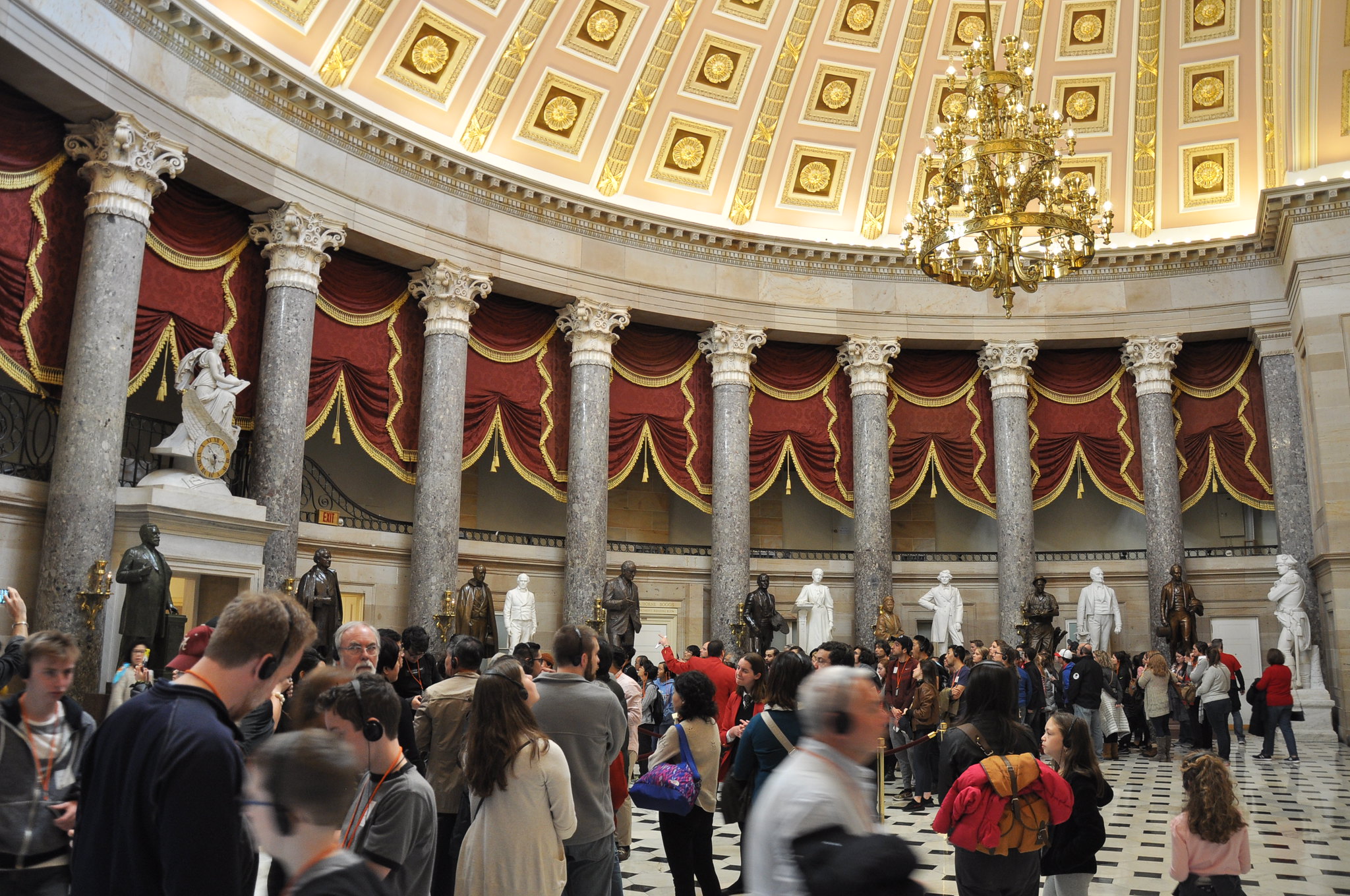
These statues, in bronze and marble, range from Jefferson Davis and Alexander Stephens, president and vice president of the Confederacy (both charged by the U.S. with treason), to former Confederate general and South Carolina Gov. Wade Hampton III, one of the country’s wealthiest plantation owners.
As the New York Times noted five years ago: “There are few places where those symbols are in more abundance than at the United States Capitol, where millions of tourists flock each year to take in the living history of America.”
Each state is allowed two statues in the Capitol’s National Statuary Hall Collection, established in 1864.
Most of these statues are located in the National Statuary Hall near the Rotunda or the Capitol Visitor Center. Pelosi, however, moved Confederate Gen. Robert E. Lee’s statue to the subterranean Capitol Crypt during her first term as speaker. (Of note: While the Crypt sounds dungeon-like, it’s actually a well-lit area beneath the Rotunda and one of the most heavily used spaces in the building.) Hampton’s statue was also moved from the Statuary Hall to the visitor center.
The Lee statue is one of the two statues representing Virginia in the Capitol Building and has been there since 1909. However, in July, a state commission voted unanimously to remove the statue of the Confederate leader, a decision Virginia Gov. Ralph Northam backed. In December, the same commission recommended that the state replace the Lee statue with a rendering of Barbara Johns, who led a 1951 school walkout protesting unequal segregated schools in the town of Farmville. Johns’ protest became the basis for one of five cases examined by the Supreme Court in its landmark Brown v. Board of Education ruling. The Virginia General Assembly will have to approve the recommendation.
(Update: The Lee statue was officially removed from the Crypt in the early morning hours on December 21.)
As protests over police brutality and racism against Black Americans have spread nationwide following the killing of George Floyd in Minneapolis, Democratic lawmakers in Congress stepped up their efforts to remove these statues from the seat of the country’s legislative branch.
In June, House Speaker Nancy Pelosi renewed her calls for removing Confederate statues at the Capitol, and leaders of the Congressional Black Caucus introduced legislation to do so. A similar bill, introduced by Sen. Cory Booker, was blocked by Republican Sen. Roy Blunt.
Pelosi also ordered the removal of Confederate portraits in the Capitol, per the New York Times, writing to the clerk of the House on the eve of Juneteenth: “As I have said before, the halls of Congress are the very heart of our democracy. There is no room in the hallowed halls of Congress or in any place of honor for memorializing men who embody the violent bigotry and grotesque racism of the Confederacy.”
Similar efforts are taking place around the region, too. In Virginia, Gov. Ralph Northam has pushed to remove the Robert E. Lee statue in Richmond, where Confederate statues have been defaced and the headquarters of the United Daughters of the Confederacy was set ablaze. That effort was recently temporarily blocked by a judge. In Maryland, a plaque honoring Confederate soldiers will be removed from the Maryland State House.
And in the District, thousands of people have signed a petition calling for the removal of the Emancipation Statue in Lincoln Park due to its “degrading racial undertones.” (The statue depicts President Abraham Lincoln towering over an enslaved person, crouching with broken shackles on his wrists.) Two bills to diversify the District’s statues and review its street and school names have also been making their way through the D.C. Council this year.
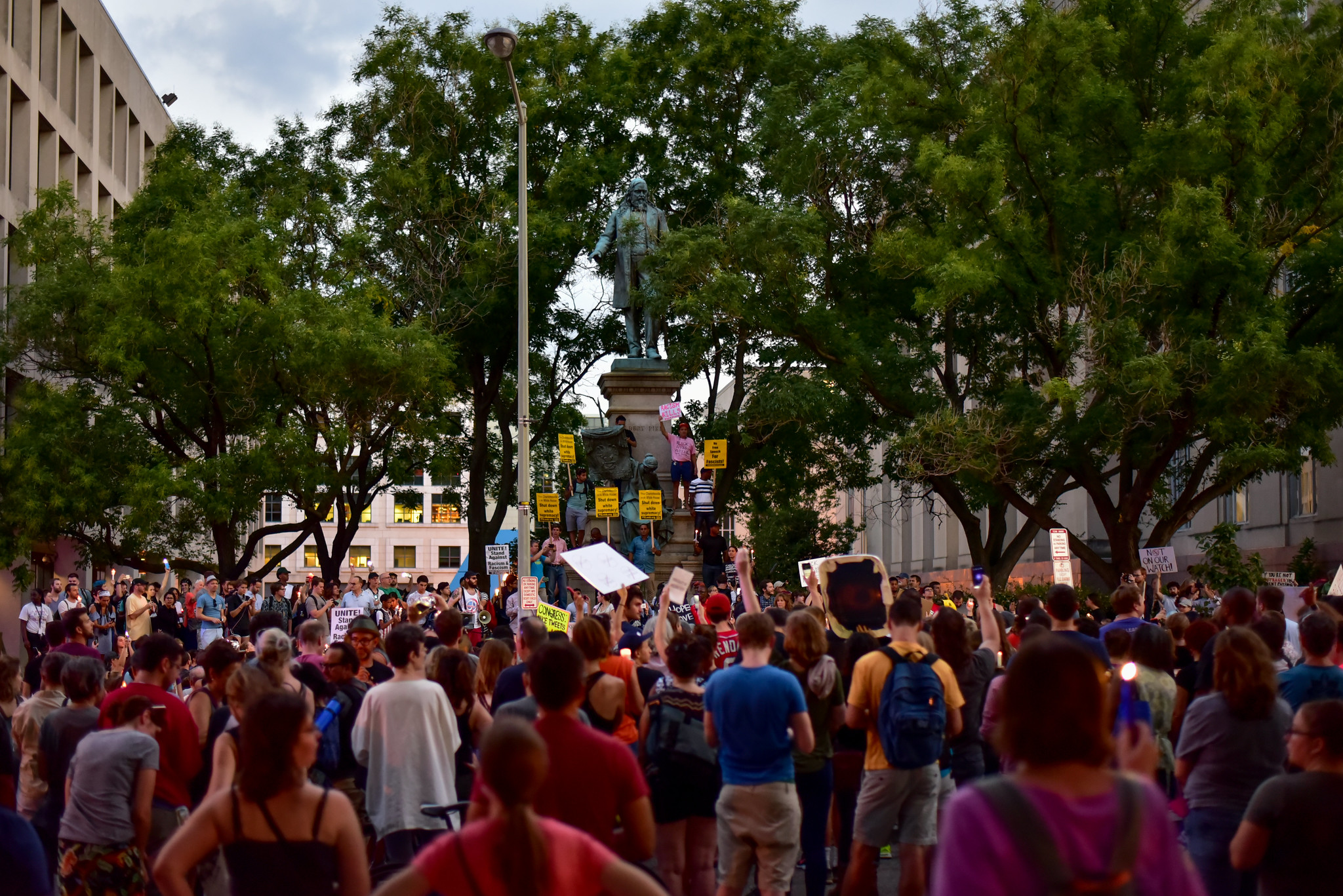
The news reports about Friday night’s action in D.C. weren’t totally off, though. Albert Pike statue was the only outdoor public monument to a Confederate general in D.C. It stood just blocks from the Capitol building and feet from the Metropolitan Police Headquarters, on federal land, for more than a century.
There was a push to remove it in 2017, as the Unite the Right rally in Charlottesville prompted a national reckoning over monuments to the Confederacy. The Freemasons gave their approval to take the Pike statue down, and one lawmaker even had a crane operator ready to go.
But because it was originally authorized by federal lawmakers, removing the monument legally would require another act of Congress. (The National Park Service told former Ward 2 Councilmember Jack Evans that he or the crane operator would be arrested if they attempted to remove it. “One of my ideas was to get all 13 councilmembers to go down and then they could arrest all 13 of us,” Evans said at the time.)
D.C. Del. Eleanor Holmes Norton introduced legislation twice to take Pike down from his perch, but it never passed.
On Saturday morning, the National Park Service hauled away the burned, graffitied, toppled statue with a flatbed truck.
For now, the statue will reportedly sit in a maintenance facility. NPS spokesperson Mike Litterst tells DCist in an email that the fallen statue was removed to “ensure public safety at the site” and that the agency will “work to determine next steps in the near future.”
In a statement to DCist, the Park Service said it recognizes that some statues under its care represent “controversial figures and painful chapters” of U.S. history, but that it preserves the memorials as “features of a historic landscape.”
“We are committed to telling the larger story behind these memorials and to encouraging dialogue and reflection on their legacies today,” NPS said. “The NPS has determined, unless Congress directs otherwise, that commemorative works, including Confederate monuments, will not be altered, relocated, obscured, or removed, even when they are deemed inaccurate or incompatible with prevailing, present-day values.” (In 2017, NPS officials told DCist that historians had no record of the agency ever removing a monument or statue from the federal parks system.)
Still, the policy doesn’t provide insight on what the agency is to do when protesters take matters into their own hands.
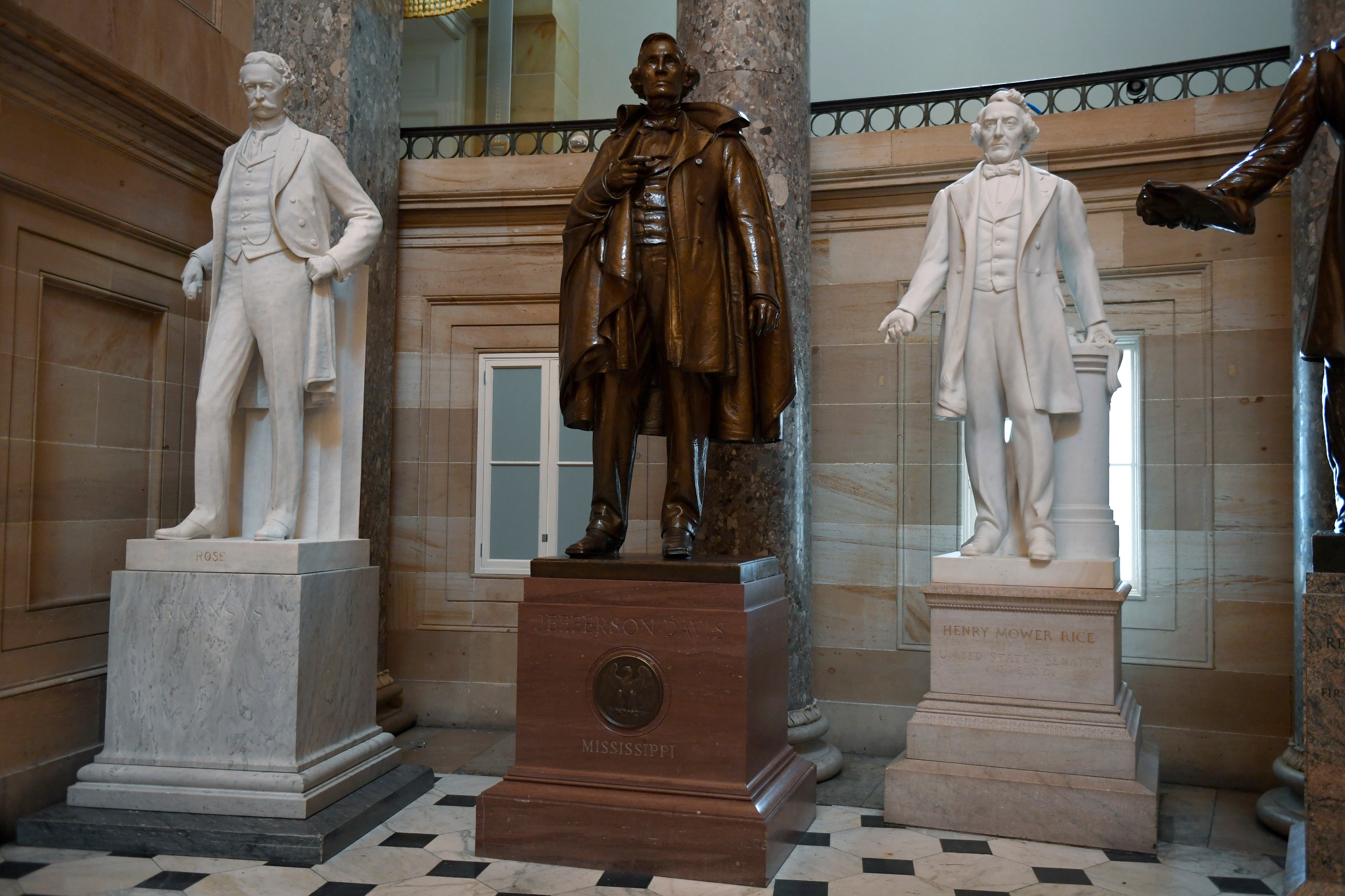
As far as the U.S. Capitol goes, the inclusion of the Confederates in the National Statuary Hall Collection took place in the early 20th century, part and parcel of the Jim Crow era, as recounted in a lengthy history in the Atlantic.
In 1908, Virginia decided that one of its two statues should depict Robert E. Lee, prompting outrage particularly from Northern and Western states. Lee — depicted in full Confederate uniform — appeared at the Capitol a year later. The attorney general at the time was asked to intervene, but he instead sanctioned the decision.
Over the next 22 years, Southern states sent seven more statues to the collection. By the time that Mississippi sent James Z. George, a Confederate colonel, and Jefferson Davis in 1931, there was no longer much protest.
According to the Atlantic, the Davis statue “received a respectful unveiling ceremony led by Southern senators and Davis’s great-granddaughter. House and Senate chaplains gave benedictions. The U.S. Marine Band played patriotic songs. Mississippi’s Pat Harrison, who helped orchestrate the defeat of the Dyer Anti-Lynching Bill in a 1922 filibuster, had the gall to cast the Confederate statues’ arrivals as a healing moment for the nation.”
Today, many Republicans continue to defend the Confederate statues’ place in the Capitol in the name of states’ rights. “I think the appropriate way to deal with this issue is to stick with the tradition,” Senate Majority Leader Mitch McConnell said Thursday.
But over the last decade, some state leaders have taken the lead in replacing or working to replace the statues with inspiring women and people of color.
In 2009, Alabama replaced its statue of Confederate officer Jabez Curry with one of Helen Keller (though its statue of Joseph Wheeler, considered by Lee to be one of the best Confederate cavalry leaders, still stands in the Statuary Hall).
Meanwhile, D.C’s lack of statehood has historically left Washingtonians even symbolically underrepresented. The District finally got its first statue, of Frederick Douglass, in 2013. Earlier this year, Congress decided to accept D.C.’s second statue, of Pierre Charles L’Enfant, though it has not yet been unveiled. But neither will be considered a part of the official National Statuary Hall Collection.
When Philonise Floyd, George Floyd’s brother, came to Capitol Hill this summer to testify about police brutality before the House Judiciary Committee, he likely would have walked past Confederate Gen. Edmund Kirby Smith to get to the Congressional Auditorium. Florida is on its way to replacing Smith’s statue with prominent civil rights activist and Black educator Mary McLeod Bethune.
But statues aren’t everything. In his opening statement, Floyd called on lawmakers to do more than public displays in support of Black Lives Matter, to put up more than monuments.
“People of all backgrounds, genders and races have come together to demand change. Honor them, honor George, and make the necessary changes that make law enforcement the solution — and not the problem,” he said. “If his death ends up changing the world for the better, and I think it will, then he died as he lived. It is on you to make sure his death isn’t in vain.”
Previously:
Protesters Topple, Burn Statue of Confederate General Albert Pike In Judiciary Square
D.C. Councilmembers Want Statue Of Confederate General To Come Down, But Congress Is In Their Way
Mayor, D.C. Councilmembers Want Statue Of Confederate General On Federal Land Removed