 Jenny Gathright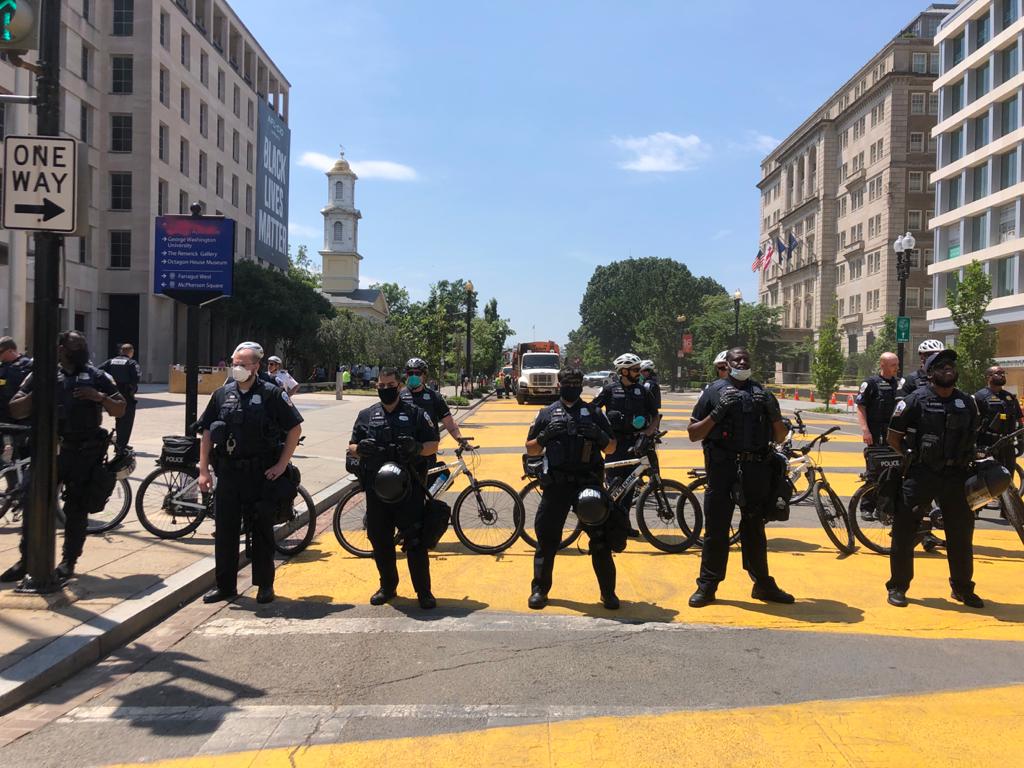
This is a developing story and was last updated at 6:43 p.m.
Demonstrators once again took to the streets in downtown D.C. on Tuesday, after police clashed with protesters in Lafayette Square and District officials cleared people from an encampment at Black Lives Matter Plaza.
Police blocked off streets around the square. About 75 police officers stood in a line on 16th and I Streets NW, as a small number of protesters gathered in front of them, some of whom were there overnight.
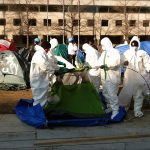
A group of about a dozen demonstrators affiliated with Earl’s First Amendment Grill, a pop-up restaurant for protesters that’s been operating by St. John’s Church for weeks, say they were forced out of their tents by police around 10 a.m. Tuesday.
They camped in their tents overnight, but said they didn’t get much sleep as the protests lasted into the wee hours of the morning.
The police presence downtown was significant; MPD officers were preventing public access to several blocks surrounding the White House and Lafayette Park. City employees arrived late Tuesday morning to sweep the streets and clear objects from the area in front of Lafayette Park and St. John’s Church.
Nahom Demoz, who’s been working at Earl’s for two-and-a-half weeks, said police didn’t give demonstrators a chance to collect their belongings when they forced them out of the area in front of St. John’s on Tuesday morning.
He said he waited for hours to get contact information in order to retrieve the items, and planned to stay in the area all day. The members of Earl’s Kitchen say they are determined to re-occupy the space again.
“The consensus is, we’re still gonna stand here and we’re not gonna be intimidated,” Demoz said.
Later on Tuesday, the city offered an explanation for the intervention by police and city officials.
Wayne Turnage, D.C.’s deputy mayor for health and human services, told DCist in an emailed statement, “We are always concerned when we have people staying in tents outside – it is not safe. It is also a serious concern if they are staying in tents in the middle of the road. Therefore, today, we deployed our interagency team to talk with the people staying on H Street and, eventually, to remove the tents.”
Howard L. Gardner, who also works at Earl’s, said he was pepper sprayed when police began forcing protesters away from the area on Monday.
Gardner said feeding protesters has become its own kind of demonstration.
“That was our movement, that was the way we protested,” he said. “By having a grill.”
Gardner said they’ve been feeding between 400 and 500 people a day for free, developing a sense of community through providing food for demonstrators, passersby and people experiencing homelessness. He said the business was “just helping the people.”
Leigh McAlpin, who ran a medical tent called the D.C. Aid Station outside St. John’s for three weeks, was also cleared out. She said police threw away thousands of dollars worth of medical supplies and other items on Tuesday morning. She says on Monday night, police were indiscriminate in using force on those gathered in front of the White House.
“I’ve still got a bruise on my stomach from where I got hit,” said McAlpin. “My arms are still burning from pepper spray. They pepper sprayed and tear gassed medics.”
McAlpin and her team initially set up the station to help protesters who had been tear gassed or had other medical needs during demonstrations.
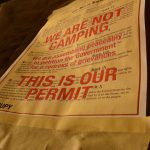
“We were filling a need, and people had come to depend on us and depend on us being there, and we’re all devastated that we can no longer be there, even though we have written permission from St. John’s to remain there.”
McAlpin said she and her team will rebuild, even if they have to move to another location.
Romulo Richardson, who said he had been consistently coming to protest for the last 23 days, called the scenes on Monday night and Tuesday morning, when police in riot gear used tear gas and batons on protesters, “horrific.”
He said he hoped that protesters and city leadership could have a discussion about maintaining H Street as a gathering space for activism. “One minute, it’s a place that we can come to protest. The next minute, you don’t want us here. Let’s get a plan together so that … there can be some type of compromise made.”
While McAlpin, Richardson, and others have been regulars at the protests, some attended Tuesday’s demonstration for the first time.
Paul Myers came up from Charlottesville, Virginia, to visit his sister and decided to come to Black Lives Matter Plaza. After arriving on the scene early in the afternoon, he found himself getting emotional, tearing up as he watched the line of police.
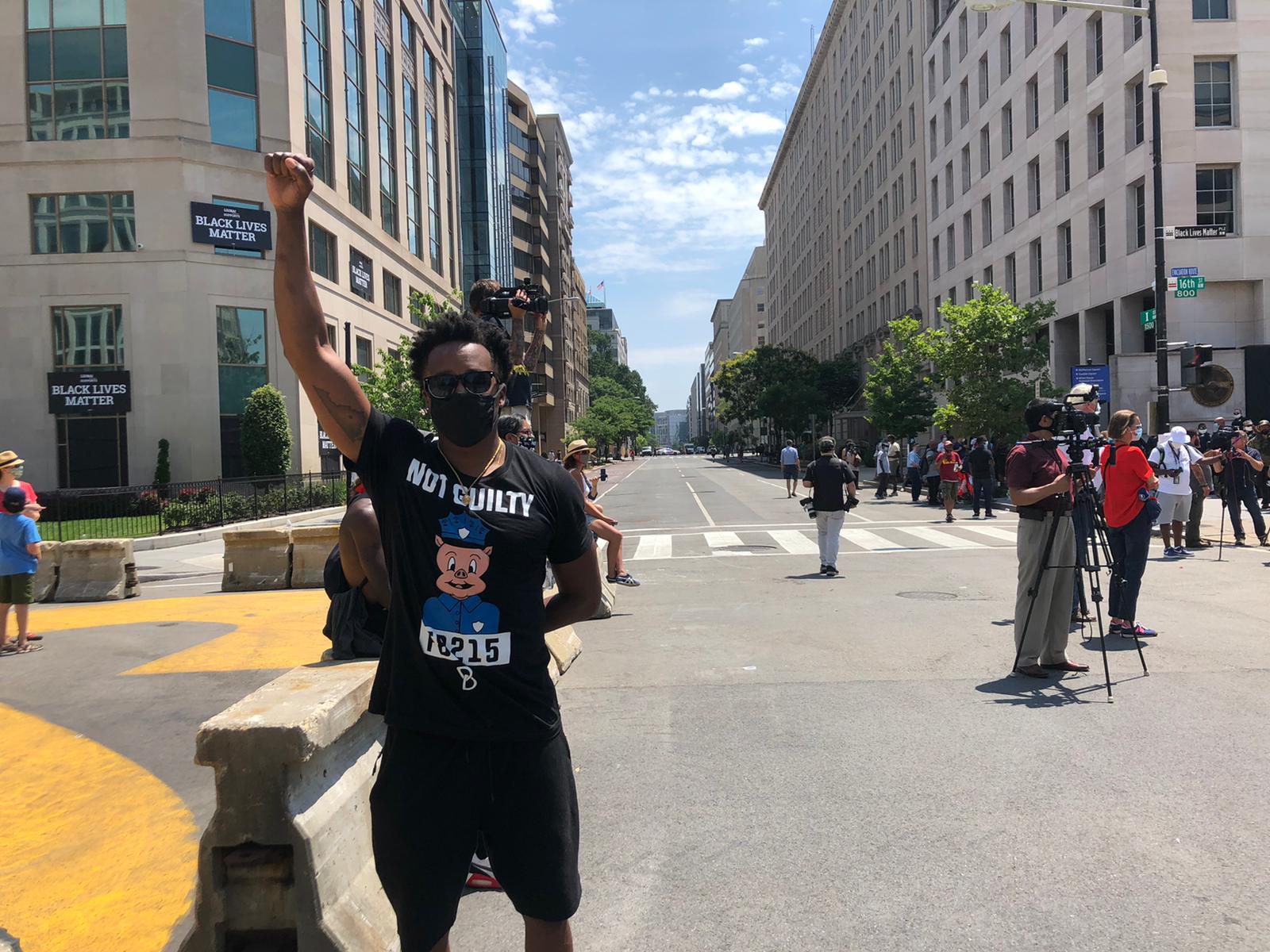
Myers, who is originally from New York, reflected on his own charged interactions with police over the years, and said he wanted a better future for his 3-year-old son.
“I’m here for the future. I’m here for the kids we’re raising, black, white,” he says. “You know, this has got to stop. I don’t want to raise my kid the way I was raised, with aggression.”
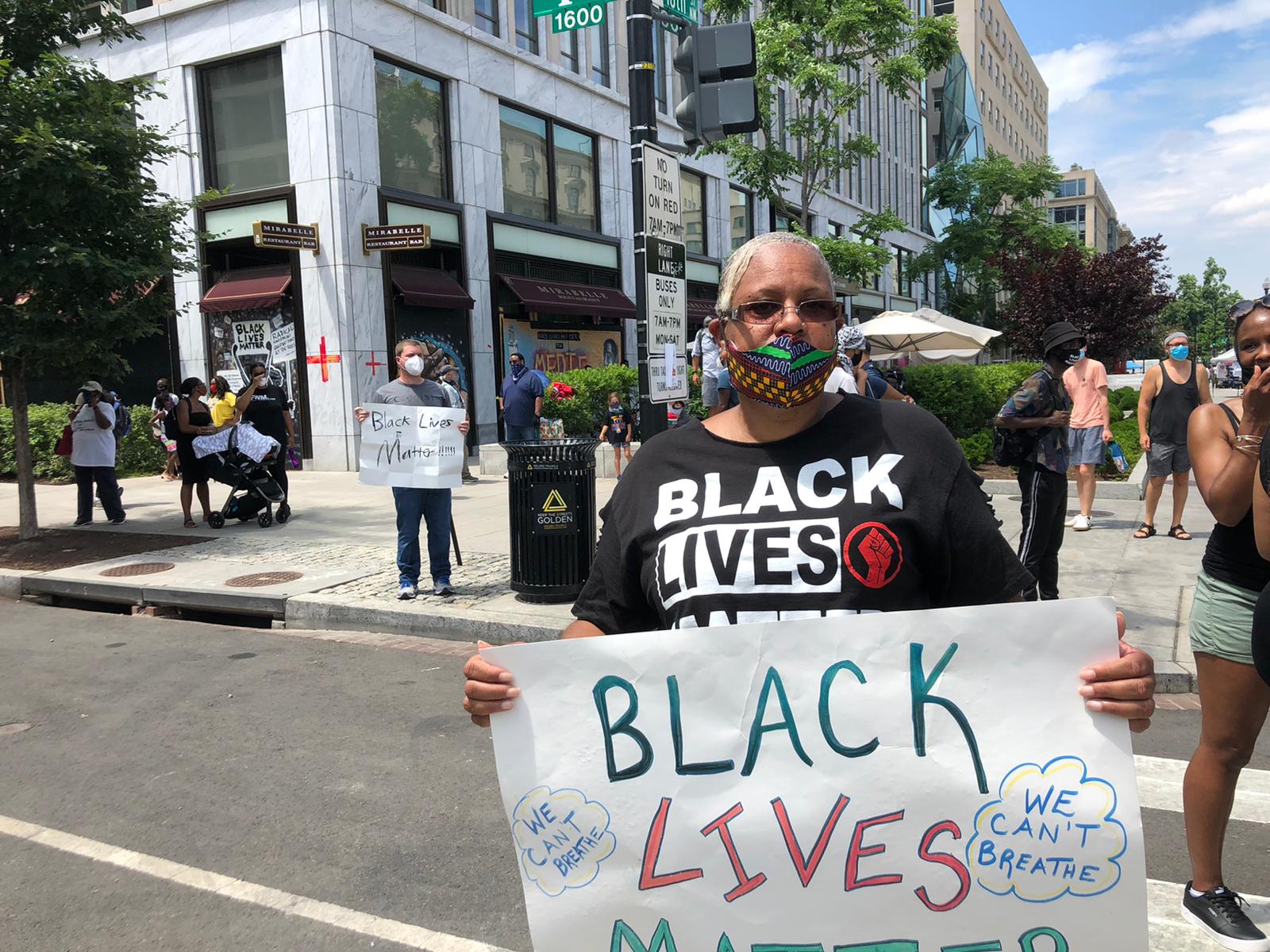
Michelle Griffin, a Temple Hills, Maryland, resident, brought her family to see Black Lives Matter Plaza, and was distressed by the line of police blocking the way. She said she was frustrated that the area had been closed following Monday night’s demonstrations.
Griffin and her family spent the first part of the day praying for friends, loved ones, and Black people across the country. They then planned to walk the length of the plaza, before they realized it was blocked off.
“That’s the White House,” Griffin said, “Why can’t we walk down there?”
Griffin had been to the plaza before and was able to walk the whole street. She wanted her family to be able to do the same.
“This is what’s wrong in America,” she said. “You won’t allow people to be free, and you stop us from doing what we should be allowed to do: walk down 16th Street.
She added, “We got to walk Black lives, but we didn’t get to walk matter.”
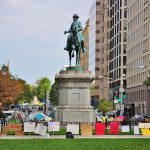
On Monday night, police cleared demonstrators from Lafayette Square after protesters scaled and tried to tear down a statue of former President Andrew Jackson. Police were seen firing pepper spray, and some protesters reported that officers hit them with batons.
The D.C. Police Union issued a statement on Tuesday, saying that several of its members were injured over the past 24 hours.
The Union also praised its members for being “professional and restrained” in their response to the demonstrations.
The Metropolitan Police Department told DCist in an email on Tuesday that officers working to clear the area with the city’s encampment response team gave three warnings via loudspeaker to remove any belongings.
The department said as police began to remove property, some protesters started throwing objects at police and tried to take their bicycles. MPD said four officers were injured, and two people were arrested and charged with assaulting a police officer.
Later, after police moved protesters from Lafayette Square, demonstrators gathered near Black Lives Matter Plaza and someone spray painted the letters “BHAZ” on the pillars of St. John’s Episcopal Church. The letters stand for Black House Autonomous Zone, referencing the Capitol Hill Organized Protest Zone, a self-declared an autonomous protest zone in Seattle.
On Tuesday morning, President Donald Trump responded by tweeting, “There will never be an ‘Autonomous Zone’ in Washington, D.C., as long as I’m your President. If they try they will be met with serious force!” (Twitter later said the tweet violated its “policy against abusive behavior, specifically, the presence of a threat of harm against an identifiable group” and limited how users can interact with the tweet.)
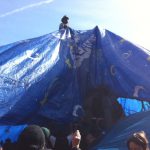
Earlier on Monday, police on bikes used chemical irritants to clear protesters from H Street NW, following a confrontation that broke out as officers were trying to clear tents there.
Police confirmed the use of pepper spray in an emailed statement to DCist.
The move came even after the D.C. Council passed emergency police-reform legislation by unanimous vote earlier this month, banning the use of tear gas and riot gear to disperse protesters, among other changes.
Ward 6 Councilmember Charles Allen, who introduced the bill, told DCist in an emailed statement that the bill was sent to Bowser on Tuesday and she has until July 7 to sign.
Allen said after discussions with council attorneys, it’s unclear whether the legislation’s language around tear gas would have applied on Tuesday. He’s calling for a public hearing on a permanent version of the bill to clarify those details.
“Still, we don’t need a hearing to know peaceful protestors should never be subjected to what we saw last night,” Allen’s statement read in part. “It is the kind of behavior that has drawn so many out to protest in the first place,” he continued.
Allen said the council and the public will review police actions during the protests, but believes the legislation will make a difference for residents in other, more routine interactions with police.
Monday’s confrontation marked the first major clashes between police and protesters in the area since demonstrations began three weeks earlier following the killing of George Floyd.
On June 1, federal law enforcement used chemical irritants to clear protesters from Lafayette Square so President Trump could take a photo outside St. John’s.
Protests have been largely peaceful since, though the city has seen tensions rise in recent days.
Over the weekend, protesters toppled and burned a statue of a Confederate general Albert Pike, a move that mirrored similar incidents in cities across the country.
Albert Pike, a move that mirrored similar incidents in cities across the country.
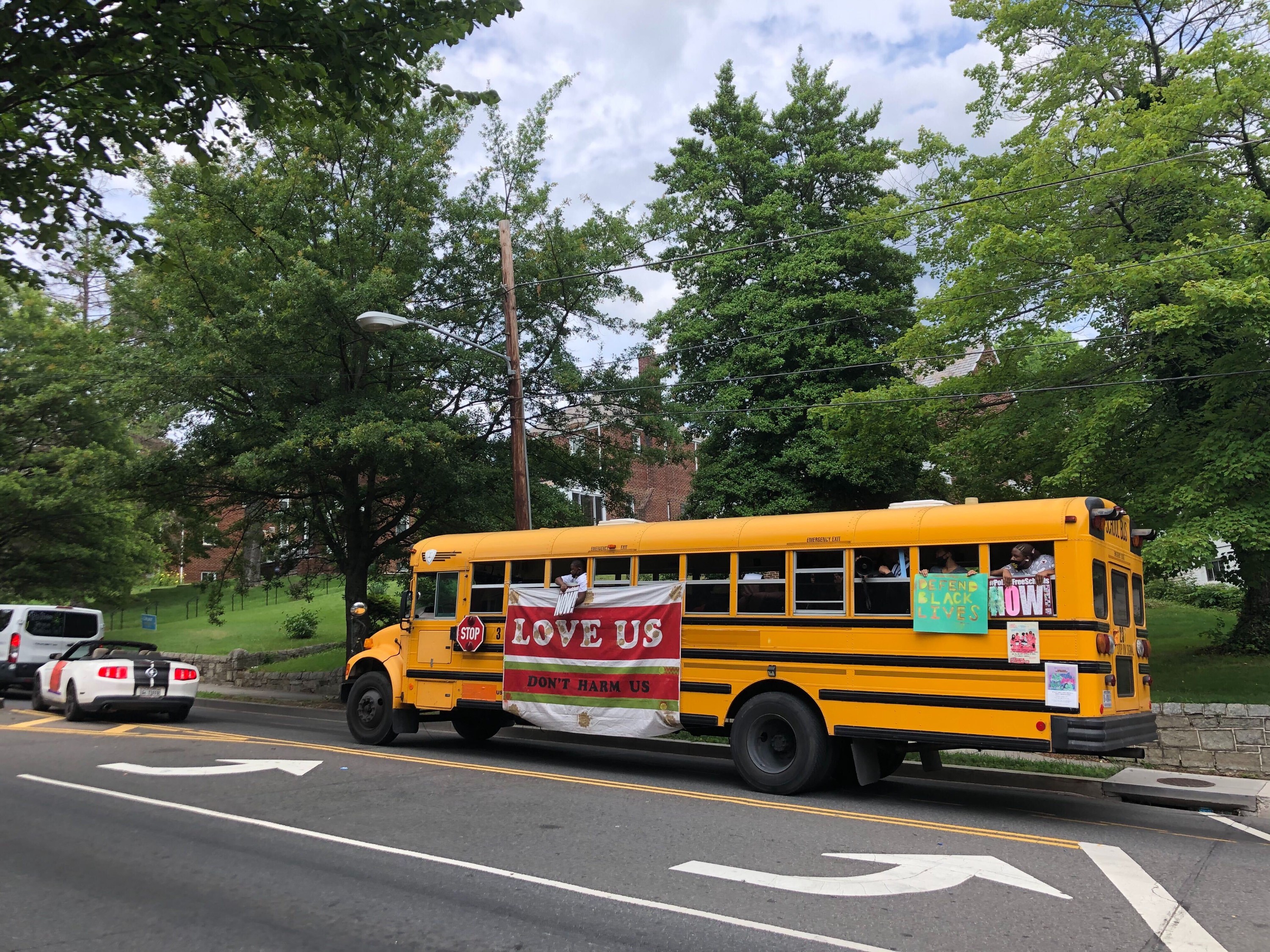
The downtown area in front of Lafayette Park was not the only location of activism on Tuesday. Organizers and young people with Black Swan Academy and Black Lives Matter held a caravan protest, demanding that all police be removed from D.C. schools. They stopped at D.C. Councilmember Vincent Gray’s house, and then moved on to the home of D.C. Council Chairman Phil Mendelson.
“We need therapists, not police,” they chanted.
Youth activists have highlighted the school-to-prison pipeline as a major concern and policy priority. At-large Councilmember David Grosso, who co-chairs the council’s education committee, told the Washington Post he may propose a change to the budget that would divert funds away from the school system’s police contract and toward more mental health support for students. Mendelson told the outlet that he does not support removing police from schools entirely, and he wants to examine available data before making a decision about budget investments in school policing.