Matt Blitz
The Washington NFL team this week began removing references to former owner and adamant segregationist George Preston Marshall from its website and physical spaces.
Spokesperson Sean DeBarbieri confirmed the news in an email to DCist, saying the removal began on Monday. ESPN reporter John Keim had tweeted the news earlier this morning.
The team will remove Marshall’s name from its website, as well as from the Ring of Fame, a list of worthy retired players and team luminaries placed in a ring around the inside of the stadium. His name will also be removed from the history wall outside the team’s practice facility in Ashburn, Virginia.
DeBarbieri also confirmed the team will be replacing Marshall’s name on the lower level seating section of FedEx Field with that of Bobby Mitchell, the team’s first Black player, and whom Marshall brought to the team only after the federal government forced his hand.
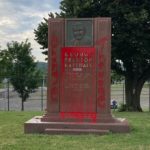
This comes only days after Events DC removed a monument dedicated to Marshall outside the team’s previous home, RFK Stadium, which someone had spray-painted “Change the name.” There has long been an outcry for the football team to change their name from one that is a racial slur. Marshall’s own granddaughter told the Washington Post in 2014 that she thinks the name needs to change.
The team’s owner Daniel Synder has continued to refuse to do so, however. But that momentum may be swinging. Earlier this month, D.C. Mayor Muriel Bowser said it was “past time” for the name change, particularly if the team has any interest in moving back to the city. At-Large Councilmember David Grosso repeated his 2013 demand that the team’s name be changed and recommended the alternative of the “Washington Redtails.”
Marshall obtained what is now the Washington football team in 1932, when it was a Boston team, and moved it to D.C. five years later. For decades, Marshall refused to employ Black players on his team—making it the last one in the league to integrate. This left the team not only at a competitive disadvantage, but in violation of federal law in that any party contracting with any public facility could not discriminate in hiring based on race, creed, color, or national origin.
In 1961, the United States government—including Attorney General Robert F. Kennedy—issued an ultimatum to Marshall that, if he didn’t immediately start employing Black players, they could pull the team’s lease to play at the publicly-funded D.C. Stadium (later renamed RFK Stadium after Kennedy). Marshall’s response: he would obey the law by hiring “Eskimos or Chinese or Mongolians.”
Finally, the feds won out and Marshall traded for Mitchell and drafted two Black athletes, Joe Hernandez and Ron Hatcher. At the contract-signing press conference, Marshall refused to take a photo with Hatcher.
Marshall died in 1962. In his will, he barred money from his estate to go towards “any purpose which supports or employs the principle of racial integration in any form.”
Over recent weeks both nationally and locally, statues, monuments, and other items honoring Confederates and racist figures have been coming down fueled in large part by protests in the wake of the murder of George Floyd.
In D.C., protesters tore down and burned a statue of Confederate General Albert Pike in Judiciary Square last week, and attempted to do the same to a statue of former president Andrew Jackson in Lafayette Square on Monday. The Minnesota Twins, meanwhile, removed a monument dedicated to former owner Calvin Griffith, who also owned the former Washington Senators owner Calvin Griffith was also removed. In the late 1970s, he made racist remarks about D.C. baseball fans.