Margaret Barthel
Parents in the region are facing tough choices about how their children will attend school next year as they weigh the learning needs of their kids, with the ongoing public health crisis caused by the coronavirus pandemic.
Some school systems are asking parents to make a binding choice between in-person or online learning, or a mix of the two. In Fairfax County, officials are posing those two options for families, with a July 10 deadline for the decisions. It’s uncharted territory for one of the nation’s largest school systems — and for parents, too.
“Obviously, this is a challenging time for everybody, with choices that we haven’t had before and ways of doing things that we haven’t done before,” said FCPS Superintendent Scott Brabrand.
“This is not a normal year,” he says. “That’s a complex task.”
In the first option, Fairfax County parents can request at-home, all-online learning for their children for the full year, regardless of the reopening status of the school system, county, or state. Students would have scheduled online learning time four days a week, and one day a week of independent work time. FCPS says it will try to arrange for elementary and middle school students to stick within the same circles and have dedicated online-only staff. High school students would take a combination of Virtual Virginia, Online Campus and FCPS online classes.
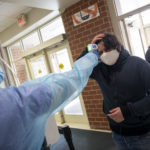
In the second option, parents can send their children back to physical school for some amount of in-person learning, with the rest completed online. Information on the FCPS website gives an example schedule of two days per week in school, and the other three at home. The system also says it will implement federal and state social distancing and public health guidance to keep students and staff safe, with health screenings, enhanced cleanings of buildings, strict school bus capacity limits and seating changes to ensure students and staff stay six feet apart as much as possible.
Faced with the two options, some parents say they don’t have enough information to make such a decision — one that will affect their child’s learning for an entire school year, and their family’s health, too.
‘I’m Pretty Torn Up About It’
When FCPS rolled out the two reopening options last week, questions from parents and staff started rolling in to the Fairfax County Special Education Parent-Teacher Association Facebook page, according to Diane Cooper-Gould, the group’s advocacy chair. The group represents the interests of the tens of thousands of students with special needs and their families. Fairfax’s SEPTA put up a Google form to collect questions; within hours, they had more than 300 questions on the list.
“The needs run the gamut and the desires by the families run the gamut,” she says. “So for every person who wants to be in school five days, just like normal, there’s another person who wants everything to be all virtual.”
Cooper-Gould says SEPTA submitted an edited version of the list of questions to FCPS. The organization is also calling on FCPS to not require parents of children with special needs to make a binding choice on the return to school by July 10.
“If the system can’t explain how they’re going to implement the services for these children, who are some of our most high-needs kids, then how can parents make a reasonable decision by July 10 when you have no idea what services will look like in either setting?” she asks.
The SEPTA questions, reviewed by WAMU, are wide-ranging, covering everything from how the school district will implement social distancing and public health practices to how it will support special needs students.
Cooper-Gould wonders how student individualized education plans, or IEPs, will fit into the two options, and what flexibility there is to make changes to a student’s learning environment to suit their plans in the middle of the year. (An IEP is a document created by the school and parents that guides the learning plans of students with special needs.)
“Forcing parents to choose for the entire year is somewhat counter to the spirit of an IEP,” she says. “It’s a living document.”
Brabrand says the July notice is important to give officials time to plan.
“We’ve asked parents to make a commitment for a year … to really make sure that we can have the staffing to support the online option throughout the year,” Brabrand says. Without the firm year-long commitment, he worries parents might try to switch to an in-school option midway through the year, which would take away staff from the online-only students.
Brabrand says the school district will host a town hall on July 6 to attempt to answer as many parent questions as possible as families weigh their options.
Cooper-Gould acknowledges the staffing and logistics challenges facing the school system, but she’s still worried about making a decision without enough information. She has a medical condition that puts her at greater risk for COVID-19, and she’s the mother of two children with individualized learning needs — one who has thrived with online learning, and the other who she believes would benefit from a return to in-person instruction.
“I feel a little bit like I’m gambling between my health and my survival and my kids getting services,” she says. “I am wringing my hands and I do not know how I could possibly make a decision with a lack of information out there right now. And I’m pretty torn up about it.”
Right now, she’s leaning toward electing for partial in-person instruction. But before she makes the final decision, Cooper-Gould hopes FCPS will provide more information about the vendor for online instruction and the schools’ plans for contact-tracing if someone gets sick.
And parents aren’t the only ones wondering about the implications for in-person learning. The three major professional associations for teachers in Fairfax County pushed back against the plans to offer the option of a few days of in-school instruction, the Washington Post reports. In a joint letter, the associations called on their membership to select the distance learning option on a county survey of educator preferences.
Seeking Input On The New Normal
While Fairfax County Public Schools is one of the first systems in the region to release reopening plans, other counties have also rolled out plans or surveys about family preference for the fall.
Loudoun County Public Schools recently put out a similar plan for partial in-school instruction, provided that Virginia enters Phase Three of its reopening by the time students return. Arlington County Public Schools will also offer families a choice between a hybrid learning model and full virtual education in the fall. Families have until July 20 to choose between the two learning models.
Other schools and school systems are also asking parents to provide feedback on their experiences with distance learning so far. D.C. Public Schools surveyed parents last month, but the system hasn’t released its plans for the school year. KIPP D.C. charter schools also collected parent feedback, and will provide an all-virtual learning option for the upcoming year, which families can select early next month.
In Maryland, Montgomery County Public Schools is asking parents to fill out a survey — which is available in seven languages and asks for ZIP code and demographic information — with their preferences for the school year by July 8. MCPS Spokesman Derek Turner says the results will help inform how MCPS ultimately designs its school offerings for the fall.
“Given that we are in a whole new world, it’s important for our stakeholders to to lend their voice to the conversation as we grapple with a decision for the fall,” Turner says.
The survey asks parents questions about remote learning, childcare, social distancing options at school, devices and internet access in the home, transportation, and whether they would like to see the school system offer a way for parents to opt out of in-school instruction. But parents say it’s tricky to express preferences on the survey when there’s no way to predict what the trajectory of the pandemic will look like in a few months.
Oscar Alvarenga, a parent with children enrolled at Gaithersburg High School and Forest Oak Middle School, is skeptical that sending his kids back to school in the fall will be a safe choice.
“In September — I hope I’m wrong, but I don’t think we’re going to be in a position to go back,” he says. “I think that MCPS really has the time right now to come up with a way to really teach the children [virtually] and not just keep them busy.”
He worries especially about how school staff would be able to get students to maintain social distancing guidelines — given that his kids gravitate physically closer to their friends even when he’s around to monitor them.
And then there’s the mammoth task of trying to ensure that the survey includes a cross-section of all families — not just those who have the time, energy and tech access to fill out a lengthy online document.
Turner of MCPS says the school system is keeping track of the responses to the survey as they come in. He says they expect to gear additional outreach to communities in the county that are not well-represented.
Alvarenga, who is part of a Latino parents group, says there are always more ways to explore for getting the word out to families, including asking churches and nonprofits working on the Montgomery County COVID-19 response to remind families to fill out the survey.
He says the reality is that not all parents have the time and space to think about their preferences.
“There’s going to be thousands of parents out there that are still confused and lost,”Alvarenga says. “When they’re worried about how they’re going to pay rent, you know, the truth is that how well their kid is doing in school isn’t a priority because they’re trying to figure out how to keep the lights on.”
Turner agreed that it is “a mighty challenge” for parents to juggle overseeing school work with employment and other home concerns. But he also notes that virtual learning, where students can complete assignments on their own time, has promise for students who have traditionally struggled to fulfill other obligations while going to school.
“They’ve been penalized because they have sick parent at home, they have to have a job because they are the breadwinner for their family, they have a sibling at home that they have to take care of around certain hours,” Turner says. “So this is really an opportunity to serve those students the way that they deserve to be served.”
This story originally appeared on WAMU.