 Dominique Maria Bonessi
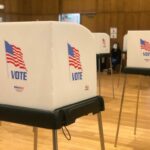
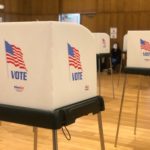
Prince George’s County Executive Angela Alsobrooks and councilmembers requested Tuesday for Gov. Larry Hogan to make November’s general election a combination of both mail-in and in-person voting similar to the June 2 primary.
Councilmembers voted unanimously to send a letter to Hogan demanding that the state provide multiple voting options for the upcoming election, including expanding the number of in-person voting centers and leaving voting centers open from Oct. 29 through Election Day, Nov. 3.
“I think there’s general consensus among the state board of elections and local administrators and other jurisdictions that solely an in-person vote is not feasible in November,” Council President Todd Turner told members at a meeting Tuesday.
The debate over how to conduct the November election began after Maryland leaders called for the State Elections’ Administrator Linda Lamone to resign. Lt. Gov. Boyd Rutherford and Comptroller Peter Franchot cited multiple issues with the June primary.
The State’s Board of Elections proposed three voting options for Hogan to consider last week, which advocates want him to strongly consider. Those options include in-person voting, voting by mail, or a hybrid.
Board members have been divided along party lines on the issue. The three Republican members Chairman Michael Cogan, Kelley Howells, and William Voelp supported a mix of extensive in-person voting and mail-in ballots–under the condition that registered voters would receive an application to vote.
Cogan said he was concerned that mailing ballots to every registered voter might hurt voters’ confidence in the election process, especially if ballots are sent to old addresses or to dead voters.
“I’m not sure the voters have confidence in an election if they’re seeing ballots crop up for people that aren’t there,” he told the board last week.
The board’s two Democratic members, P.J. Hogan and Malcolm Funn, said they supported a hybrid of voting options similar to tactics used during the primary. Funn said a mail-in election is the only way to make sure every voter can participate.
“There is no optimal option,” Funn said. “All of them have issues and problems. My overall concern is to make sure that every citizen has a right to vote.”
Republican and Democratic state lawmakers also stand divided on the issue of voting by mail.
In a letter to state board members last month, Senate President Bill Ferguson and Prince George’s County Sen. Paul Pinsky requested that the board increase the number of ballot drop boxes, expand the number of in-person voting sites, use early voting centers statewide and enhance the methods used to reach historically disenfranchised communities.
In a different letter to state board members last week, Minority Leader Chair Nic Kipke (R-Anne Arundel County) and Minority Whip Kathy Szeliga (R-Baltimore County) said they were “adamantly opposed to the use of vote-by-mail” in the November election.
David Garreis, president of Maryland’s Association of Election Officials, also wrote a letter to state board members and officials last week saying that mailing an application to vote prior to the election would create “voter confusion.”
“The local boards of election [LBEs] who do not have enough personnel to manage processing all vote by mail requests will face a significant burden while preparing for the general election,” Garreis wrote. “Many LBEs do not have additional funding available to hire staff to process a large increase in vote by mail request.”
Garreis also expressed concern that the election will fail due to an insufficient number of election judges willing to work during a pandemic.
“The local boards of election are concerned it is not possible to recruit, train, and retain 25,000 election judges for the election [sic],” he wrote.
Garreis said Hogan should make his decision on the election by the end of this week to allow state and local boards to prepare. It’s unclear what decision Hogan will make.