Matt Blitz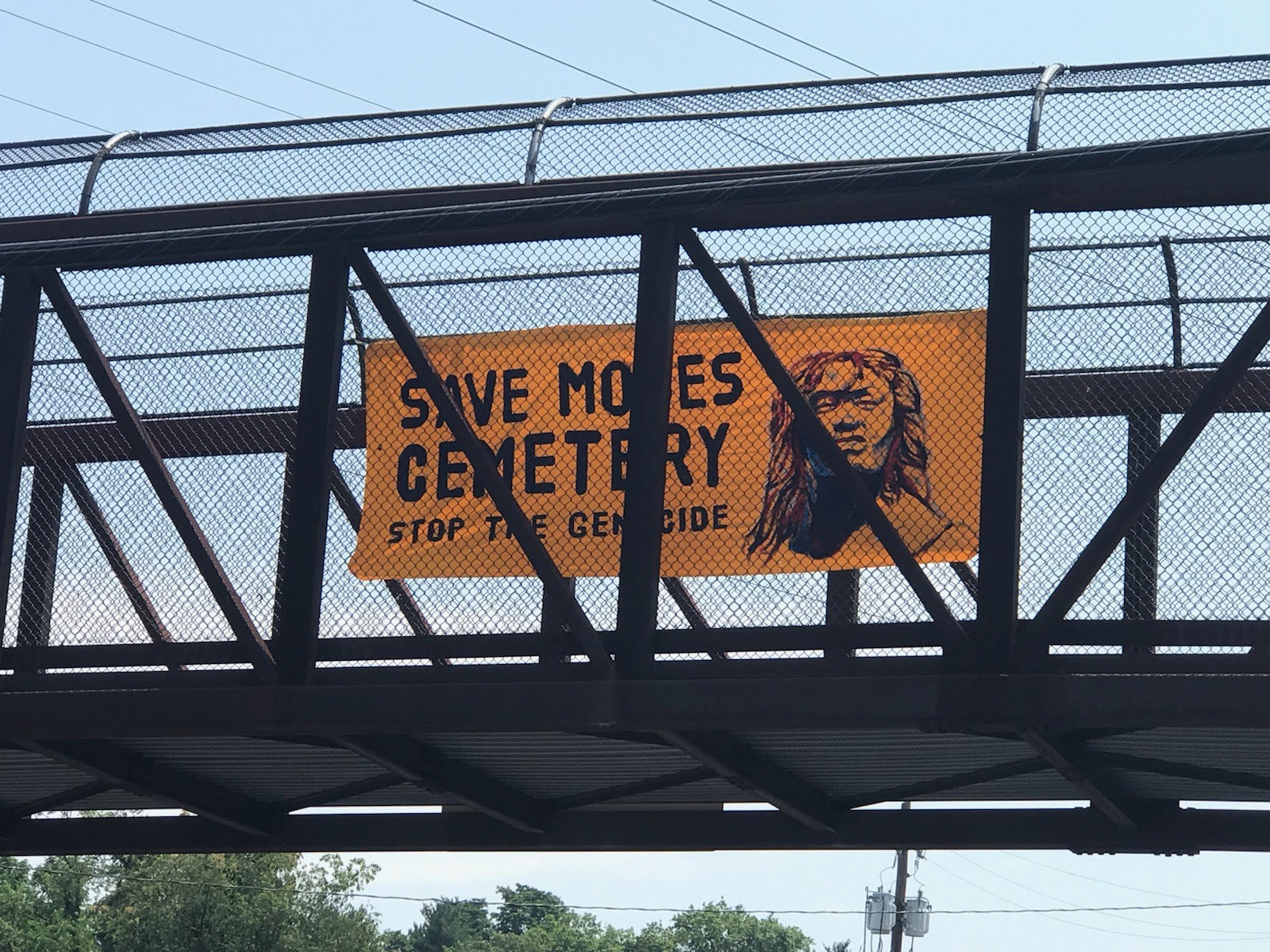
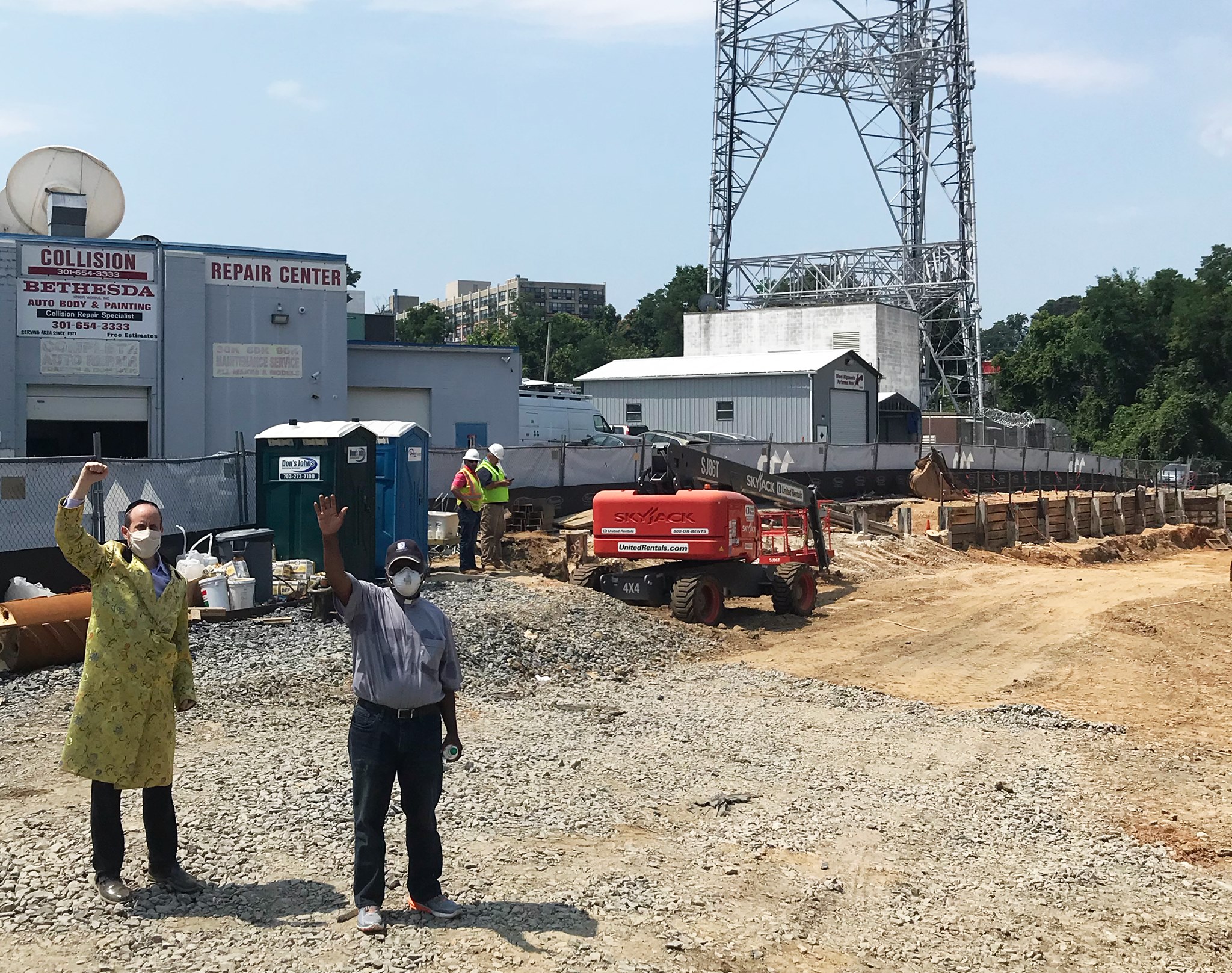
5204 River Road in Bethesda, Maryland appears to be an empty lot sitting next to a McDonald’s and across the street from a Whole Foods.
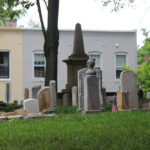
But this land may be anything but empty, according to local historians and anthropologists. It’s here, under the hard clay soil, that they believe a burial ground and mass grave for formerly enslaved African peoples dating back to the 18th century lies. It’s known as Moses African Cemetery.
And, now, a company is in the midst of constructing a self-storage facility on top of it.
“They are again tearing apart Africans,” says Marsha Coleman-Adebayo, president of the Bethesda African Cemetery Coalition which is fighting to preserve the burial ground. “This is the second desecration of our ancestors.”
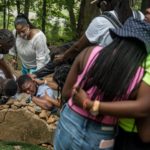
Over the last several weeks, dozens of people have come out to the lot and protested the churning, the digging, and developing of land that they consider a sacred site. On Monday, the Bethesda African Cemetery Coalition—made up of anthropologists, religious leaders, and local historians—held a protest and press conference near the cemetery, calling for a moratorium to halt construction and urging local officials to return the property to the Macedonia Baptist Church, the one-time owner of the cemetery.
“There’s no way in the world this would happen to a typical white community,” says Coleman-Adebayo. “We have decided that we are going to take a stand against this kind of white supremacist violence [on] our history and the people whose shoulders we stand on.”
Prior to the 1960s, this part of Bethesda was a vibrant, working-class neighborhood of Black farmers, quarry workers, and small business owners (today, it’s known as Westbard).
The community was initially founded in the years immediately after the Civil War by a mixture of free Black people and freed enslaved people who had previously been forced to work on plantations in the immediate area. For all intents and purposes, the Macedonia Baptist Church and the cemetery, which has burials from this time period and potentially ones dating even further back, are the last remaining pieces of physical evidence of this community.
Starting in the late 1950s, large parcels of this land were bought up by the county and other well-funded developers. As shopping centers and high-rise apartment buildings went up, many of those who have lived here for generations were forced out.
“They came up with all kinds of taxation schemes and sanitation schemes, but they were able to steal every single inch of land from Black people on River Road so that the only institution left standing was Macedonia Baptist Church,” says Coleman-Adebayo.
In early 2017, Bethesda Self-Storage’s parent company, 1784 Capital Holdings, announced that it had acquired 1.5 acres of land, which housed an auto body shop, for $11 million.
“The Bethesda area has extraordinary demographics and extraordinary market fundamentals,” the company’s CEO said in a press release at the time. “It is a significantly undersupplied market with three times the national average for rent. We chose the site because it’s one of the last zoned and developable parcels of land for self-storage in Bethesda.”
In December of that year, the Montgomery County Planning Board approved a project for a multi-story, self-storage facility.
It appears at least a portion of the cemetery was paved over or otherwise destroyed during the development of the 1960s. Some remains were moved and reinterred in other local cemeteries. It’s feared that others were simply pushed further down into the ground or into storm sewers.
In the years since the church moved across the street, and, to this day, it’s unclear exactly how far the cemetery extends. Official documents say it only encompasses land where an adjacent apartment building and parking lot currently stand, a point emphasized by the county and Bethesda Self-Storage.
In an emailed statement to DCist, Timothy Dugan, a lawyer for the company, wrote that the company actually handed over a third of an acre that makes up Parcel 177 (one of two parcels the company had acquired; the other being the adjacent Parcel 175) back to the county-run Maryland-National Capital Park and Planning Commission in February 2019, acknowledging that it’s part of Moses African Cemetery.
But the group of advocates believes the burial ground actually extends to where construction is currently taking place on Parcel 175. “There’s never been a delineation of [exactly] where the bodies are,” says Coleman-Adebayo. “Because, quite frankly, they were all torn apart.”
For the last three years plus, Coleman-Adebayo says she’s been trying to find ways to stop the project, or, at least, allow archaeologists and anthropologists to survey the disputed site for the presence of human remains. This is something that, according to a letter sent from the group’s lawyer Joshua Odintz to County Executive Marc Elrich on July 1, is required by the conditions of the initial approval.
In addition, the group believes the disputed site falls under Section 106 of the National Historic Preservation Act, which requires a review of a site’s historical significance when a development project is federally or state-funded. The group argues that this is the case since 1784 Capital Holdings recently received a Payroll Protection Protection loan from the federal government.
Coleman-Adebayo says she has met with the president of Bethesda Self-Storage, but calls it “very disappointing” and says they offered few concessions to the community.
Dugan says that “fundamentally, we are not building on the burial site” and that there is an archaeologist on-site to ensure work is done in accordance with federal and state laws. He adds that if any human remains are found, they are required by state law to report it to law enforcement.
“We have no reason to believe that the land where the self-storage building is being erected ever served as a burial site,” Dugan writes in the emailed statement. He adds that the company contributed $45,000 toward “archaeological assessment,” when it became known that the parcel of land was part of the cemetery. “On our site, our crews are operating with care and caution.”
On Monday, Kelly McKone, Executive VP of Real Estate for Bethesda Self-Storage’s parent company Capital Holdings, released a statement saying Bethesda African Cemetery Coalition (BACC) is spreading “misinformation” about the project.
The statement says claims that the self-storage project is harming Moses Cemetery are “simply untrue.” It is also false, reads the statement, that there hasn’t been an appropriate archeologist investigation.
“The publicly available map and archeologist reports speak for themselves – our project is not posing a threat to Moses Cemetery,” continues the statement. “BACC has decided, however, to launch a campaign against us rooted in misleading information and propaganda. Their leaders have ignored the facts and conveniently erased from their protests chants and media interviews our past offers to help preserve Moses Cemetery and honor its historical significance for Bethesda’s future generations.”
But there’s little doubt to the Bethesda African Cemetery Coalition that this disputed site is historically significant and contains human remains.
Indeed, a July 2017 review by The Ottery Group, a local, independent historic preservation consulting company, determined that Parcel 177 was, in fact, used as a burial ground. It found that Parcel 175 was potentially used for that purpose too, but reported that further field investigation is needed.
The company found “ample evidence” that both parcels were utilized as a cemetery beginning in 1911. “Historical records seem to establish that a portion of the cemetery has been disturbed, but it is improbable that the cemetery was completely effaced; nor is there evidence that the cemetery was formally moved,” the report reads.
The review recommended no further destruction to the grounds of either Parcel 177 or Parcel 175 until additional archaeological probing and historical research could be carried out, managing director Lyle Torp of Ottery Group confirmed to DCist.
Meanwhile, advocates also enlisted anthropologist Michale Blakely to back-up their claims, who wrote in a statement that photographs and his own observations show “light-colored elongated material consistent with skeletal material” and a “flagged area of possibly organically rich soil” could represent a burial, though he’s unable to verify without proper examination.
Coleman-Adebayo says that watching the construction workers at the disputed site on Monday was hard for her. “They’ve got this really heavy equipment and they’re just pounding the soil, digging down maybe 30 feet or more. Which is where they might be encountering or hitting remains.”
The group has also asked Montgomery County for assistance in stopping the construction at the burial site, and it plans to protest in front of County Executive Marc Elrich’s house on Thursday.
In a statement to DCist, Elrich says that, while he is willing to request the company halt construction, he doesn’t have much authority beyond that.
“I understand the concern that the disrespect of the cemetery is part of the history of racism in Montgomery County and I want to see memorialization of the cemetery and the true history told,” he writes. “I do understand the concerns raised and am willing to ask the owner to pause construction work while issues about the delineation of the cemetery are addressed.” In a follow up, Elrich adds that he has spoken with a representative of the property owner and “is currently discussing the next steps to try to address people’s concerns.”
It’s not enough for Coleman-Adebayo.
“He has no lineage with the people in the ground. It is the community that holds a genetic link,” she says. “[They] should be in the driver’s seat in terms of how we memorialize their mothers and fathers.”
Elrich also says he does “not have the authority to order a moratorium on construction on the property.” But Odintz, the lawyer for the Bethesda African Cemetery Coalition, counters that if it’s a permitting issue, “the County Executive does have authority over and can withdraw or modify the condition of the permit.”
In the meantime, Coleman-Adebayo and the Bethesda African Cemetery Coalition pledge to continue the fight. They are filling injunctions, she says, and will be protesting construction at the disputed site Wednesday, Thursday, and into next week by blocking concrete trucks. On Monday, the police were called, according to both Coleman-Adebayo and Odintz.
“The community is not welcome to go visit our own ancestors. They call the police on us every time we go there,” says Coleman-Adebayo. “But our goal is to stop… the desecration of our ancestors.”
This story has been updated with a statement from Bethesda Self-Storage’s parent company 1784 Capital Holdings.