Margaret Barthel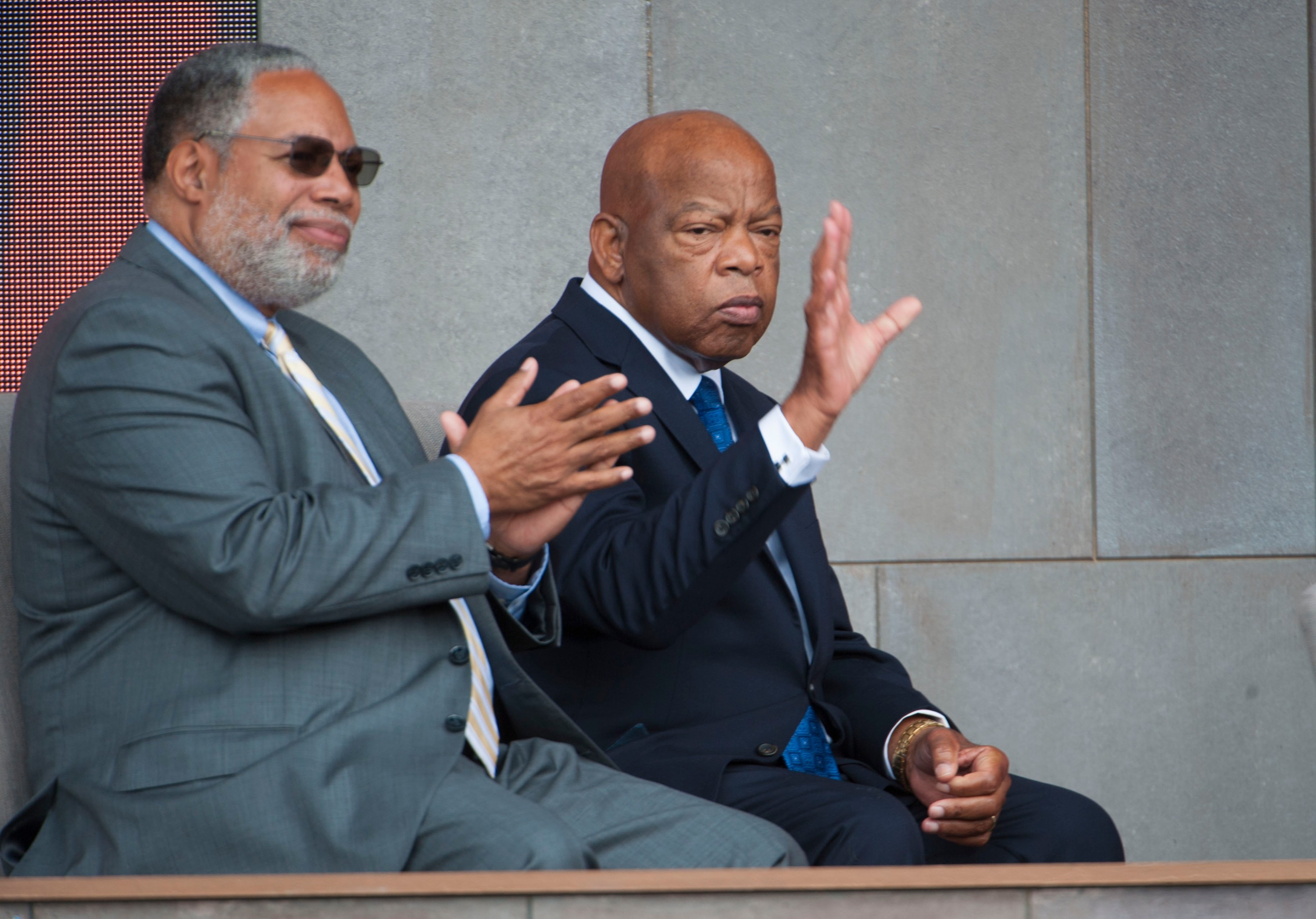
This story was updated at 5:25 p.m.
In one of his last public appearances, civil rights icon and longtime U.S. Rep. John Lewis visited Black Lives Matter Plaza in the District, where protests against police brutality and systemic racism have been ongoing for nearly two months.
“You must be able and prepared to give until you cannot give any more,” Lewis told The Washington Post, when asked about his message to today’s generation of protesters. “We must use our time and our space on this little planet that we call Earth to make a lasting contribution, to leave it a little better than we found it, and now that need is greater than ever before.”
Lewis died on Friday at the age of 80, after a battle with cancer. He grew up in rural Alabama, and spent more than three decades representing Georgia’s 5th District in Congress. His life work for civil rights and racial justice brought him to the District over and over again, as a civil rights organizer and then as a lawmaker.
Less than a mile from Black Lives Matter plaza is one of Lewis’ lasting contributions to the District: the Smithsonian National Museum of African American History and Culture. The bill to create the museum was one of the first that he sponsored after he arrived in Congress in 1987.
“Mr. Lewis helped keep the project alive in people’s minds by introducing legislation for the museum every year until Congress finally enacted it in 2003,” said Lonnie Bunch III, the founding director of the museum and the Secretary of the Smithsonian, in a statement on Lewis’ passing. “I do not know if the National Museum of African American History and Culture would have happened without him.”
He introduced legislation for the museum again and again, battling opposition from conservative lawmakers in the Senate and critics who suggested that creating the museum would prompt other groups to demand museums of their own. When the movement gained bipartisan support, Lewis pushed to make sure the museum would have a spot on the National Mall.
“I call the Mall the front porch of America. In the South, a lot of decisions were made on the front porch,” Lewis told the Washington Post in 2016. “People would meet on the front porch, and they would talk about everything.”
Former President George W. Bush signed the bill into law in 2003 — 15 years after Lewis first introduced it. The museum broke ground in 2012 and opened in 2016: a three-tiered, bronze building designed by David Adjaye between 14th and 15th streets. Until the coronavirus pandemic closed museums, the NMAAHC was among the top-visited Smithsonian museums, having welcomed more than 7 million visitors since its opening day.
In his statement on Saturday, Bunch recalled walking through the finished museum with Lewis for the first time, to show him “what his persistence helped create.”
“During that emotional occasion, I asked him if he ever despaired––when he was marching, when he was protesting, or when he was being beaten in Selma and thought he might die,” Bunch wrote. “He said, ‘No, you can’t despair. You have to be hopeful.’ It was an insight into his character and his abiding belief that the nation could become better than it had been. That we would one day make real the promise of justice and equality just as we had made real the museum.”
At the opening of the museum in 2016, Lewis himself paid tribute to the struggle of decades — and of centuries — to arrive at the moment on the National Mall.
“We are gathered here today to dedicate a building, but this place is more than a building. It is a dream come true,” he said in a speech. “You and I — each and every one of us — were caught up in a seed of light. We were a vision, born in the minds of black Civil War veterans and their supporters. They met right here in Washington, D.C., in 1916, exactly 100 years ago, at 19th Street Baptist Church, still in existence today. Oh say! See what a dream can do!”
“If you could roll up the sleeves of those veterans or touch the rubble on their backs, you might find the wounds of shackles and whips,” he continued. “Most could not read the Declaration of Independence or even write their names, but in their hearts burned an enduring vision of true democracy that no threat of death could ever erase. They understood the meaning of their contribution, and they set a possibility in motion — passed down through the ages from heart to heart and breath to breath — that we are giving birth to today.”
It was far from Lewis’s first speech given on the National Mall. To the west, on the steps of the Lincoln Memorial, he addressed the March On Washington in 1963 as a 23-year-old leader of the Student Nonviolent Coordinating Committee. He was the last surviving speaker at the March.
His words in 1963 give voice to the frustration — and the tirelessness — of his generation and generations of racial justice activists since.
“To those who have said, ‘Be patient and wait,’ we have long said that we cannot be patient. We do not want our freedom gradually, but we want to be free now! We are tired. We are tired of being beaten by policemen. We are tired of seeing our people locked up in jail over and over again,” he said.
“And then you holler, ‘Be patient.’ How long can we be patient? We want our freedom and we want it now. We do not want to go to jail. But we will go to jail if this is the price we must pay for love, brotherhood, and true peace,” he continued.
Lewis championed voting rights all his life. As a young SNCC organizer, he was at the front of the ‘Bloody Sunday’ voting rights protest in Selma, Alabama, when the group was attacked by state and local police. In Congress, he worked to protect the Voting Rights Act of 1965 — and has been calling for action since the 2013 Shelby v. Holder court decision took away some of its central provisions.
This year, Lewis was one of the sponsors of H.R. 51, the D.C. statehood bill that passed in the House of Representatives in June.
Lewis’ passion for voting rights has been passed down to today’s activists, said scholar and political commentator Julianne Malveaux.
“The young people in the Black Lives Matter movement really have taken John Lewis’ passion for voting rights and equal rights, they’ve taken it to the next level,” she said. “And I think they may be the ones to help us push D.C. voting rights over the line.”
On Saturday, D.C. leaders paid tribute to Lewis’ memory.
“Our appreciation for his life will be demonstrated in the work we do to build on his legacy,” Mayor Muriel Bowser said in a statement. “So we remember what the Congressman taught us: that we have a moral obligation, a mission, and a mandate to do our part.”
“John Lewis has left us. But his legacy, his mission, his struggle, his history & his example never will,” a tweet from the D.C. Council said.
John Lewis has left us. But his legacy, his mission, his struggle, his history & his example never will. From civil rights to civil service, from City Council to Congress, he left an indelible mark. (Lewis is 2nd from right in the SNCC pic below; Marion Barry is in the long coat) pic.twitter.com/yrPSgJekmz
— Council of DC (@councilofdc) July 18, 2020
The D.C. Council tweet includes a photo of Lewis in a SNCC meeting with D.C. Mayor-for-life Marion Barry. The two men met as student organizers at Fisk University in Nashville in 1959, and Lewis succeeded Barry as SNCC chairman.
Congresswoman Eleanor Holmes Norton remembered working with Lewis on the SNCC and for decades in Congress.
“John’s heroic courage came from principled conviction so deep that it led him to repeatedly risk his life to achieve equal treatment for all Americans. So searing was his example that John was elected chair of SNCC — not because he was strongest but because he was the bravest,” she said in a statement. “John’s determination to ‘never give up or give in’ was always leavened by his commitment to non-violence and love.”
“There will never be another like him,” Norton said.
This post has been updated with the D.C. Council’s tweet. Tamika Smith contributed reporting.