As coronavirus cases surge across the country, the D.C. region has seen its own uptick.
The District, Maryland, and Virginia have seen striking jumps in case loads over the past week. Maryland recorded 925 new infections on Sunday, its highest case load since late May, and D.C. and Virginia both saw their highest numbers since early June last week. Last Wednesday, the District reported 80 new cases — its highest since June 9 — and Virginia saw 1,084 new infections, the highest number there since June 7.
But experts say those numbers aren’t necessarily as alarming as they seem, because other key data can better indicate how well an area is doing.
“The DMV region has, relative to many areas of the country, been doing really very well when we’re looking at cases, when we’re looking at our positivity rate, when we’re looking at hospitalizations and deaths,” says Dr. Melissa Hawkins, the director of the public health scholars program at American University’s department of health studies. (Disclosure: AU holds the license for DCist’s parent company, WAMU.)
Hawkins notes that cases are likely to spike as cities and states move forward with their reopening plans. Virginia is currently in Phase Three of its reopening plan, while D.C. and Maryland have opted to remain in Phase Two for now. Even activities allowed in Phase Two, like socially distant outdoor dining, allow for more spread than when the city was on lockdown.
“June was probably the best month, where we really started to look very different from some of the other regions … and we had some of our biggest declines in Maryland, Virginia, and D.C.,” says Hawkins. “And they were sort of steady across the three, and then we … entered into other phases.”
She says a bump in cases are “expected anytime that we’re going to be opening more, and the public [is] feeling that it’s safer to be out, because more is open, more businesses are open,” she says.
That doesn’t mean the uptick isn’t concerning, she says, and residents should remain vigilant in an effort to prevent the region from going the way of new hotspots like Texas and Florida. “This is a really critical time,” Hawkins says.
Dr. Jesse Goodman, a professor of medicine at Georgetown University Medical Center who has worked extensively on emerging infectious diseases, says single-day case loads can vary. He points to seven-day averages of new cases across the region as a more accurate marker of how the region is doing, as they allow you to compare with previous weeks.
“I wouldn’t place too much in a day-to-day difference because peoples’ behavior around getting tests and then the labs’ reporting of tests may vary from day to day,” he says.
As of July 19, D.C. had a seven-day average of 62, as compared with 43 one month prior. Maryland and Virginia also had averages of 713 and 966 compared with 413 and 512 respectively on June 19.
Not the entire region has experienced the same uptick, though. Trends in Northern Virginia look dramatically different than the rest of the commonwealth. The area, which was a hotspot for the virus, recorded a sharp drop in cases in May before plateauing in mid-June.
The rest of the state, meanwhile, saw cases largely going up around the same time, with a sharp increase beginning on July 10.
Testing capacity in all three jurisdictions has also continued to increase, which has an impact on case loads, though Hawkins says that can be a good sign. She recommends keeping an eye on the positivity rate, which she says should ideally remain below 5%.
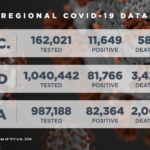
On Sunday, the same day Maryland saw a surge in new cases, Mike Ricci, a spokesperson for Governor Larry Hogan, tweeted that Maryland had reported a record number of tests at 28,899. 3.83% of those tests came back positive. As of Monday, Maryland reported a total of 958,608 tests, with a positivity rate of 4.5%.
D.C. currently has a positivity rate of 4.4%. Virginia’s however, is higher, at 7.7%, according to local health data. By contrast, Texas currently has a positivity rate of 14.7%, while Florida’s is 11.8%.
D.C. Health Director Dr. LaQuandra Nesbitt warned during a press conference on Monday that an increasingly casual approach to social distancing has an impact on case numbers. She noted that locals should minimize their trips to places like the grocery store, as health officials had advised early on during the crisis.
“We still need people to be very judicious about choosing their activities and being in that kind of posture,” she said, adding “Are you socially distant in the workplace? How often are you wearing your mask? Are you giving space in the elevator cabs? All of those things really make a tremendous amount of difference, and we need people to be adhering to them and taking them very seriously.”
Officials in beach towns across the region have raised similar concerns in recent weeks as summer tourists have flocked to the water, stating that lax attitudes about social distancing and wearing masks could be contributing to rising cases among young people.
“I just want to tell people, be careful that right now there are so many unknowns about this virus that you can’t be too cautious,” Hampton, Va. Mayor Donnie Tuck told DCist/WAMU last week. “You need to make sure you protect yourself, and not just that — have the courtesy of protecting others.”
Deaths in D.C. and Maryland have also largely trended downward over the past month, while Virginia saw fatalities rise in late June before tapering off in mid-July.
Goodman says removing obstacles to efficient testing, like long lines and lag times in getting results, is critical to maintaining an effective response to the crisis, but that individual behaviors are equally crucial.
He says that safety precautions like wearing masks and social distancing have left people across the country feeling fatigued, but that they are as important as ever. “There’s a little bit of wishful thinking going on that this has all gone away,” he says. “But it hasn’t.”