 Jordan Pascale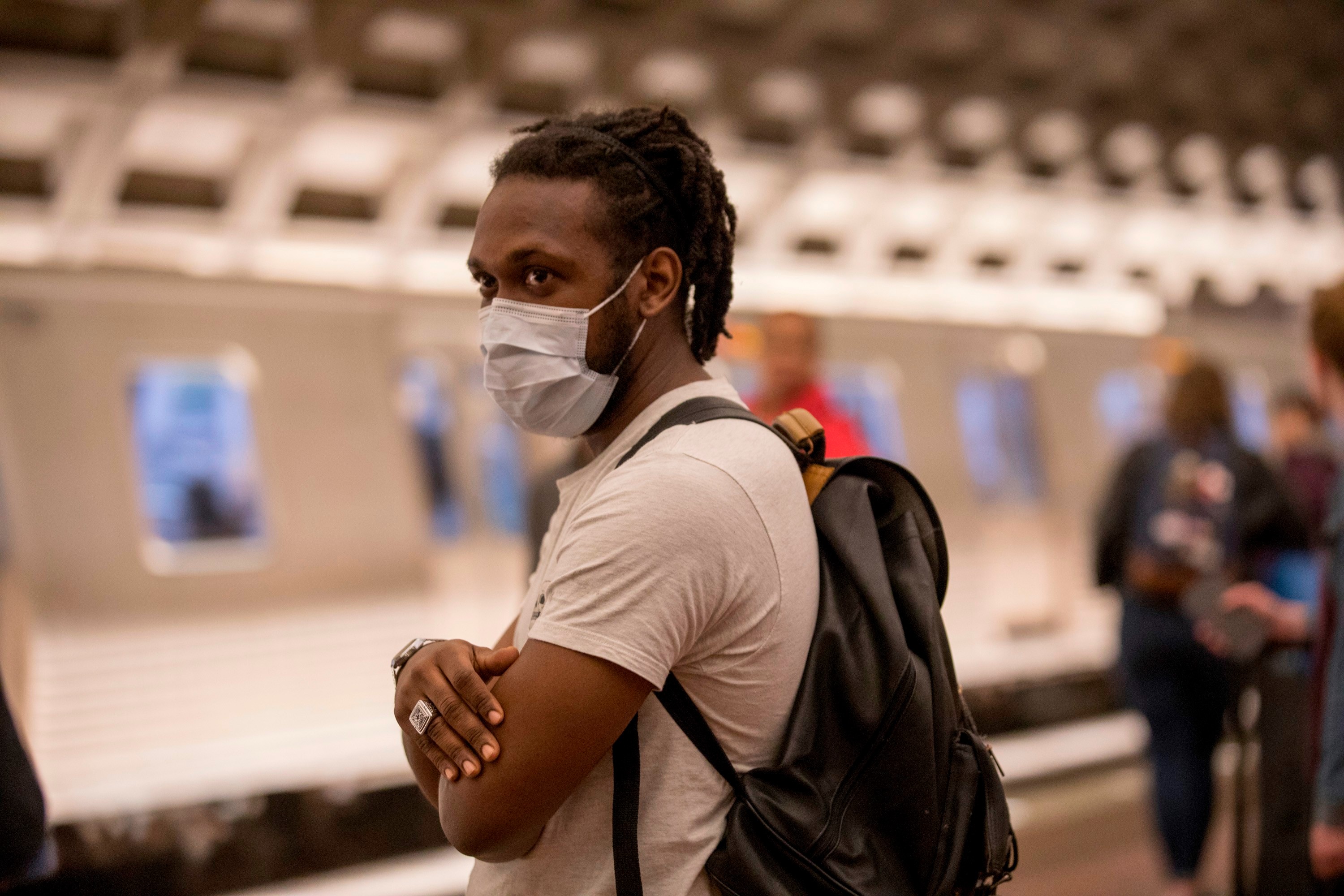
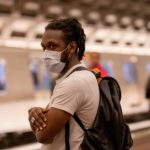
Next month, Metro will start to hand out 500,000 cloth masks it received from the U.S. Department of Transportation, the transit agency announced Thursday.
It’s unclear exactly when and how they will be distributed throughout the system. WMATA General Manager Paul Wiedefeld said they’re looking to individually wrap each one for sanitary purposes.
Wiedefeld says they hope to distribute them at major stations and bus transfer points.
“We hope that people take one as they see fit and hopefully everyone self-polices,” he said.
So far, Metro Transit Police have handed them out as needed.
Metro started requiring masks on the system on May 18, but hasn’t been enforcing it heavily. Wiedefeld says most people have complied. Earlier this week D.C. Mayor Muriel Bowser issued an even stricter mask rule that calls for face coverings in public, except while actively eating or drinking or during vigorous exercise.
Wiedefeld says the transit agency doesn’t want to get into any confrontations with riders over masks, and he says so far there haven’t been any dustups.
“My view is that we are all in this together,” Wiedefeld said. He said the focus shouldn’t be on getting into fights over it. “I don’t think that’s the way to go. I think we got to reinforce, ‘you’re a part of this (community). We’re a part of this (community)’ and we all want to get this thing back up and running as best we can. Let’s all do our part.”
Many have argued that masks should be provided as a good policy decision if the expectation is that riders should wear them. Several other transit agencies around the country, including Montgomery County’s Ride On locally, have provided masks to riders.
The U.S. DOT has provided about 87 million masks to airports and about 10 million masks to 458 transit agencies and Amtrak for passenger use at no cost to the agencies.
“This Administration is committed to protecting our people and reopening the economy; distributing these facial coverings will help boost public confidence as we begin to resume our normal lives,” Transportation Secretary Elaine Chao said in a June 12th news release.
Metro also plans to install hand sanitizer in certain areas, but they haven’t figured out how to dispense it yet.
Board Members Want Solutions On Bus Crowding Issues
Board members Matt Letourneau, Michael Goldman, and Greg Slater asked how Metro is addressing crowding on multiple bus lines.
“The concern isn’t just coming from (current) riders, it’s coming from employers as well who have employees potentially taking transit,” Letourneau said.
Metrobus ridership has consistently outstripped the safe, socially-distance capacity since the start of the pandemic.
Metro says it currently can accommodate 85,000 trips a day, but 130,000 passengers a day on average are riding.
Metro Chief Operating Officer Joe Leader says they’ve added “gap” buses to 21 routes starting today. Metro did not say which routes these were on. These buses essentially are on call when crowded conditions occur. Metrobus operators are allowed to skip stops if buses are too full.
Starting late-August, service will increase again and be able to carry up to 110,000 trips a day, allowing for social distancing.
Leader said it’s been a challenge to address crowding since it isn’t across the board on every bus and at all times of the day. He says certain routes are busier in the morning or midday or in the evenings.
Goldman says he hopes that fixes the issues and wants a report back. Wiedefeld, in a post-meeting interview, said the agency has been under stress to provide enough service while also protecting its workers.
“To be frank, I think that stress has backed off a little bit,” he said. “I think in August, we’ll be in a better place. I think we’re doing some things now to get us there.”
Letourneau says he wants to see more communication when a train station or bus is crowded. So did Rider Advisory Council Chair Andrew Kierig who likes Boston‘s tech solution that provides real-time crowding information via the website or app. WMATA says that will be difficult, but the agency is looking into it.
Letourneau also wanted to know how quickly Metro can respond if schools come back, or if the pandemic worsens.
“This is a very large ship,” Wiedefeld said. “It’s not something we can turn on a dime.”
Previously, Metro said it takes nearly two months to change schedule plans because workers have to pick new assignments and staff has to create new schedules.
Travel patterns have changed as restrictions have loosened. Wiedefeld expects patterns to change in the future, too. He’s particularly looking at D.C’s school plans and how that decision will impact workforce plans.
National Airport Station To Undergo Construction; Little Impact To Riders
The train platforms at National Airport will undergo reconstruction starting August 8. Metro moved up the platform project two years from fall 2022 in order to more quickly repair crumbling concrete on the two islands.
While most stations are closed during reconstruction, National Airport’s station has three tracks and two separate island platforms, which allows Metro to keep the station open.
“In general, we are looking at maybe a tougher situation than we thought,” Wiedefeld said. “So we wanted to get on top of that. And we’re looking for opportunities to not disrupt people.”
Metro will take one track out of service at a time.
“The work will focus on reconstructing the concrete and granite platform edge and installing new slip-resistant tiles on the platform,” a Metro news release said. “The installation of other customer experience improvements, such as new shelters and information screens, will be completed at a later date.”
The project will tentatively be completed in three phases:
- Platform 1 (platform nearest the airport): August 8–late-September
- Platform 2 (platform nearest the parking garage): late-September–mid-November
- And portions of both platforms will be closed: mid-November–December 25