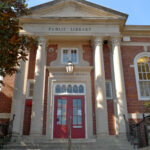
When the Northeast Library abruptly closed July 15 for a “deep cleaning,” some residents and D.C. Public Library employees started wondering why.
The library, located in the north part of Capitol Hill, had begun allowing a limited number of visitors to use its computers just two weeks earlier, under Phase Two of the city’s coronavirus reopening. Commenters on Facebook were quick to ask if the closure was COVID-19-related. “If it’s COVID, the public needs to know,” one wrote.
Several DCPL staffers later told DCist that the library shut down because a staff member had tested positive for the coronavirus. (The Hill Is Home blog first reported on the reason for the closure.) But the library system never publicly stated why the library required a deep cleaning.
The branch’s brief shuttering confirmed some DCPL workers’ worst fears. DCist spoke to six who say they worry that partially reopening the city’s libraries puts them as well as patrons at risk of getting sick—echoing debates over the reopening of schools and other shared facilities as the pandemic stretches on and regional COVID-19 cases spike.
The six employees spoke on the condition of anonymity, citing labor contracts that bar them from commenting to the press without permission. They want DCPL’s administration and Mayor Muriel Bowser’s office to better communicate safety protocols and reconsider some aspects of library reopenings, including current policies that let customers enter branches to pick up books.
Phase Two allows public libraries to reopen with capacity limits and physical-distancing measures. These restrictions mean that no more than 50 people per 1,000 square feet are permitted inside at a time, and that all open library buildings are capped at 50% capacity.
Eight library branches initially opened June 29 for limited indoor services, with the count growing to 14 as of July 13. The offerings include book pick-up services, self-service and remote printing services, and restricted computer access. Bathrooms are also open for one patron at a time. (The system has more than 25 branches in total.)
As libraries reopen for some in-person services, DCPL employees say they lack sufficient support to ensure patrons follow public health guidance, such as staying six feet apart and wearing masks.
“We’ve had some struggles with customers wearing their masks effectively,” one employee told DCist. “That’s really been very frustrating and worrisome. It’s been hard to make sure everyone is complying.”
The responsibility to enforce mask-wearing has largely fallen on librarians, according to the staffers who spoke with DCist, though some branches have public safety officers who might help with asking patrons to wear masks.
Richard Reyes-Gavilan, the executive director of DCPL, says patrons are required to wear masks within the libraries, and staff have been provided a script to rely on if someone enters without a mask. He adds that seven public safety officers directly serve seven branches, with two to three officers performing periodic checks at the remaining branches throughout the day.
“Ultimately, we are relying on people’s good cooperation, and I think we do that for all behavioral issues in the libraries,” Reyes-Gavilan says in an interview. “Most visitors come in for book pick-ups or a print job. The longest time anyone can spend in a branch is one 45-minute computer session.”
Computers also pose an issue, several staff members say, since librarians often have to come close to customers to assist them with questions. According to DCPL spokesperson George Williams, staff have been instructed to answer patrons’ questions about the computers from a distance and while wearing a mask. Reyes-Gavilan says there are plexiglass sneeze guards at every branch’s information desk.
Some of the employees DCist spoke with say they believe Bowser’s office pressured DCPL to reopen the libraries. “Why has DCPL rushed to open our buildings so quickly, so far ahead of our peers?” one worker writes in an email to DCist.
“It feels like we’re out of sync with the rest of our region,” says another staffer. “We care about our customers. We do want them to be able to use the library, but I think moving this fast has essentially created the dangerous situation.”
A spokesperson for Bowser says the mayor’s office makes the final decisions around reopening plans in consultation with city agencies, and that the one to reopen libraries wasn’t made lightly or in a rush. “We’ve been listening to the community,” the spokesperson adds. “We know the library [system] is one of the things the community wants.”
But DCPL workers say management has failed to communicate adequately with staffers and patrons about safety protocols, as shown recently in the case of the Northeast Library.
An employee with knowledge of the branch’s closure says the branch manager arrived around midday July 15 and told the staff the library was closing early. The staff were then brought into a meeting room and informed that an unnamed colleague had tested positive for COVID-19.
All the workers at the branch were told to go into a 14-day quarantine and encouraged to get tested for COVID-19, according to the employee. Although the workers weren’t told who had gotten sick, they were allowed to ask when the sick staffer had worked to get a better sense of whether they had been in contact with that person, the employee said. (The staffers continued to be fully paid during the quarantine period.)
The DCPL employees interviewed say they’re also concerned about the lack of communication around a different case at the Mount Pleasant Library. In early July, a librarian who works there told the Washington Post that she’d received a presumed positive diagnosis for COVID-19 from her doctor and provided a doctor’s letter to her manager. But she says her coworkers were never informed by their supervisors about her condition, the Post reported.
In a statement to DCist, DCPL says its ability to share information about employees’ health is limited by its obligation to protect their privacy. “To ensure that we create the safest possible environment in which we work, amongst many actions, we may decide to close locations for deep cleaning out of an abundance of caution when there is a possible exposure to coronavirus (COVID-19),” the statement says. “We recognize staff are concerned about the welfare of their colleagues.”
DCPL Director Reyes-Gavilan says the library system is following D.C. health department guidance, which includes having infected employees go into quarantine, and only notifying those who were in close contact with the infected workers.
“We would not disclose to anyone who may not be a close contact about a confirmed case,” he explains. “This is something that we’re learning about, really, and what we have learned is that that would be a violation of any number of privacy laws—or approach being a violation of any number of privacy laws.”
The employees who spoke with DCist say they anticipate their coworkers or customers testing positive for the coronavirus, but don’t feel adequately prepared for that outcome.
“I think there’s a case to be made for expecting a little more than the bare minimum from them,” one librarian says of DCPL leadership. “There are ways to say someone got infected. We’re not asking to name who got COVID. When they don’t announce to the public, everyone who came to the library earlier that week has no reason to believe that they might be exposed.”
By contrast, on the same day the Northeast Library shut down, the Anne Arundel County Public Library system in Maryland announced that an employee at one of its branches had tested positive for COVID-19, noting that the local health department had launched contact tracing with certain individuals.
According to one DCPL staffer, a virtual town hall hosted by library administrators and D.C. Health before the reopening didn’t answer enough questions from staff, including what would occur if someone who’d visited a branch later test positive for the virus. “They were like, we’ll kind of figure it out as it happens,” the person says.
Reyes-Gavilan tells DCist he understands there’s a “certain natural level of anxiety that people are going to have” amid the pandemic. He also says DCPL’s town halls were meant to provide maximum information to staff, and that the department continues to communicate closely with D.C. Health experts.
“But nothing helps quite like getting used to something, right?” notes Reyes-Gavilan. “Right now, we’re still in the opening weeks of this new limited-entry posture. I do think it will take some time for people to absorb this new normal.”
Other DCPL safety measures include providing hand sanitizer at branches and sectioning off returned books for 72 hours. “We have these big bins full of books that say ‘do not touch this big bin of books until, you know, July 23rd,'” he says. The system plans to reopen its flagship Martin Luther King Jr. Library downtown this fall.
While Reyes-Gavilan says he’s heard concerns from DCPL employees about reopening, he’s also heard from residents who want the city’s libraries to reoepen. “We are being cautious and we’re being deliberate,” he says. “Are we doing things perfectly? That’s not for me to decide—I’m sure not. But, at the same time, we’re doing things as best and as safely as we possibly can.”
AFSCME Local 1808, the union that represents DCPL librarians, recently postponed a July 22 demonstration in front of open library branches where workers intended to distribute flyers to residents that included information on the Northeast Library and concerns about safety within the system. According to a DCPL employee, the demonstration was postponed to give District Council 20—of which Local 1808 is part—more time to share its concerns with city officials.
Caryn Morgan, a staff representative at the union, is monitoring DCPL workers’ concerns and regularly relaying them to the library system. “It can never be said the union didn’t bring this to their attention,” Morgan says. “I don’t want to believe that [DCPL doesn’t] care about the staff. I just think it’s easier to make decisions when you’re not on the front line.”
Morgan adds that employees had to push DCPL to provide them personal protective equipment and cleaning materials, including masks, hand sanitizer, and wipes. And when one branch ran out of supplies, it took two days for them to be restocked, she says. “Somebody tells you there aren’t any wipes, someone in a vehicle should drive over and get wipes,” says Morgan.
Williams, the DCPL spokesperson, says the library system’s facilities-management department oversees PPE and cleaning materials, and began providing them to essential staff after the city implemented a stay-at-home order during the spring. When additional workers returned to the reopened branches, they were also offered PPE, he says.
Inventory levels are tracked weekly, with supervisors submitting requests for supplies to the facilities-management team. The requests are filled within three days and DCPL’s tracking system doesn’t currently show any libraries running out of supplies, according to Williams.
Morgan points out that people experiencing homelessness frequently visit DCPL branches, and some of them might lack masks on entry. “They should be safe and feel safe as well,” she says, stressing that DCPL should make sure all patrons are offered masks. “I can’t say that’s the case right now.”
In June, Local 1808 members and others participated in a letter-writing campaign targeted at public officials, in which they requested that the reopening plan for DCPL libraries be slowed. The union says it’s still communicating library workers’ concerns to the Bowser administration.
“We’re not asking to close the library [system], we’re asking that it operates safely,” Morgan explains. “I should not dread getting up to go to work because I could get sick today. If I lived with an elderly person, or I have a baby in my home, I shouldn’t have to worry about catching something and then bringing it home to a loved one.”