 Aja Beckham
 Matt Blitz
Across the city, COVID-19 has decimated local small businesses.
In June, the Federal Reserve warned Congress in its biannual report that a large number of U.S. small businesses could fail.
For Black-owned businesses, however, this crisis could be especially catastrophic.
Access to capital can already be a challenge for small businesses, but especially those owned by people of color. They are more likely to lack the resources, capacity, and existing relationships to traditional lenders that larger businesses can turn to in a crisis, according to the D.C. Fiscal Policy Institute, a local think tank that advocates for widespread prosperity across the District through budget and policy recommendations.
While federal resources are available in the form of the Payroll Protection Program and economic injury disaster loans, the District has also looked to help out.
In March, the city announced an initial $25 million investment (later adding an additional $8 million) into a Small Business Recovery Microgrants program. About 7,400 applications were submitted, according to Mayor Muriel Bowser’s office, and most got something.
In June, the city announced a second microgrant program: the D.C. East of the River Small Business Economic Relief Microgrant Program for Wards 7 and 8. Those wards, where the population of Black residents exceeds 90%, are home to 6.5% of D.C. businesses, according to data provided by D.C.’s Office of the Deputy Mayor for Planning and Economic Development. Similar to the first grant, businesses were able to apply for up to $10,000.
The intention, according to the Deputy Director of D.C. Department of Housing and Community Development Sheila Miller, is to award the East of the River microgrant to “all eligible applicants.”
However, some businesses are expressing frustration about the timeline of receiving notification about the awarded money. Though city officials initially told DCist that recipients of the East of the River grant would be notified “on or about June 19,” only 190 out of 270 applicants have received notification as of July 22, according to DHCD.
DCist spoke to 6 Black-owned D.C. businesses about how they are weathering this pandemic-caused economic crisis, how they are planning to use city and federal assistance, and if they are hopeful for the future.

The barbershop that’s ‘cautiously rebounding’
Lesley Bryant is the owner of Lady Clipper Barbershop, a salon on U Street that prides itself on inclusivity. She opened her shop in 2017 by relying on personal financial resources as well as help from family and friends.
“It’s very difficult, when your company is under two years [old], to get that financing” from the bank, Bryant says. “This was something that I needed to do quickly. So I dug deep and went into my own savings to do so.”
But all was going well for Bryant and her team of three barbers. “Business was booming since the day I opened,” she says. Of course, the pandemic paused all of that.
At the end of March, Bryant says, she sat down and applied for all financial help she could. She received the PPP money fairly quickly, but nearly four months later, she still hasn’t received an EIDL from the SBA.
As for the D.C. microgrant program, the shop eventually received $4,666, according to DMPED, though it took until mid-June for the funds to actually hit their account. Bryant says they’ve used the money to purchase PPE for the staff and cleaning supplies for the shop.
Lady Clipper reopened on June 9 in accordance with D.C.’s phased reopening and so far they are “cautiously rebounding.” Due to restrictions, they are taking more time to clean and are spacing out appointments, which means they are seeing fewer clients.
But they remain optimistic about the future. “I definitely think we’ll be able to move forward,” says Bryant.
The boutique owner who’s still hopeful
The shop Nubian Hueman at the Anacostia Arts Center sells clothing, accessories, and shoes sourced from and curated by designers representing the African diaspora. Since it opened in 2013, Nubian Hueman has partnered with roughly 500 artists and designers. A second location opened in Baltimore last year.
Owner Anika Hobbs applied for the East of the River microgrant, but hasn’t received a notification yet about the application status.
“But that means I’m hopeful,” says Hobbs.
She was awarded a DC Small Business Recovery Microgrant in the amount of $6,711, which she’s received. Hobbs also plans to apply for the EIDL loan.
“We need money,” says Hobbs. “I mean just looking at our days, we’re not making anywhere near the numbers we were making last year, but I still have the same amount of expenses, if not more.”
Hobbs says the grant funding has and will be used for payroll, inventory, bills, and marketing, now that her online store is currently the only revenue generator. Meanwhile, she says the business adjustments she’s made have been challenging.
“It was hard because, you know, I have a store team. Taking a brick and mortar team and all of a sudden we’re looking at an e-commerce business, that took a bit of time,” Hobbs says. “And, the employees are going through a pandemic as well with their families, so it was a bit of a struggle.”
The ice cream shop whose owners say, “For now, we are grateful”
Southwest Soda Pop Shop at the Wharf is a family business. Brittany Jones, along with her three sisters and her father, opened their ice cream shop on May 23, 2018.
But the Jones family are no strangers to small business ownership.
Brittany’s father Darryl Jones was a co-owner of Virgo Fish House (which has since closed) for nearly three decades. “We were the first and only Black business at the Wharf,” Jones tells DCist.
When the Wharf underwent renovations, so did their business, and they pivoted to ice cream. Over the last two years, their sweet treat shop has done pretty well, says Jones, though they are still learning. “The good thing about being a small business that you own and operate is you can hear what the community wants and … make adjustments.”
The family was hopeful for the future this spring, and gearing up for their busy season.
Then, the pandemic hit in mid-March, and the family closed down the shop. They initially applied for a PPP loan but got denied. The shop thought about applying a second time after someone offered to help them sort through the application. However, that help never materialized and Jones says they ultimately didn’t do it.
Southwest Soda Pop Shop reopened on May 30 and business has since been very good, Jones says. She says over the last several weeks, they have had consistent lines and a solid customer base.
She thinks it has to do with their increased social media presence and folks wanting to support a Black-owned business in wake of the protests earlier this summer. “It’s been a dream,” says Jones.
In late May, the shop put up a GoFundMe as a way to make ends meet as they try to recover from the pandemic. In two months, they have raised more than $37,000 — well beyond their intended goal of $10,000. So far, they have received about half of those funds from GoFundMe and have used it on rent, electricity bills, product, and paying off taxes.
While overwhelmed by love for the community and hopeful for the future, Jones remains on edge.
“We are no longer worried about being able to stay open, but we worry about how long the support will last,” she says. “For now, we are grateful.”
The barbershop that’s doing ‘everything we’re supposed to do’
Sharon and Eugene Hollinsworth opened Like That Barber Shop on Good Hope Road SE in October 1992, “to provide employment for young men and women east of the river where there was a dire need for legitimate employment,” Sharon Hollinsworth says. A second location followed in 2000.
“In the late 80’s early 90s, it was horrible, a lot of murders,” Sharon Hollinsworth says of the city. “A lot of the young men and women who have worked as barbers here went on to college, worked for the government, including as firemen and police officers. A lot of these guys didn’t have father figures, and my husband played that role for them.”
Now, nearly 30 years after opening, the family business is concerned staying afloat during the coronavirus crisis.
Since COVID hit D.C., Hollinsworth adjusted barbers’ booth rent. “I couldn’t charge the barbers for booth rent when they aren’t working full time,” says Hollinsworth. “We could only have 10 people in the shop at a time. One shop has 13 barbers. They had to switch off to two to three days a week.” Barbers have also switched from cloth capes to disposable ones, Hollinsworth says — another expense for them.
Like That Barbershop applied for and was awarded $4,900 from the DC Small Business Recovery Microgrants. Sharon says she applied for the maximum $10,000 amount.
“It was a drop in the bucket, but I’m grateful,” Hollinsworth says.
Like That Barbershop applied for the second East of the River microgrant as well, and received a notification that they were awarded $1,006. Hollinsworth is concerned about accepting the grant because she says it may not be worth the hassle of paying taxes on it. Though, she says, “I know every little bit helps.”
The future of Like That Barbershops is uncertain.
“Well, we’ve done everything we are supposed to do,” she says. “We wear the mask and wash our hands. We don’t have but 10 people in the shop at one time. We make sure people don’t have fevers… We are just getting back on our feet. But if we close down again due to COVID, we have to go back to square one.”
The bookstore that’s trying to keep up with demand
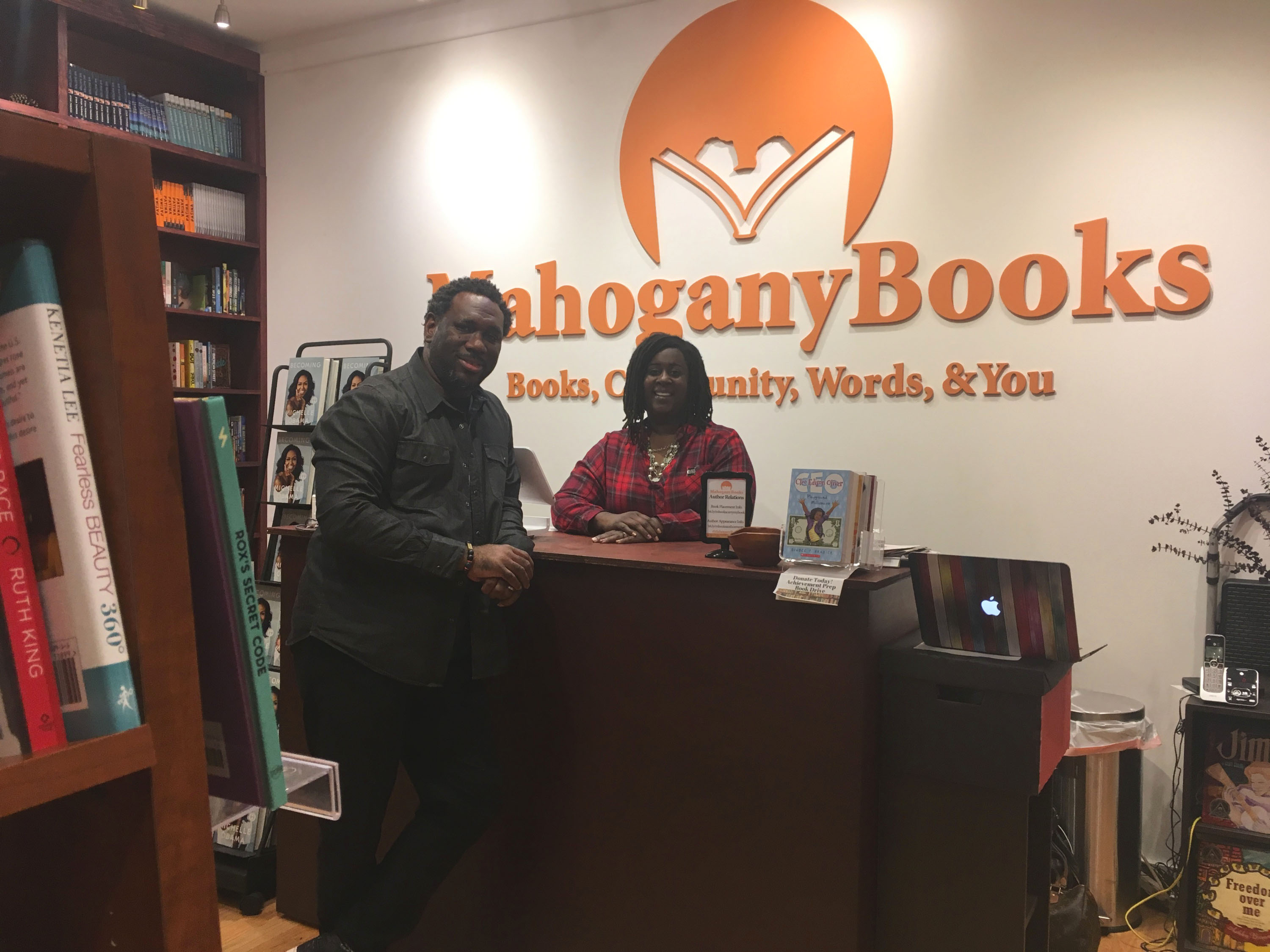
Ramunda and Derrick Young own Mahogany Books, a small book shop in Southeast that specializes in books by Black authors. The shop started as an online bookstore in 2007 and opened its storefront in historic Anacostia in 2017.
In the wake of the pandemic, their onsite author events — normally a large part of their revenue — were all canceled. (They’ve since resumed virtual events.)
Though they didn’t apply for PPP, they did apply for various other small grants, including the East of the River microgrant. They’ve also received grants from The American Booksellers Association and We Buy Black in Partnership with Shea Moisture.
“I just don’t know that one grant will make up for that lost revenue,” Ramunda Young told DCist in April.
The bookstore’s priority for the microgrant is funding jobs, as the staff has gotten smaller.
“We went from five employees who were part time to two employees. So now we’re gradually getting back up to that five, maybe a little bit more than that,” Derrick Young says now. “A lot of [the microgrant] will be for payroll and getting people paid on time.”
In addition to payroll expenses, additional costs have come up since COVID. The remaining amount will be used “to purchase PPE, sanitizer, and stuff like that. My wife told me about the price of the hand sanitizer stand,” Young says. “That would be a good place to put part of that as well.”
While Mahogany has reopened, they’re taking orders online for shipment or curbside pickup. In the wake of ongoing protests about police brutality and racial injustice, Mahogany has been featured in national coverage of Black-owned bookstores. The shop posted on Instagram last month that they’ve seen “tremendous support” and were working “tirelessly” to fill orders.
“We’ve just been focused on getting books out,” Derrick Young says.
The cycling studio adjusting to “the new normal”
Shayla Cornick owns a boutique cycling studio called CYCLED! with locations in Capitol Hill, Takoma, and Silver Spring, with about 20 employees. She started her business in February 2015 and it has steadily grown ever since, culminating with the opening of a Capitol Hill location this past January. “I just wanted to promote health and wellness in my community,” says Cornick.
In recent months, she’s applied and has received EIDL and PPP monies as well as a D.C. Small Business Microgrant in the amount of nearly $9,000. “That [microgrant] covers two of the three months that I’ve had my business closed, just rent,” she says. “Not anything else.”
Cornick also told DCist that it took longer than she expected to physically receive the D.C. microgrant money. She said she applied for it at the deadline in March, but didn’t actually get it until early June.
It wasn’t an easy road for Cornick to initially get her business off the ground back in 2015. She applied for bank assistance but was roundly denied, she says, without even having her business plan looked at. “[I] had this long business plan, like 50, 60 pages long,” says Cornick. “And the guy never looked at it. They were like ‘if you haven’t been in business for at least two years, we won’t be able to help you’… so I ended up using my own personal resources to start CYCLED!”
Alas, Cornick says there remains stereotypes that Black-owned businesses have to contend with. “I think some non-Black people might think that Black businesses aren’t professional and don’t operate to certain standards,” says Cornick. “Which is entirely not true.”
Even as the city has partially reopened, Cornick has remained concerned about her business. She had to sell and rent some of her bikes to make ends meet, so she had to get her equipment back.
But she’s in the midst of transitioning her business model. Since D.C.’s Phase Two will only allow five people for every 1000 square feet inside an exercise studio, Cornick has moved classes outside at her Takoma Park studio (the other locations remain closed). CYCLED! is also launching a fitness app in the coming weeks that will expand its virtual offerings.
For Cornick and CYCLED!, though, it likely will never be the same as it was prior to the pandemic.
“For us, the new normal doesn’t look similar to the old normal,” she says.