Matt Blitz
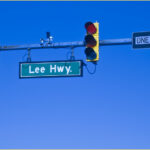
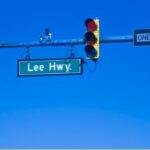
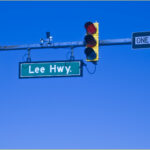
For decades, Robert E. Lee’s name and other references to the Confederate general have adorned a number of public spaces in Arlington County. There’s Lee Highway, Lee Community Center, and — until early last year — a public county high school.
Even the county logo prominently features the house he lived in, which remains a memorial dedicated to Lee on top of the hill at Arlington National Cemetery.
But, as is the case around the country in recent years and months, this is changing.
Last month, the Lee Highway Alliance — a coalition of civic associations, landowners, and businesses — announced they were moving forward with renaming the portion of the century-old thoroughfare that runs through the county. Additionally, Arlington’s branch of the NAACP has recently called on the county to retire its flag, logo, and seal that features Lee’s former residence.
“Symbols matter. They shape how we view the world and inform our culture,” Julius D. Spain Sr., the President of NAACP Arlington, tells DCist. “Do these [symbols] really represent the Arlington we live in today?”
Alfred Taylor, a longtime Arlingtonian and historian, is also in favor of retiring Lee’s name from county public spaces. “It’s time to … come up with symbols that are more indicative of what Arlington is today, and what we hope it to be going forward,” he says.
Lee’s former residence, known as Arlington House, actually belonged to the Custis family, the family he married into.
Built in the early 19th century by George Washington Parke Custis, the grandson of Martha Washington and the adopted stepson of George Washington, the house was bequeathed to Lee when he married Parke Custis’s daughter Mary Anna Rudolph (back then, women were not allowed to own property and any they inherited went to their husbands.)
Lee also inherited dozens of enslaved people from Custis, to whom he was horribly cruel and violent.
“The county continues to have a blind eye to the fact that the logo, seal, and the symbol is that of a slave labor camp and memorializes Robert E. Lee,” says Spain.
Lee and his family lived there for 30 years, but when the Civil War broke out, Lee left to command the Confederate Army. He would never return to the house. Soon after Lee’s departure, the U.S. Army confiscated the estate (due to unpaid taxes) and turned it into a camp, headquarters, and eventually, a cemetery.
This is the part of the history that the county focuses on as the rationale behind why it remains part of the logo, which was designed by an Arlington resident and adopted in 1983.
“The cemetery was put there so Lee couldn’t come back, so that makes the house part of the resistance, right?” says Arlington County Board Chair Libby Garvey. She also name checks that the house’s connection to George Washington and that the Marquis de Lafayette was a well-known visitor.
That isn’t to say she’s against changing it, Garvey says, but acknowledges there isn’t a county process yet to deal with this type of request, or others she’s recently received about changing the names of a number of county streets and bridges. One petition, for example, has called for renaming Fairlington Bridge to Black Lives Matter Bridge.
“Now, we are getting so many requests that we need to think this through,” says Garvey. “I think we are ready to have a good discussion as a community about what really is our past and what does it mean.”
Garvey says the county is working on an official process on how to go about considering changing names of public spaces in Arlington. The hope is to have that process in place by September, she says.
Though no decisions have been made as of yet on the exact scope or how it will look, Garvey says it will be public-facing with community conversations and, potentially, a survey.
When asked where she stands on revising the county logo, Garvey demurs. “I’m agnostic. It doesn’t matter what I think. It matters what the community thinks.”
Spain says removing Arlington House from the county logo doesn’t deserve an extended dialogue. “The history is well documented,” says Spain. “If you can’t see this as a symbol of oppression, how can you properly address issues … of equity and social justice? You can’t.”
Elsewhere in the county, the Lee name will soon be disappearing off the 4.6-mile portion of the road that cuts through Arlington. Lee Highway (also known as Route 29) is actually a more than a thousand mile interstate road that runs from Mississippi to the District. It was named after the Confederate general a century ago.
Ginger Brown is the Executive Director of the Lee Highway Alliance and says they have long discussed changing the name, ever since plans first began to materialize to revitalize the corridor in 2016.
“Obviously, recent events around the nation have prompted a lot of folks to encourage us to move forward … and create a more welcoming place,” says Brown.
When the alliance announced in July that it would rename the road, the response from the community was positive, says Brown. Still, she says, “There are an occasional one or two [people] that feel like it’s not the right time.”
The working group the alliance is assembling will include community members, businesses, and county officials. That should be announced in the coming weeks and will deliver a short list of potential names (three to five, says Brown) to the county board sometime in late fall.
From there, it’s expected that the county board will follow a similar process to the one last year when they renamed the county’s portion of Jefferson Davis Highway to Richmond Highway (it’s still named after the Confederate in parts of Virginia and other states). That means appealing to the Virginia General Assembly or the Commonwealth Transportation Board since Arlington County can’t rename a road themselves due to the Dillon Rule.
Brown says she can’t comment on any particular names since they haven’t even announced the criteria yet, though does say that it may no longer be a highway. “We are interested in walkable, urban neighborhoods,” says Brown. “The first word that comes to mind is not the word ‘highway.’”
She said she will also encourage the group to have several potential choices in case the transportation board does decide to rename the entirety of Lee Highway within the commonwealth. Recently, some floated “John Lewis Memorial Highway” as a possibility on social media.
As his home goes through these changes, the 86-year-old historian Taylor sees it as necessary. “You have to look back at the past, so you can measure where you are today,” he says.
He says it was a conscious effort and a clear message as to why so many things in Arlington are named after Lee, Davis, and other Confederate figures. “Arlington County has not always been the great Arlington County and still has a racist past.”
But he says now there’s a chance to not be beholden to that history, but look toward the future. “It’s time to show what it is today,” says Taylor. “Not what it was yesterday.”
Garvey agrees with this sentiment, but as an elected official, thinks there may be some difficulty even in that.
“It really gets down to what it is the history we agree upon,” says Garvey. “How are we going to remember it and celebrate it? Those are major questions.”
This story has been updated to correct Julius D. Spain Sr.’s name.