 Mikaela Lefrak
Anyone seeking a little joy in this dismal, virus-ridden world should look for a ukulele player. They are unfailingly chipper, even in a global pandemic.
And over the past few days, about 140 ukulele aficionados have gathered online for UkeFest, an annual gathering hosted by the Music Center at Strathmore in Bethesda, Md. They’ve taken to Zoom out of a love of the four-stringed, guitar-like instrument adapted from instruments brought to Hawaii by Portuguese immigrants in the late 1800s.
“The ukulele is a happy instrument,” says Brian Tolentino, a retired postal worker and professional ukulele musician and teacher. “There aren’t too many angry people who play the ukulele.”
Tolentino typically flies to Maryland from his home in Hawaii for UkeFest. But this year, he’s teaching his advanced classes from Oahu. In keeping with the spirit of a ukulele player, he’s greeted the change with a smile.
“We can connect with people all over the world, which is fun,” he says. “A ‘C’ in my language is a ‘C’ in Japan, is a ‘C’ in Switzerland.” Never mind the fact that, thanks to the time change between Hawaii and Maryland, he has to get up at 4 a.m. to teach.
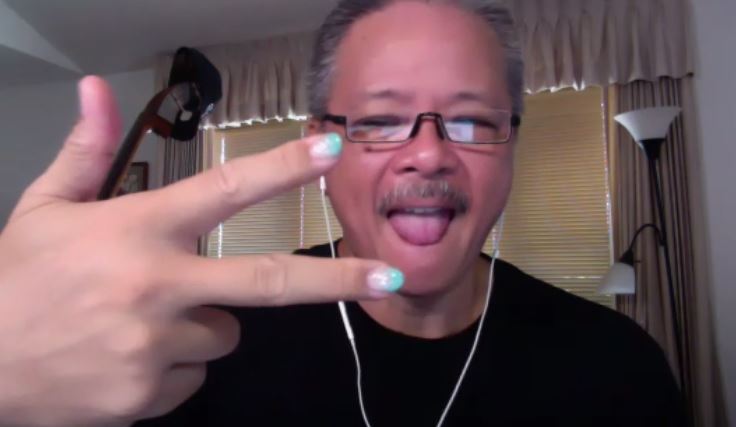
Brian Tolentino shows off his gel fingernails on Zoom, which he says give him “more attack” when playing the ukulele.
UkeFest started in 2008 as a concert and workshop on the Strathmore’s lawn. Two women spearheaded its development: Marcy Marxer and Cathy Fink, a couple and Grammy-winning musical duo. In partnership with Strathmore, they’ve grown the event into a beloved annual tradition for more than 100 ukulele students and teachers.
The event has also helped spawn one of the more robust ukulele communities outside of Hawaii. Maryland is now home to a second festival, Gaithersburg UkeFest, monthly jam sessions, ukulele library lending programs and a ukulele marching band. Ukulele concerts at Strathmore routinely sell out.
For Marxer, creating a musical community that feels welcoming to everyone has long been a priority.
“Kathy and I, as a gay couple, were not automatically welcomed into the field of bluegrass,” she says. “Diversity in the ukulele scene is something Kathy and I have been working on for about 30 years.”
Their strategy appears to be working. Local UkeFest attendees like Lori Perine have come to rely on the festival for an annual dose of joy and community connection. Perine started playing ukulele about eight years ago and has attended UkeFest every since.
“It’s like being at a buffet, a smorgasbord of music,” Perine says. “There’s the Hawaiian tradition, the folk tradition, the blues tradition, the jazz tradition.”
When the pandemic hit, Perine immediately thought of UkeFest. Would they cancel UkeFest? “I was kind of biting my nails,” she says.
Lauren Campbell, Strathmore’s program director, says she and her team knew they had to figure out a way to keep the jam alive.
“We were lucky,” Campbell wrote in an email, “because all of our faculty this year has lots of experience teaching online, so it wasn’t too steep of a learning curve for them to plan their same classes for the online platform.”
Strathmore did reduce the number of instruction days from four to two, to avoid Zoom fatigue. And despite their best efforts, there’s no perfect way to recreate the magic of an in-person jam session online.
During lessons, everyone except the instructor is muted. But there’s even a silver lining to that. In normal times, overenthusiastic ukulele players would often unintentionally interrupt lessons by messing around on their instruments—noodling, they call it. With everyone on mute, the noodlers can noodle as much as they want.
“Don’t tell Cathy [Fink] and Marcy [Marxer], but I’m definitely going to noodle,” Perine laughs. “But we’re not hearing each other, and we’re not enjoying the full communal aspect of playing.”
Next year, though, UkeFest will be back in all its pre-pandemic glory. Perine and the rest of her ukulele community are counting on it.
This story originally appeared on WAMU.