Martin Austermuhle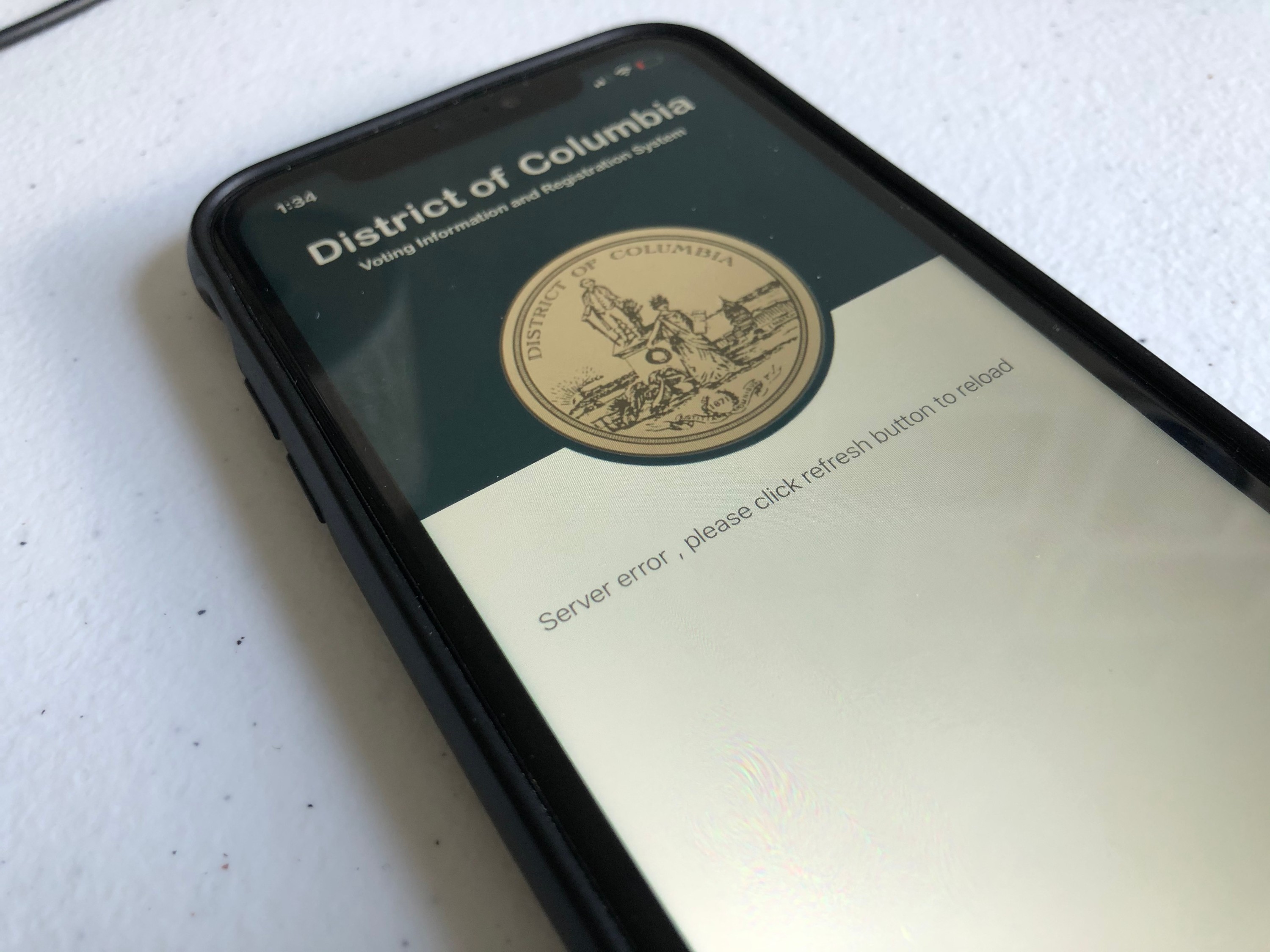
When Broadway Jackson III moved to Columbia Heights in July, he knew he’d have to update his voter registration ahead of November’s election. And there was a relatively simple way to do just that: D.C.’s official Vote4DC app, where anyone could register to vote or update their voter information.
“I was excited that D.C. had an app. I thought it was the right way to do the process, to make it accessible to young people,” says Jackson, who grew up in the Washington region and works at a local law firm.
But as Jackson, 27, tried to use the app and its companion portal online, neither would work. And he soon learned why: In a move that wasn’t widely publicized, the D.C. Board of Elections recently discontinued the long-troubled app, killing the only means for residents to register online to vote in the process.
“I was just frustrated that there was no information online,” says Jackson. “There was no clear communication.”
Election officials say the app was notoriously buggy and no longer reliable. And they concede it isn’t likely that the elections board will be able to roll out a new app before the Nov. 3 election, potentially making it more difficult for new residents to register to vote or for existing voters to change their information.
“We are working to identify a new possible vendor, but significant testing would need to be done prior to launch, and we’re not sure this will be doable before the general [election],” said Rachel Coll, a spokeswoman for the elections board, in an email. “We’re actively looking, though.”
That D.C. no longer offers online voter registration puts it in the minority nationally — some 40 states, Virginia and Maryland included, allow residents to register or change their voter information online, according to the National Conference of State Legislatures. And that D.C. is no longer in that group troubles Michael Sozan, a senior fellow for Democracy and Government Reform and the Center for American Progress.
“Central to any fair election is a vibrant system that makes registering to vote as safe and convenient as possible for all people,” he says. “And that includes through mechanisms like online voter registration and same-day voter registration, because without these sort of reliable options, many states and D.C. would be unable to ensure that their citizens can vote during the pandemic. And particularly people of color and young people who are the ones who are most often disenfranchised need these options.”
Sozan says online voter registration is gaining in popularity — in 2016, it accounted for 17% of all registrations nationwide. Online voter registration systems also cut down on possible data entry errors and can save jurisdictions money. According to a 2015 report from the Pew Charitable Trusts, “states reported spending between $0.50 and $2.34 less per electronic transaction compared with paper.”
D.C. has offered some variation of online voter registration since at least 2015 and incorporated online voter registration into the Vote4DC app over the last two years. In 2019, the year for which the most recent data is available, 15,703 people used the app to either register to vote or update their voter information. That same year, the elections board reported almost 40,000 new voter registrations through all means available.
Still, the app — which was privately developed for D.C. — was weighed down by technical issues. That was a reality election officials said became painfully evident ahead of the June 2 primary, when tens of thousands of people used the app to request absentee ballots. The app rarely worked on Android phones, and was known to be inconsistent on iPhones as well. Election officials said their requests to the vendor for quick fixes weren’t consistently addressed, forcing the city’s decision to do away with the app altogether after the primary.
But that decision — and the timing — was not widely communicated. “The lack of communication with the public is deplorable,” tweeted activist group D.C. for Democracy last week during an exchange with the D.C. elections board on fate of the app.
And Sozan says the timing is problematic. Not only is online voter registration no longer available ahead of a presidential election, but also during the coronavirus pandemic.
“During the COVID-19 pandemic, online registration allows people to avoid traveling to local registrars’ offices to register in person or to do it through the DMV if they’re going there,” Sozan says. “But also, as we know, mail service has been very, very hampered in recent weeks because of of various changes made by the Postmaster General that are very much in the news. And so those changes are causing big delays in the mail.”
This isn’t the first controversy the elections board has stepped into this election season. During the latest primary, some voters said they never received the absentee ballots they requested (DCBOE admitted losing at least 1,100 applications), which is partially what led to long lines at the few polling places that were open. For November’s election, the board made a well-received decision to directly send every registered voter a ballot in the mail — but then sent out a confusing mailer that voters could use to update their address if necessary.
D.C. does offer same-day voter registration, so any hopeful voter can register at an early voting site or polling place on Election Day. (But that means they can’t take advantage of the fact that D.C. says it will send every registered voter a ballot in the mail.) And if an existing D.C. voter registered to vote at the DMV and opted to share their digital signature with the elections board, they can email in a registration form without having to sign it.
Still, new D.C. voters will have to mail in a voter registration form. Similarly, existing voters who have not been to the DMV recently (and are unlikely to get there before the election due to long waits for available appointments) will have to print out a registration form and send it back to DCBOE in to update their voter information.
“It is profoundly unacceptable to not be able to update our voter registration online,” tweeted Jackson in frustration last week. “Regardless of COVID, it’s just the 21st century. Moreover, we’re in the usual ‘moving period’ which is amplified by COVID evictions.”
Since Jackson doesn’t have his own printer, a friend printed out the right form and mailed it to him. Once he gets it, he’ll fill it out and submit it to the Board of Elections. He hopes to have his address updated by November so he can vote in his local races and says the lack of an online option for voter registration and updates will likely impact other voters like himself: “It just leaves a lot of people out in the ether.”
“Why is online voter registration not available in the [D]istrict?” asked Twitter user Ryan Cahalane over the weekend. “Even in Missouri, of all places, I could register and change address online without having to print & mail or go in-person. Ridiculous.”