Matt Blitz
On Wednesday, D.C. Mayor Muriel Bowser announced that the Judiciary Square coronavirus testing site would be closed for the day due to a chance of thunderstorms.
It’s the latest instance in which summer weather events — including a tropical storm, heat waves, and common thunderstorms — have delayed, suspended, modified, and even outright canceled local COVID-19 testing at least a half a dozen times.
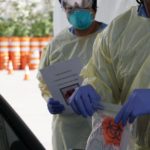
In D.C., where testing sites are primarily outdoors, the decision to close sites due to weather is based on safety concerns, according to D.C. Homeland Security and Emergency Management Agency Director Chris Rodriguez.
“If we have thunderstorms or pretty significant wind, we have to take that into consideration,” he says. “Most of our testing sites are tents that are set up, so we have to be mindful of that.”
Testing outdoors allows for more space to set up proper social distancing for both workers and patients, according to Rodriguez, and creates a safer environment.
“If we were to move testing indoors and someone who is symptomatic comes into the facility, we would need to deep clean each time that happened and it would delay the ability for everyone to get tested,” says Rodriguez. “An outdoor environment is safer.”
But waiting outdoors also brings health hazards associated with weather, he says, including lightning strikes, falls, and potential hypothermia-related conditions.
While long lines and wait times plagued testing sites earlier in the summer, more than a quarter of a million people have been tested in D.C., according to the city’s reporting.
D.C. HSEMA is constantly checking in with the National Weather Service, says Rodriguez, and attempts to have a plan several days out. The department sometimes opts to suspend testing for a short period of time and reopen after the inclement weather has passed, says Rodriguez, something that happened as recently as Sunday at a couple of firehouses during a storm.
Though most other jurisdictions in the region operate these facilities indoors, weather can still complicate testing. Fairfax County and Prince George’s County have both had to cancel testing temporarily due to heat and storms. Montgomery County, meanwhile, has suspended all county-run testing indefinitely after inspections found improper lab procedures in place.
Arlington County — which, along with Alexandria City and Fairfax County, relies mostly on private testing providers — helps run two sites, one being a drive-thru and the other a walk-up that’s primarily indoors. An Arlington County spokesperson says they’ve only had to cancel testing twice. However, weather can make sample collection difficult, the spokesperson adds. In heavy downpours, rain and other debris could potentially contaminate the samples after a test is conducted.
According to Rodriguez, while rain does not impact the integrity of coronavirus tests being given in D.C., the same cannot be said about the heat.
In June, hundreds of coronavirus tests collected at public D.C. testing sites were compromised due to “heat exposure,” forcing many to retake tests. And while we’ve had a nice break recently from the traditional D.C. August heat, it’s expected to warm back up in the coming days.
Rodriguez says that issue of protecting the samples from the heat has been rectified, but warm temperatures still pose a problem. “We have workers in full PPE and so we have to be mindful of heat and extreme temperatures on those individuals,” he says.
But in only a few short months, the weather will flip from hot to cold. Local jurisdictions are already considering how to handle testing during the winter months.
Both Arlington and Fairfax Counties, where testing is done indoors, are looking at limiting line waiting outdoors and adding tents and heaters to protect folks from the elements.
Rodriguez says that D.C. is considering moving testing indoors in the winter, though those plans have not been finalized yet. “Our testing posture for the foreseeable future will largely remain the same,” he says.