Margaret Barthel
 Aja Beckham
 Daniella Cheslow
 Jenny Gathright
 Jeffrey Katz
 Mikaela Lefrak
 Lori McCue
 Julie Strupp
 Rachel Sadon
 Elliot C. Williams
Last updated at 12:27 a.m.
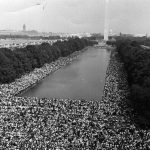
In 1963, Murray Flemming was a 14-year-old in Chicago, wishing he could attend the March on Washington. Jenene Miller was just a one-month old baby. Breyanna Collier was still three decades from being born.
They were among the multi-generational crowd on the National Mall on a hot August day, energized by the movement for racial justice and deeply dismayed by the historic parallels that remain more than a half century later.
The National Action Network began planning the event in the wake of George Floyd’s killing in June, which sparked uprisings around the country this summer. The new March on Washington took place 57 years to the day that Martin Luther King Jr. made his “I Have A Dream” speech.
While Flemming’s family of seven couldn’t afford the trip to the original event, this time he was able to come with his wife, daughter, and granddaughter.
The 71-year-old has told them stories of what it was like to grow up as a Black man in a largely segregated Chicago. Flemming recalls going to a hamburger and hotdog stand in a white part of town, only to be chased away by people throwing bottles and bricks in 1966.
“Tell you the truth, I never thought I would see this day where black, white, across the board Americans come together for a cause that’s righteous — and that’s right,” he said. “To not just care about the population, but one population within the people that’s been treated unfairly for a very, very long time.”
Miller was an infant during the first march.
“Here I am 57 years later and it doesn’t seem like much changed. So that’s one of my main reasons for being here,” she told DCist/WAMU after waiting on line for an hour and a half to enter the Mall. “I’m here, as an adult, for this march, for my children and my grandchildren.”
She and her husband drove 10 hours to be on those grounds.
“We’re here from Atlanta, home of John Lewis. We went to Selma for his farewell when he came across the Peace Bridge for the last time and we wanted to be here for this,” Miller said, her voice slightly muffled by a black mask with white lettering that read “VOTE” and a face shield that declared “GOOD TROUBLE.” “We don’t want the virus, but we have to be here for the cause. It’s worth it.”
Collier grew up in a world in which the original march was a legend.
Back home in Charleston, South Carolina, she attended a protest in June and then joined an activist book club. It has spurred the 25-year-old to become a poll worker and to reflect more deeply on both her own experiences and the country’s history.
“I think for a minute people felt like we were living in a post-racialized society, but it has not gone away,” she said, as she headed for the Mall early this morning. “When you’re learning, you do the history, you understand we’re not that far. We haven’t come that far. We’ve made headway, but there’s still a lot more work to do.”
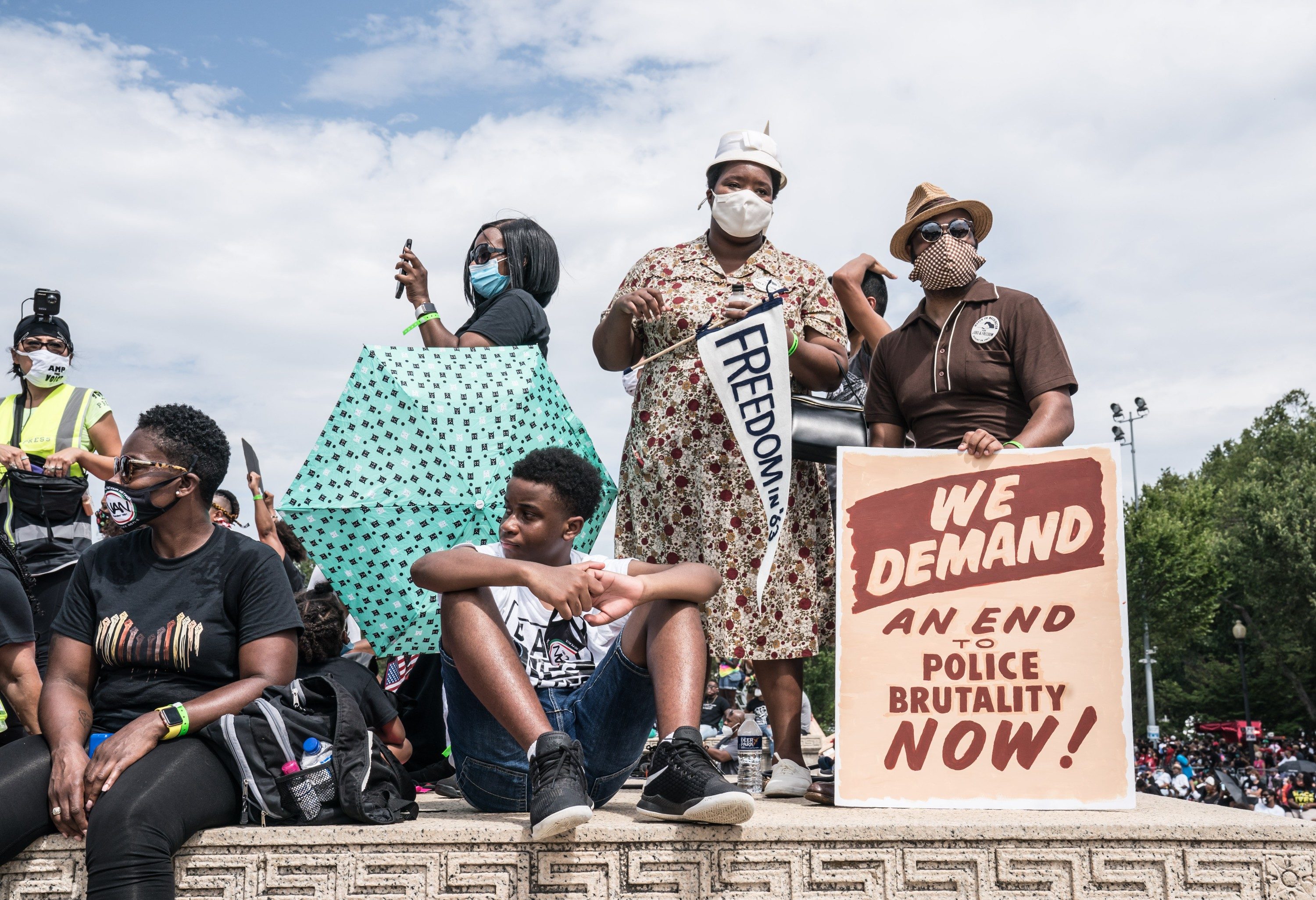
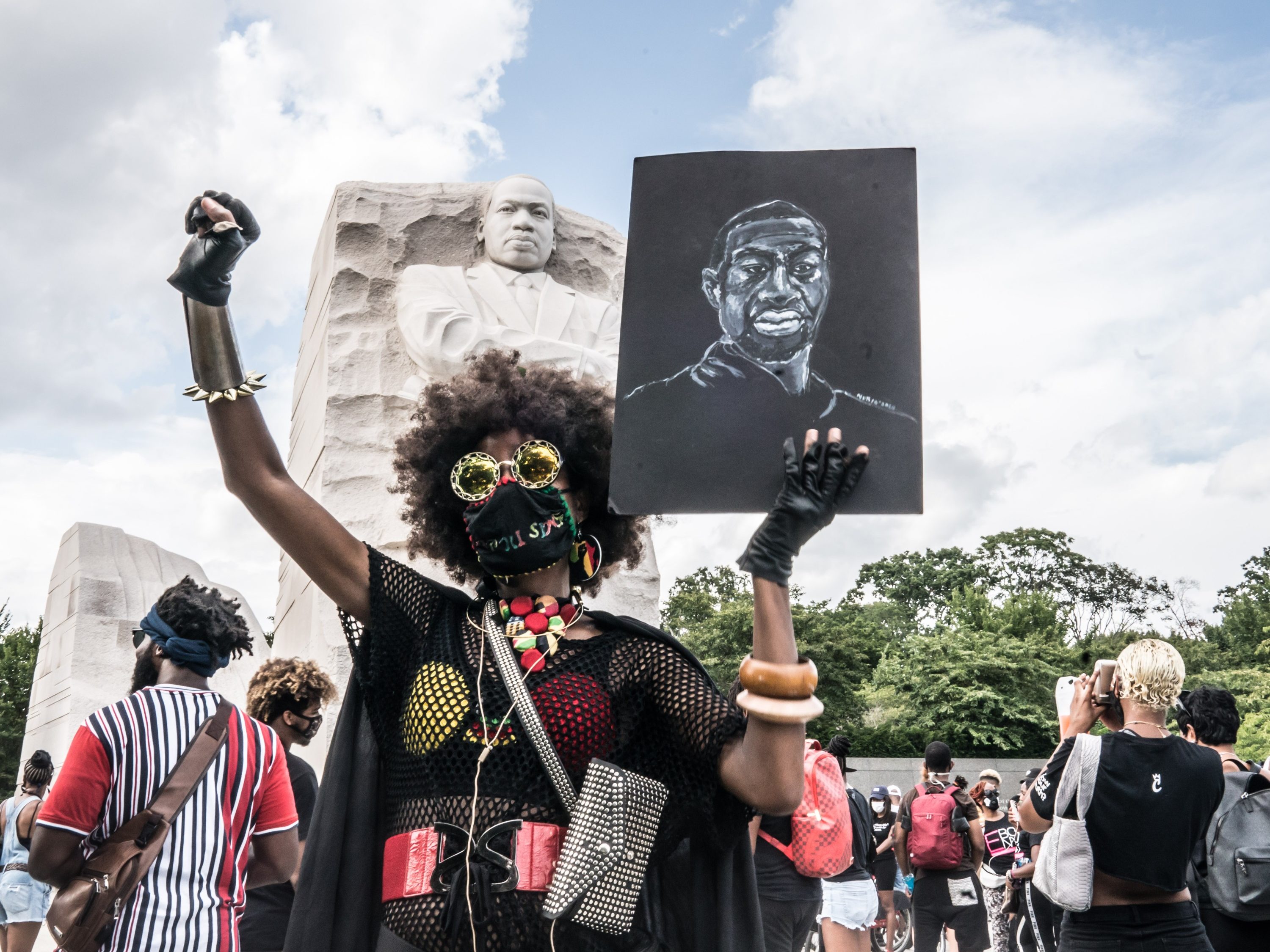

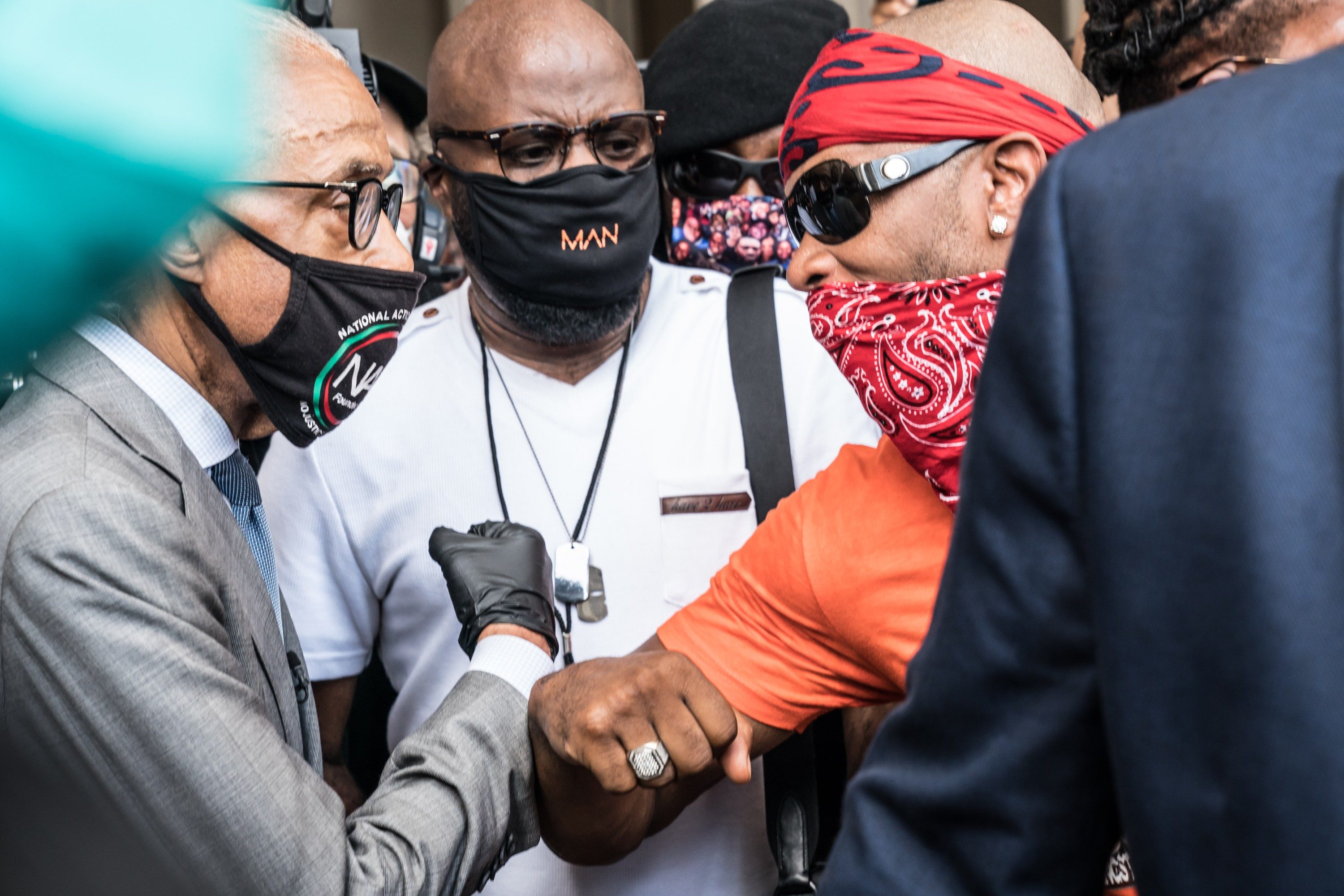
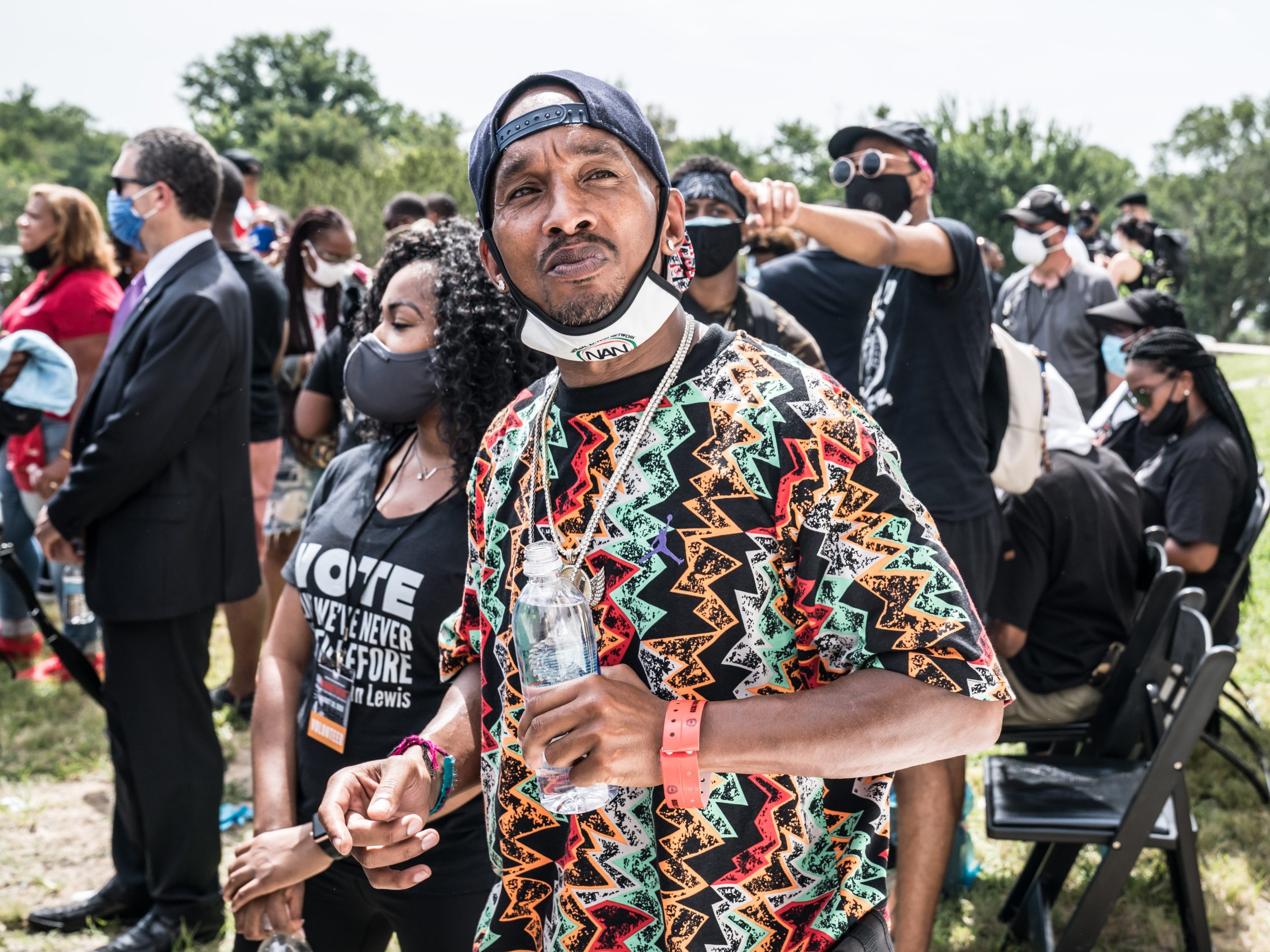
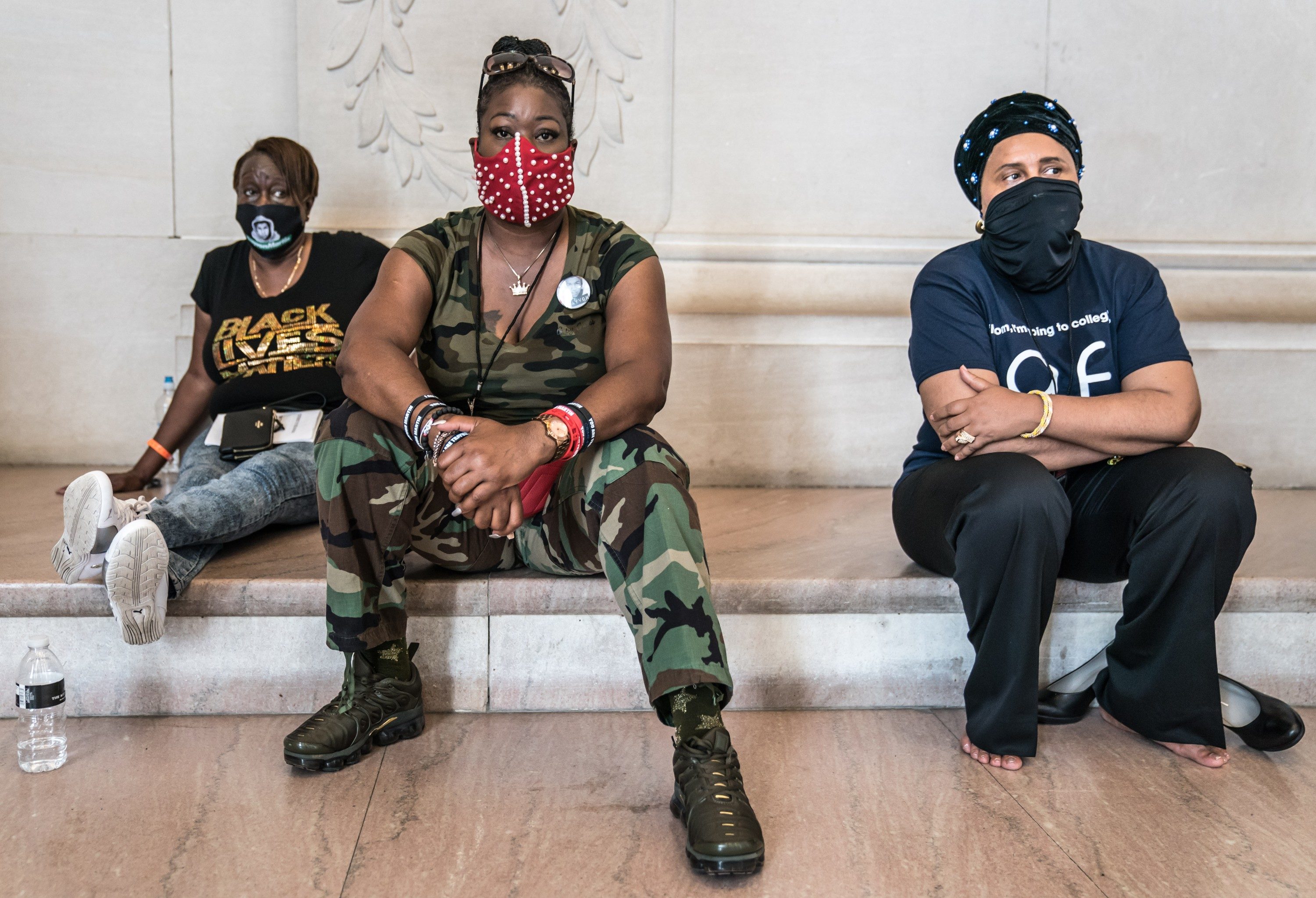
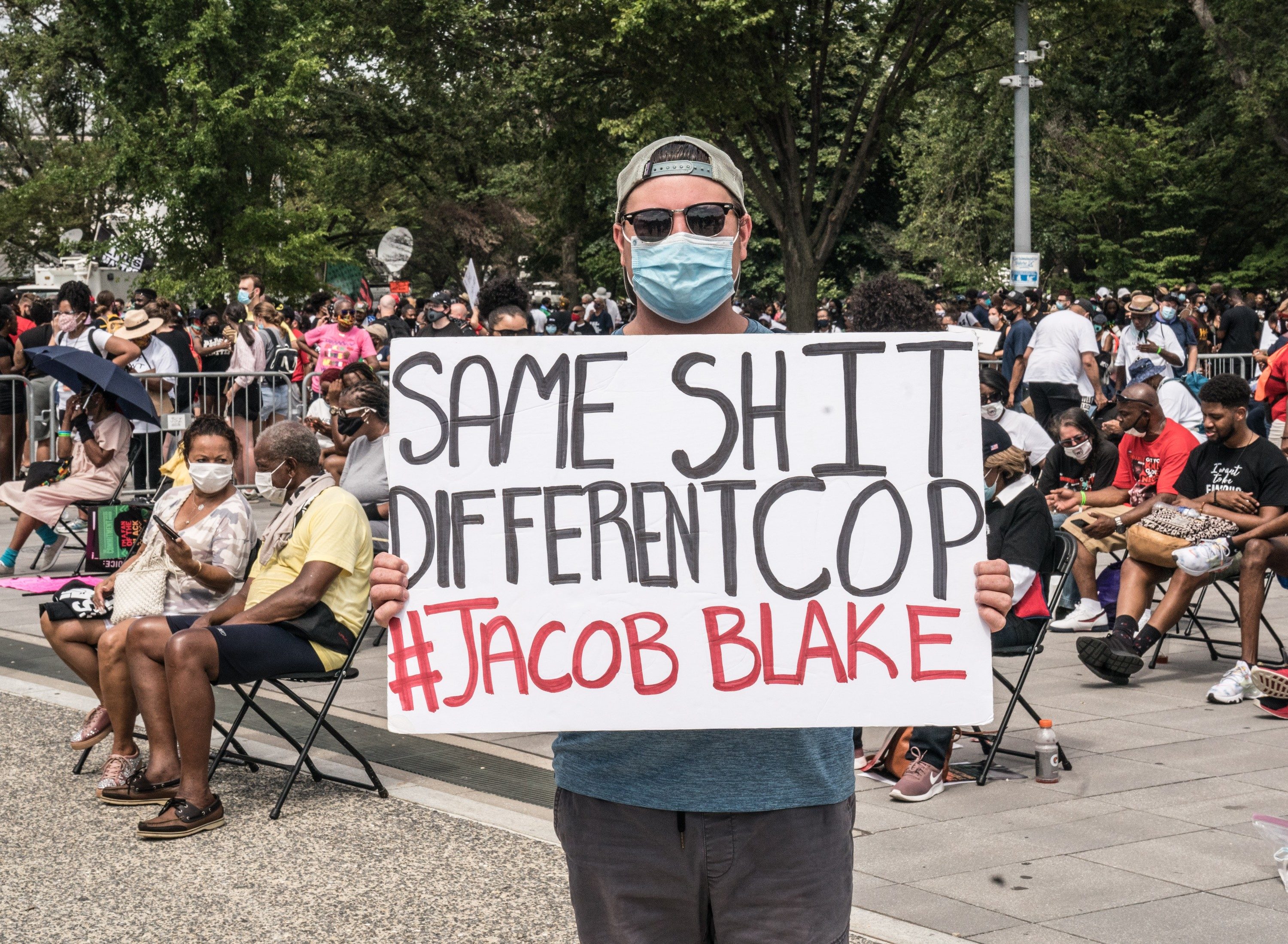

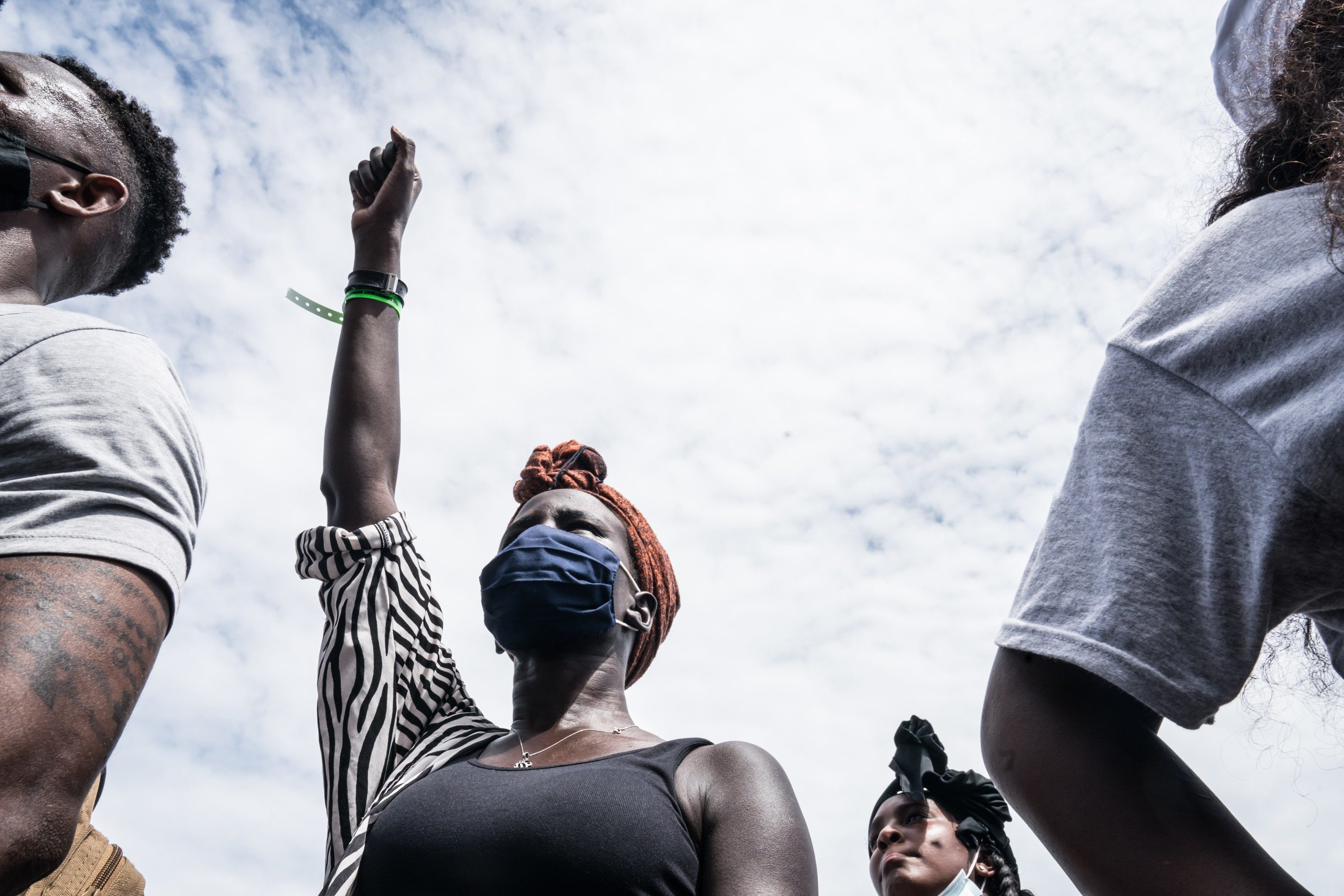
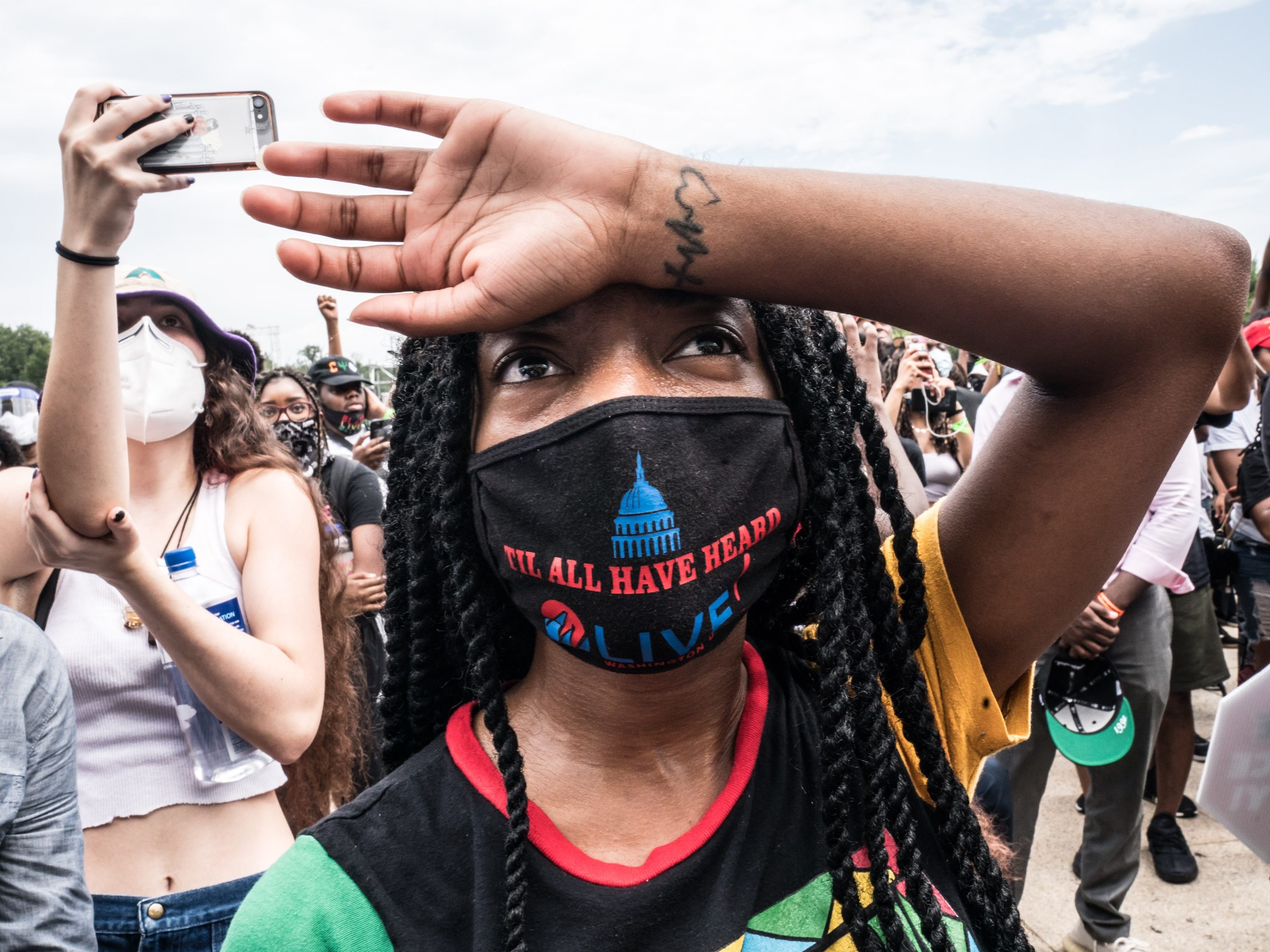
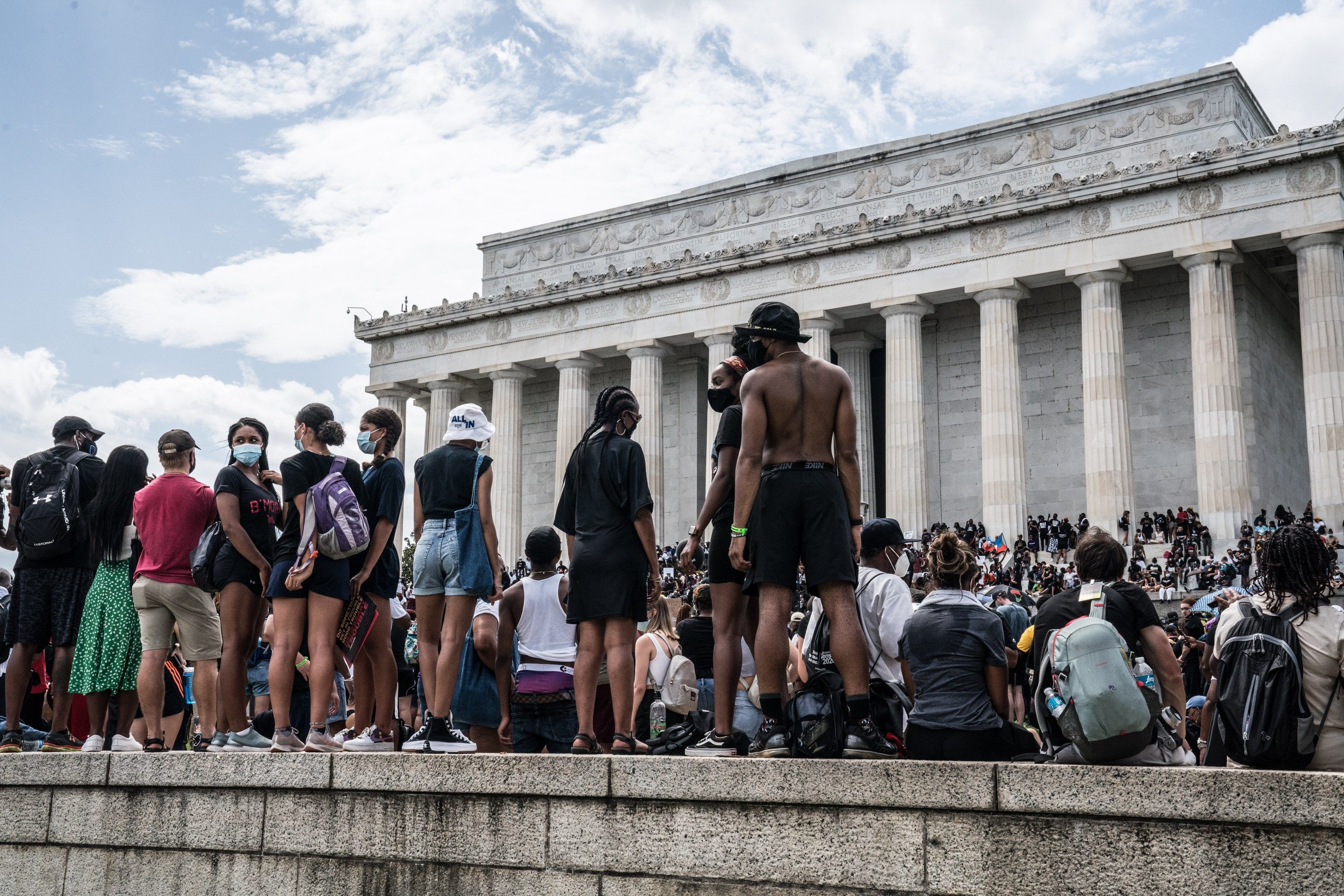
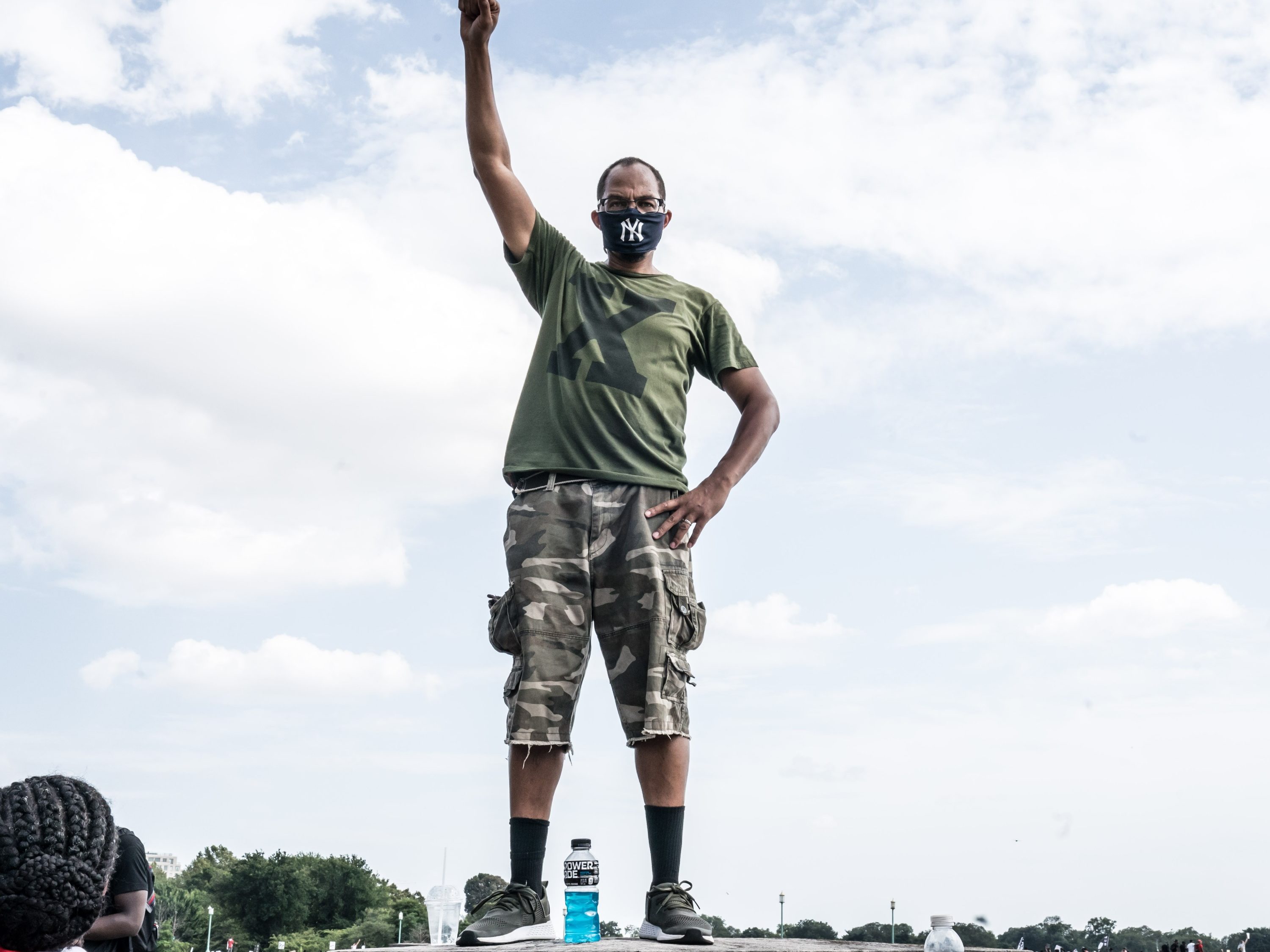
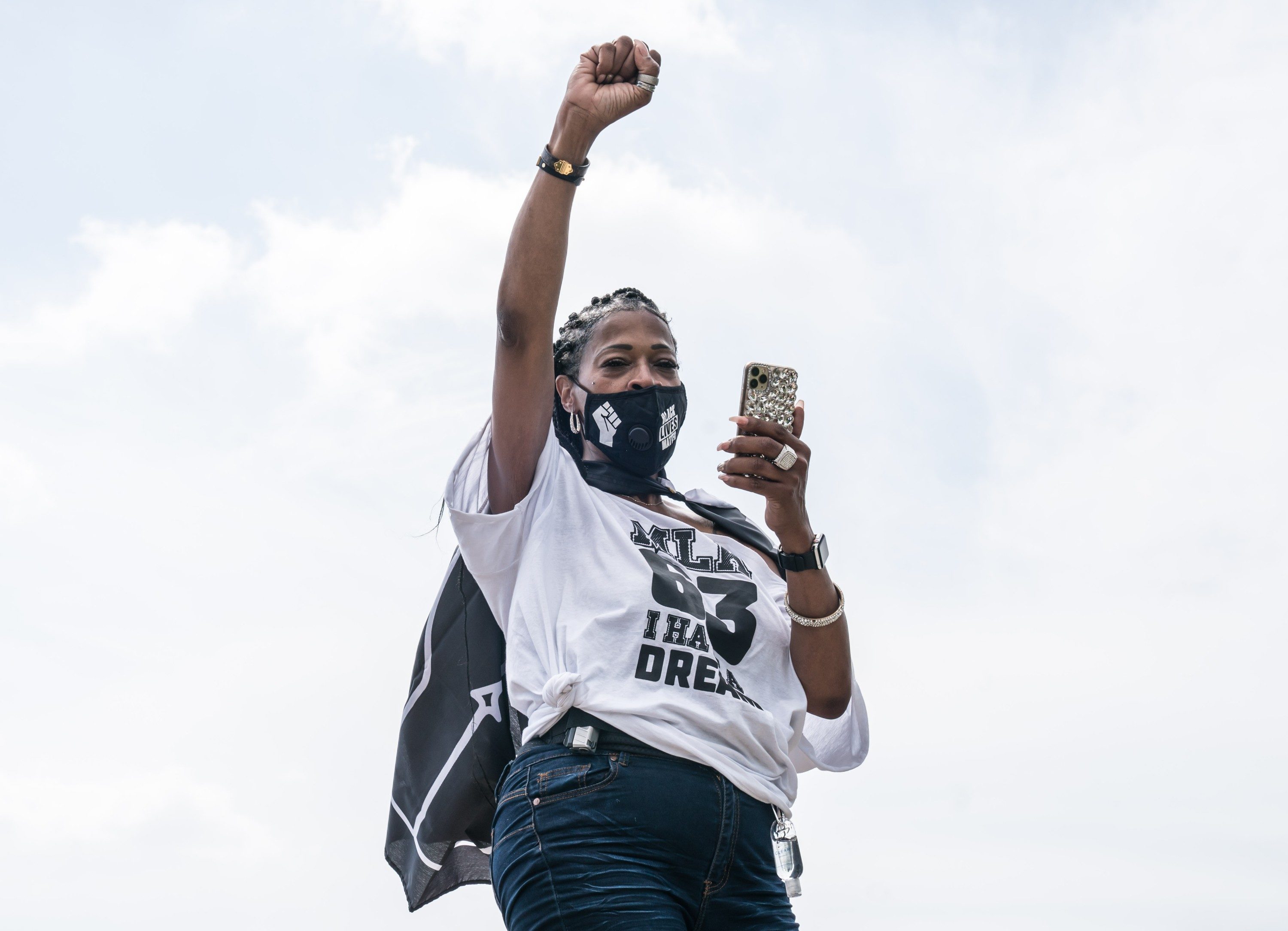
Organizers with the National Action Network described the march, officially called the “‘Get Off Our Necks’ Commitment March on Washington,” as part of an intergenerational and inclusive movement and a launch pad for police accountability reform and other civil rights work.
The name is a reference to the reported 8 minutes and 46 seconds that Minneapolis police officer Derek Chauvin knelt on Floyd’s neck.
The event came just hours after the Republican National Convention ended with a speech from President Donald Trump at the White House, where a largely maskless crowd packed onto the South Lawn. As Trump spoke on Thursday night, he made little mention of the national grief following recent police killings of Black Americans.
But on Friday, before a crowd that was largely made up of Black and Brown attendees, speakers invoked the names of those killed by police, often growing overcome by emotion.
Kentucky Rep. Charles Booker spoke about Breonna Taylor, a 26-year-old Black woman killed by police in her home in Louisville, Kentucky, earlier this year.
“Breonna, I’m representing you right now,” Booker told the crowd.
Families of people killed by police frequently paused during their respective remarks, overcome with emotion. The crowd filled the silences with cries of “Say his name … George Floyd,” and “Say her name … Breonna Taylor.”
“I’m so overwhelmed right now, with everybody here right now,” said Philonise Floyd, brother of George Floyd. “I wish George were here to see this right now. That’s who I’m marching for.”
Martin Luther King III introduced his 12-year-old daughter Yolanda Renee King, who spoke to her generation from the same monument where her grandfather Martin Luther King Jr. spoke 57 years ago.
“Great challenges produce great leaders. We have mastered the selfie and Tik Tok, now we must master ourselves,” she said. “Less than a year before he was assassinated, my grandfather predicted this very moment. He said we were moving into a new phase of the struggle. The first phase was the civil rights. And the new phase is genuine equality. … We are going to be the generation that ends systemic racism once and for all, now and forever.”
After telling the crowd that he was a “proud dad,” Martin Luther King III noted that the March on Washington is also assembled on the day that 14-year-old Emmett Till was lynched in Mississippi in 1955.
“65 years later, we still struggle for justice,” he said.
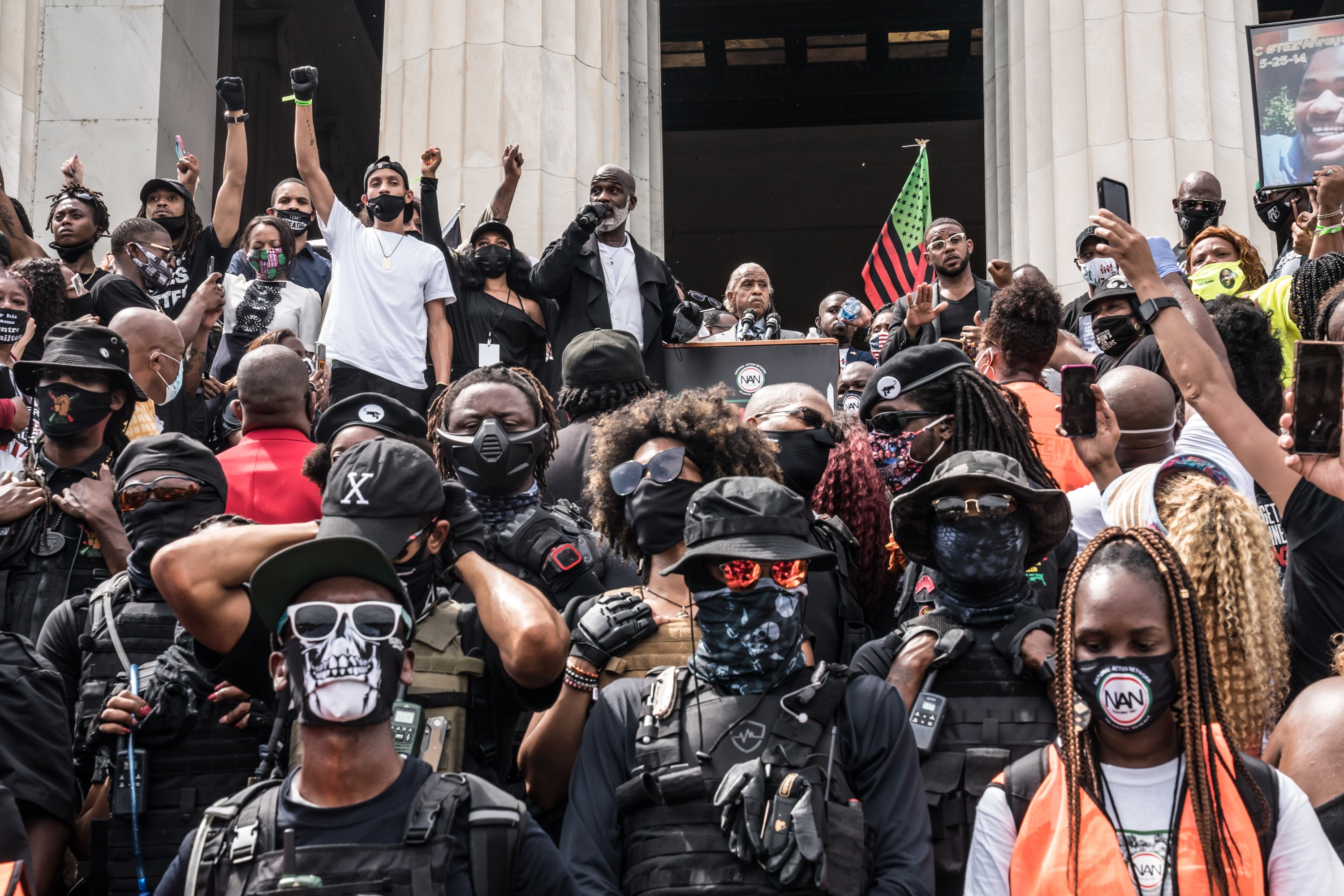
Rev. Al Sharpton, head of NAN, called for political change, advocating for two pieces of legislation: The George Floyd Justice in Policing Act, a sweeping federal police reform bill, and the John Lewis Voting Rights Act of 2020, a reinstatement of the Voting Rights Act.
“Demonstration without legislation will not lead to change,” he said. “We didn’t come out here and stand in this heat because we didn’t have anything to do. If we will stand in the heat, we will stand in the polls all day long.”
He also made mention of the pandemic looming over the event.
“We keep telling y’all to spread out,” he said. “We came to show with our bodies that enough is enough.”
Organizers tried to take precautions: Participants entered through designated entrances, where officials took their temperatures, and were arranged into grids for social distancing.
The vast majority of attendees wore masks throughout the event. Some speakers even wore masks at the podium, though it muffled their voices. But plans to have the crowd practice social distancing quickly went by the wayside on the podium and in the throngs who lined the Reflecting Pool.
Sharpton closed his speech by asking participants to sign up at the NAN’s website to be poll workers during the November election. “We’ve got to have foot soldiers to protect the vote,” he said.


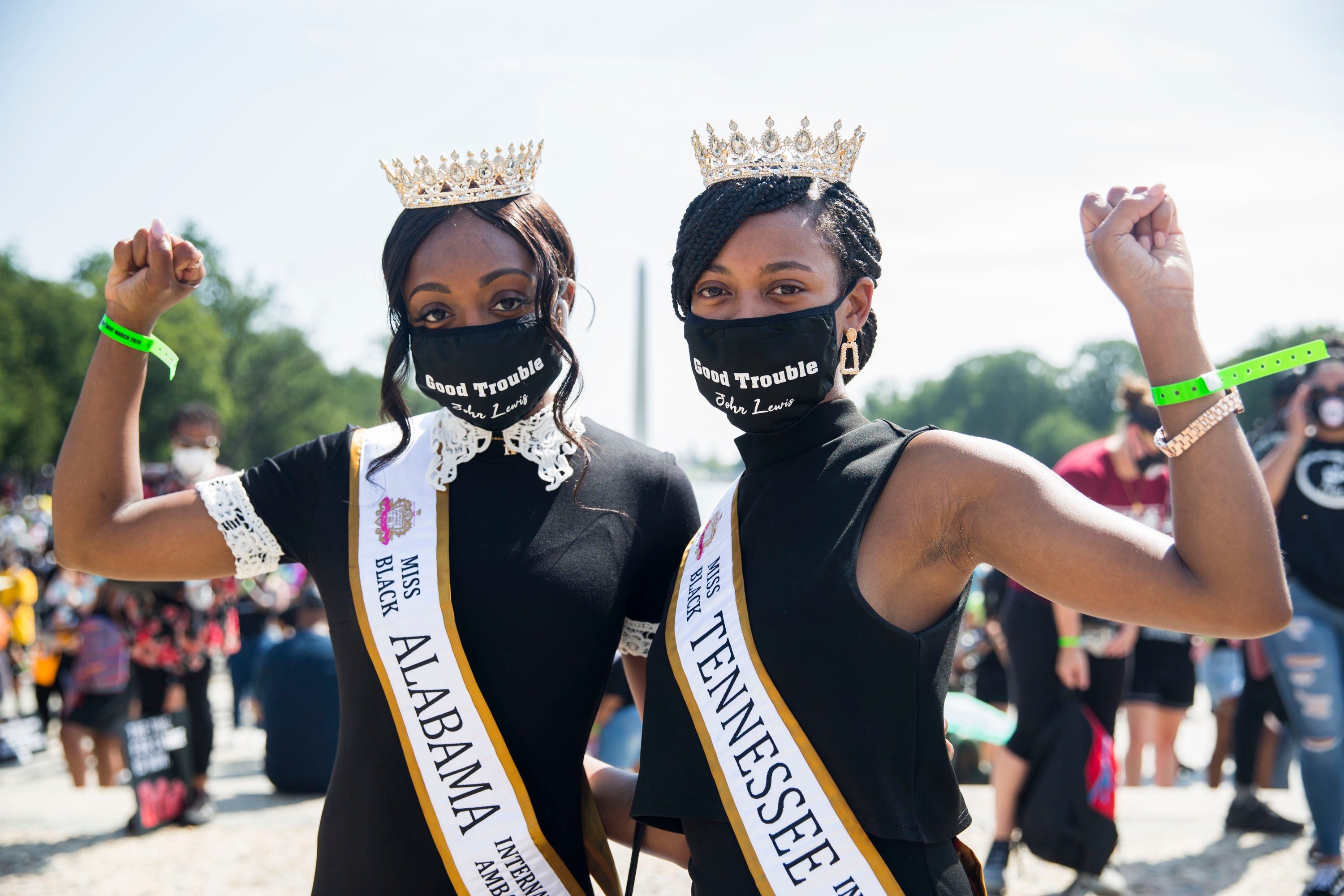
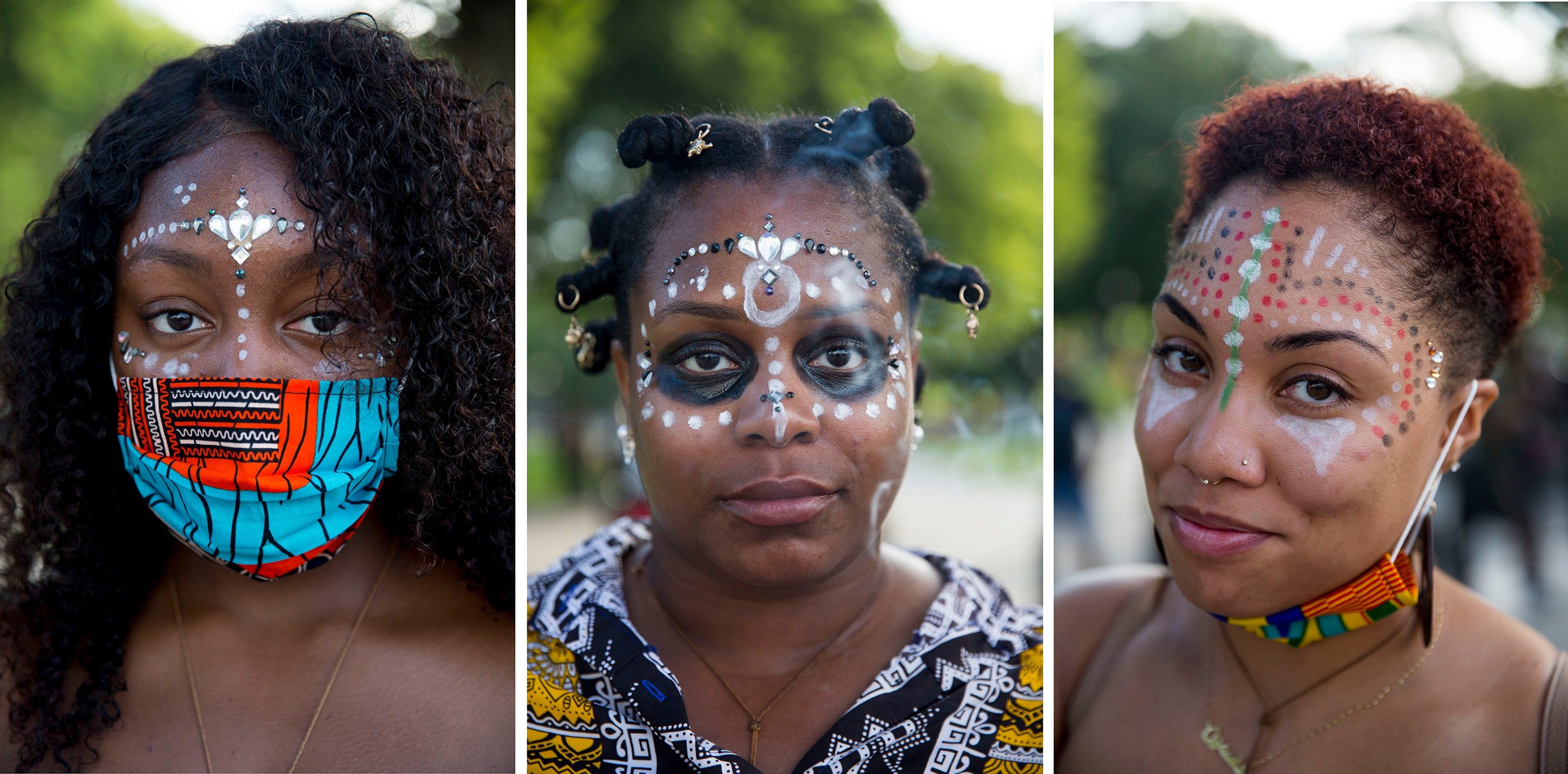

For many, the wait to get past the temperature checks was just the last step of a long trip.
Yazmyne Franklin, a newly-minted history teacher, came from Louisville, Ken., to join her ancestors in protesting for racial justice.
She said when she heard about the march, she immediately thought, “I have to do it. My future students have to see that I care about all of them.”
Ruby Marshall, her sister-in-law Elizabeth Marshall, and her husband Harry Marshall made the two-day drive from Dallas.
“We want to be treated equal, we want to stop these senseless killings of unarmed Black men and Black women,” she said, adding that she fears for her 25-year-old son. “I don’t want my only son to get gunned down. … And it shouldn’t be like that. It’s scary. That’s why I’m here.”
But over the sound of the crowd singing along to “Oh Happy Day,” she said she was glad to be here. “It’s happy, joyful. … Even though it took us two days, I’m glad to be here.”
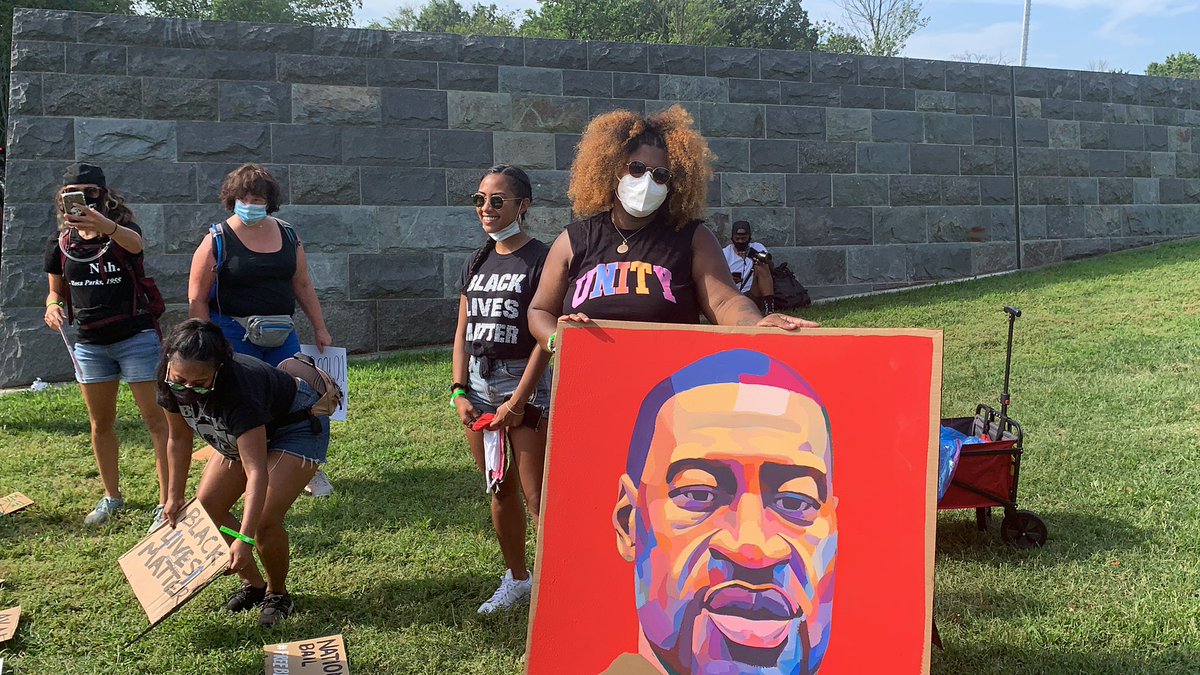
Inside the area where ticketed participants were gathered, Brianna Barrett, 25, stood with a stack of Black Lives Matter signs that she brought from Brooklyn.
Barrett said they were made by people who were immunocompromised, pregnant, or otherwise unable to be there in person. “It’s a way for them to have their voices be heard while they’re at home taking care of themselves,” she said.
Her grandmother likely participated in the 1963 March on Washington, and Barrett said they both came out for some of the same reasons.
“I’m here because I’m a Black woman in America and I’ve got to do it,” she said. “I just hope for all of us to really come out in numbers and show that we’re really about it and we’re not playing games anymore. … We’re out here to really see some change happen.”
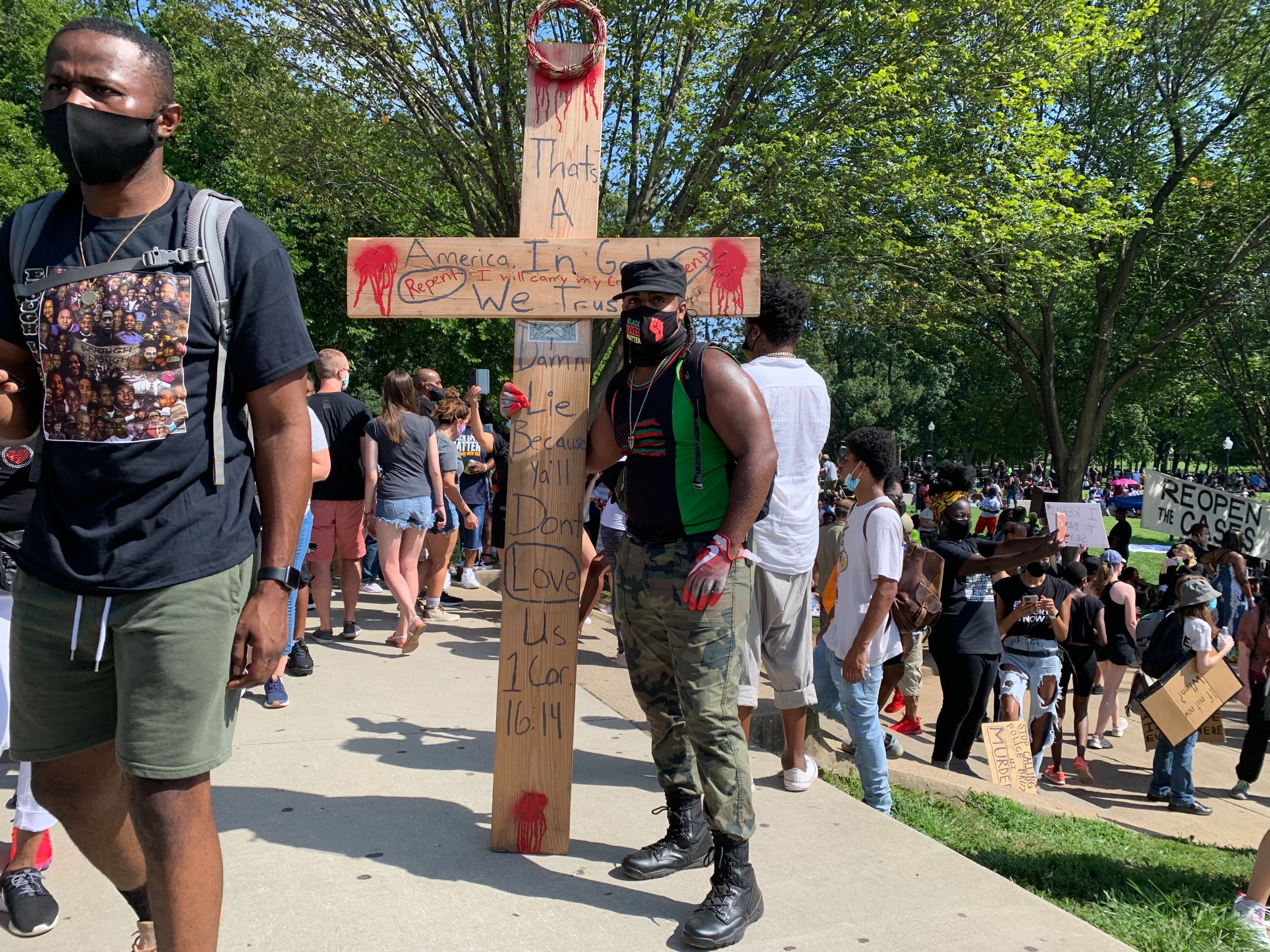
While many attendees brought signs, others shared messages via less traditional mediums. Denorver Garrett, 28, carried a 100-pound wooden cross with him during the day. On the cross, stained with red paint, he had written the message, “America, In God We Trust? That’s a damn lie because y’all don’t love us.”
Garrett, who is from Cincinnati, Ohio, said he finds the motto found on U.S. currency to be hypocritical. He said he was arrested at 8 years old for allegedly attempting to burn down a trailer. The charges were dropped, he said, but it changed his relationship to the police, and to his country.
“I felt like that’s all I was, was a criminal,” he said.
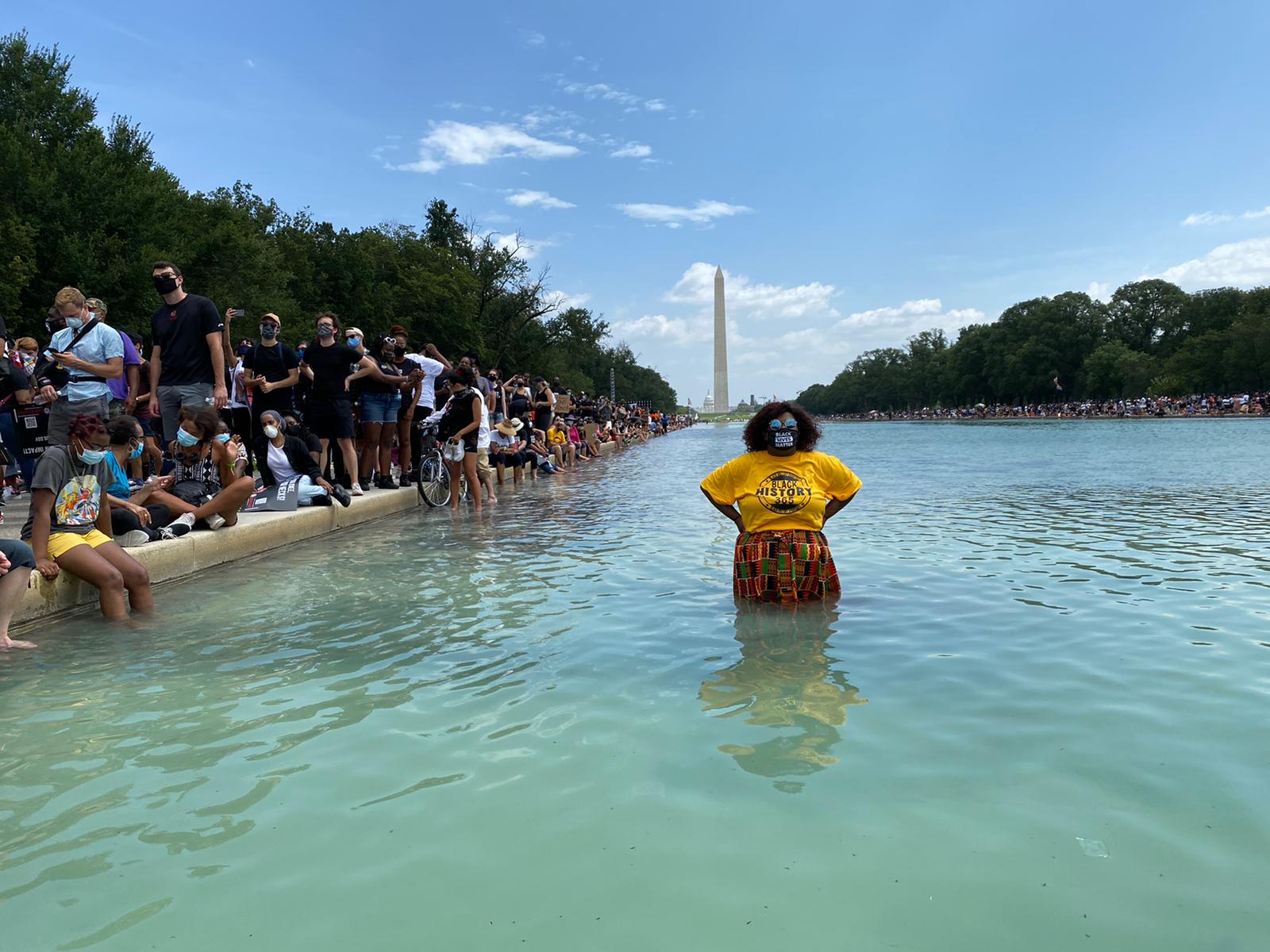

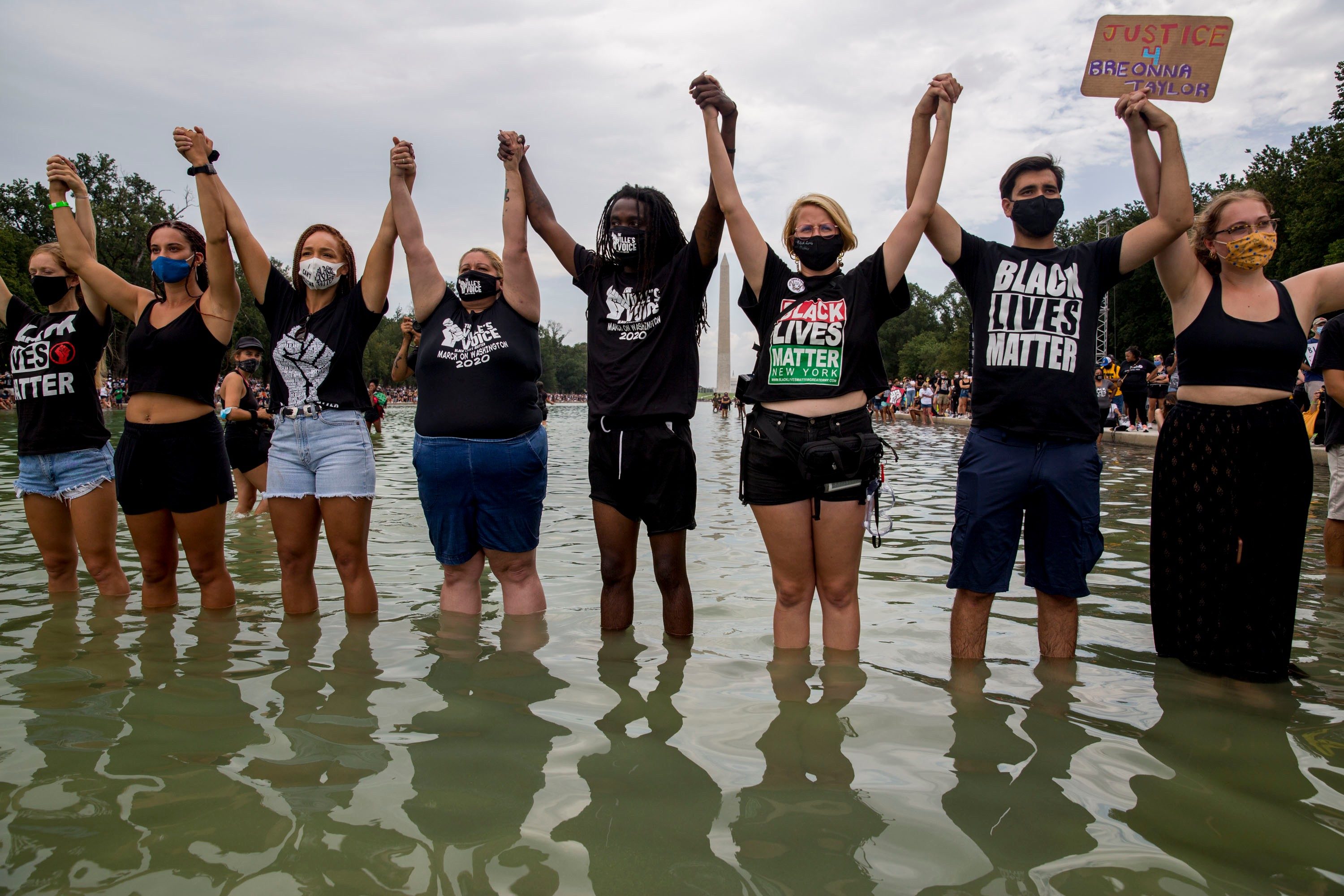
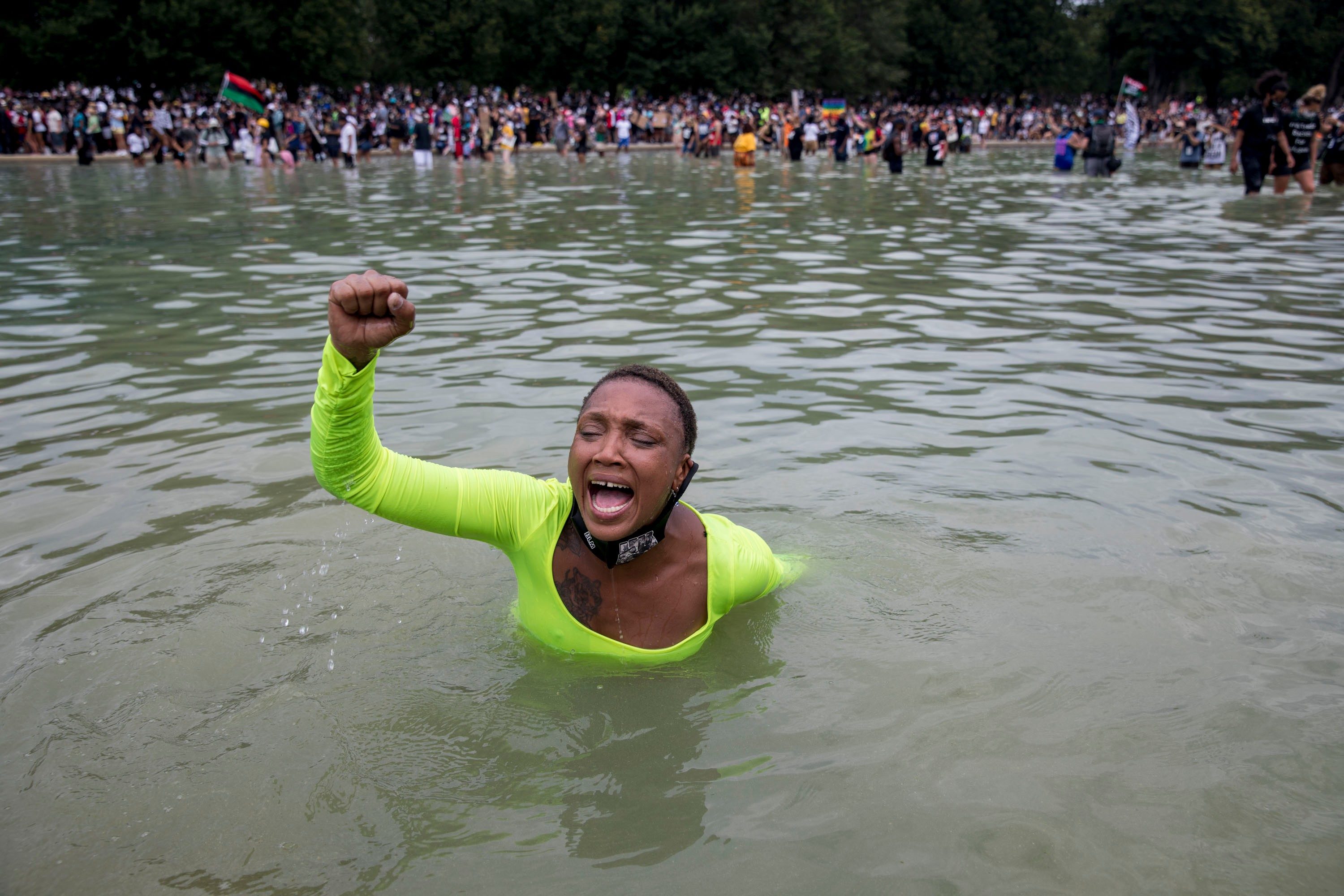
The day was hot, and some participants waded into the Reflecting Pool to cool down, including Tykevrean Cheshire, a 22-year-old from Tulsa, Oklahoma.
Swimming in the pool is generally not allowed, but Chesire said she felt safe doing so. “I feel so much love here, I don’t think I’m gonna get in any trouble,” she said. More attendees eager for a chance to cool off soon followed her. (Earlier in the day someone quipped “Forrest Gump jumped in that water.”)
Cheshire, who runs her own social justice organization back home, was energized by being at the march. “I wanna go back home and do more in my community just because of how much power is in the people today,” she said.
After the speeches ended shortly after 2 p.m., organizers led the assembled in a march to the Martin Luther King Jr. Memorial a short walk away. Marchers chanted, “Black lives matter,” and “Say his name, Elijah McClain” in a call-and-response style, referring to the 23-year-old in who died after police in Aurora, Colorado put him in a chokehold last year.
Thousands of participants continued past the memorial and down 17th Street NW and along Independence Avenue SW. They banged drums and hoisted signs with Black power fists and messages like “No Justice, No Peace.”
At one point, a group began dancing in the crowd near the Washington Monument while musicians played, pumping their fists in the air and singing, “We gonna shut it down!” while police helicopters hovered overhead.
The mood was jubilant in places, determined in others.
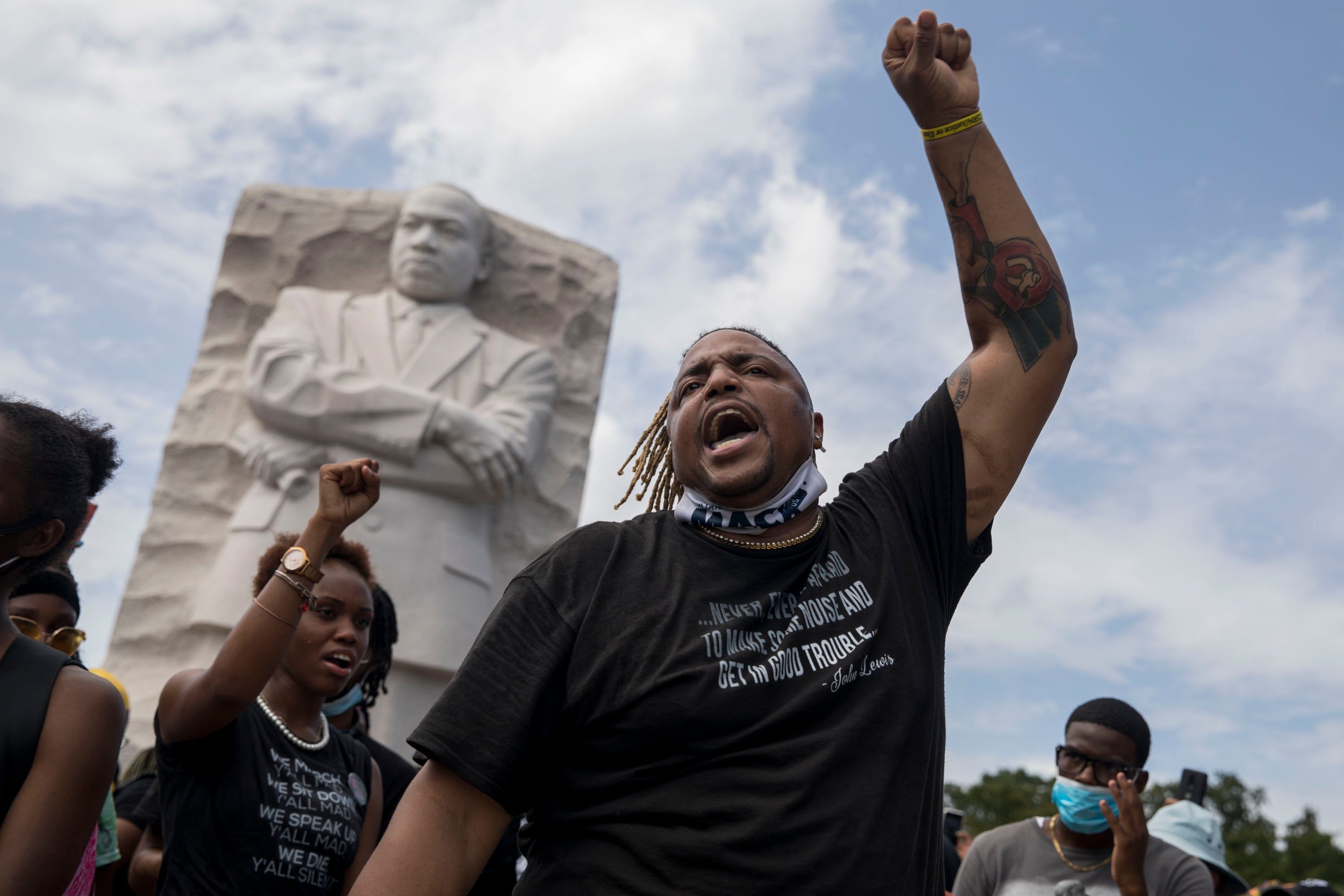
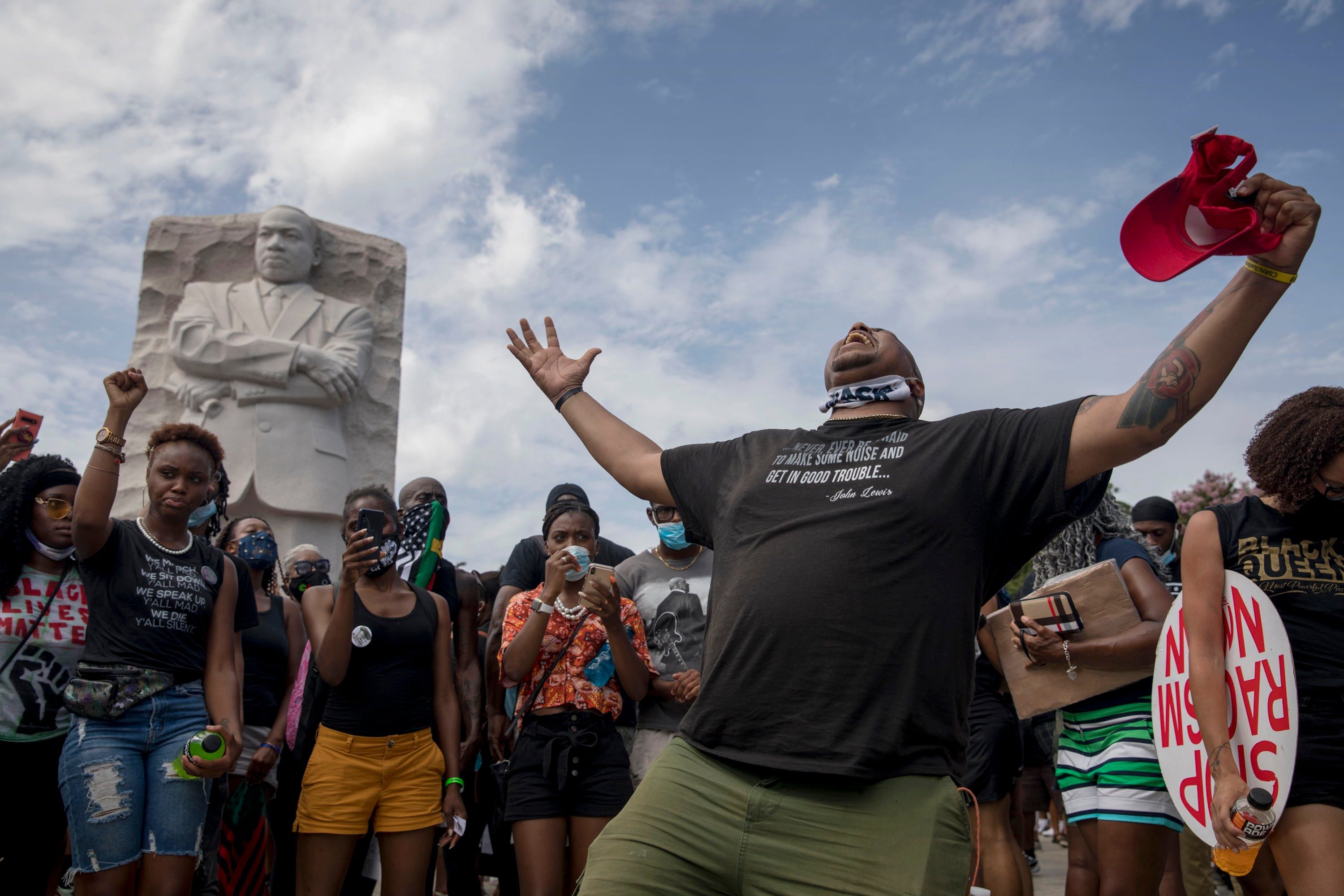
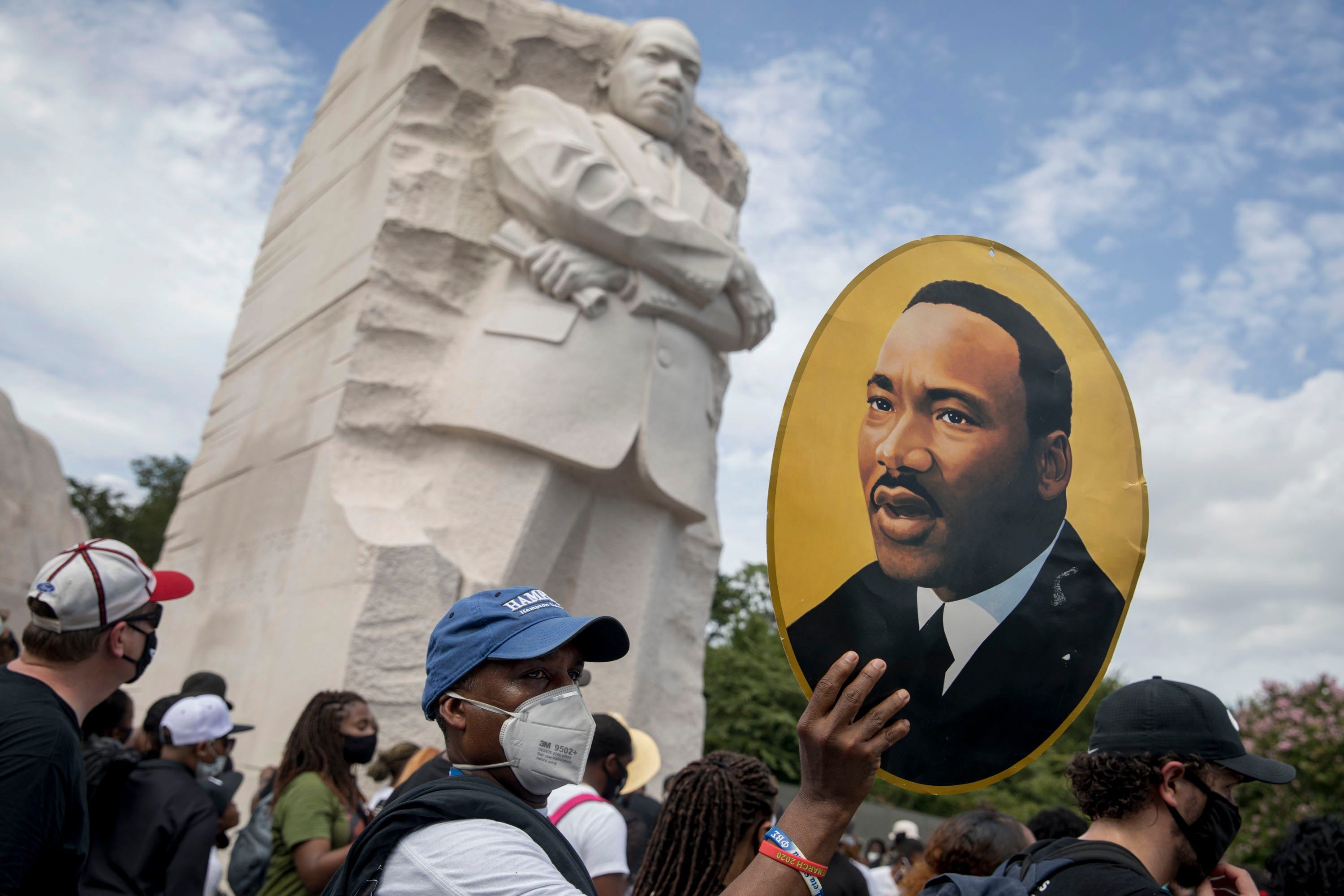
While many attendees and speakers came in from out of town, families affected by police violence in D.C. also had a presence at the event.
One local who spoke to the crowd shortly after 10 a.m. was Kenithia Alston, mother of Marqueese Alston, a 22-year old man who was shot and killed by two Metropolitan Police Department officers in Southeast D.C. in 2018.
In June, she filed a $100 million wrongful death lawsuit against the city. Earlier this month, she spoke out against the way video from the shooting was released.
“The lack of transparency in my case is just one example of MPD’s widely-practiced secrecy that had been widely criticized by D.C. residents,” she said. “As a traumatized, grieving mother, know this: I demand truth and transparency for Marqueese’s daughter.”
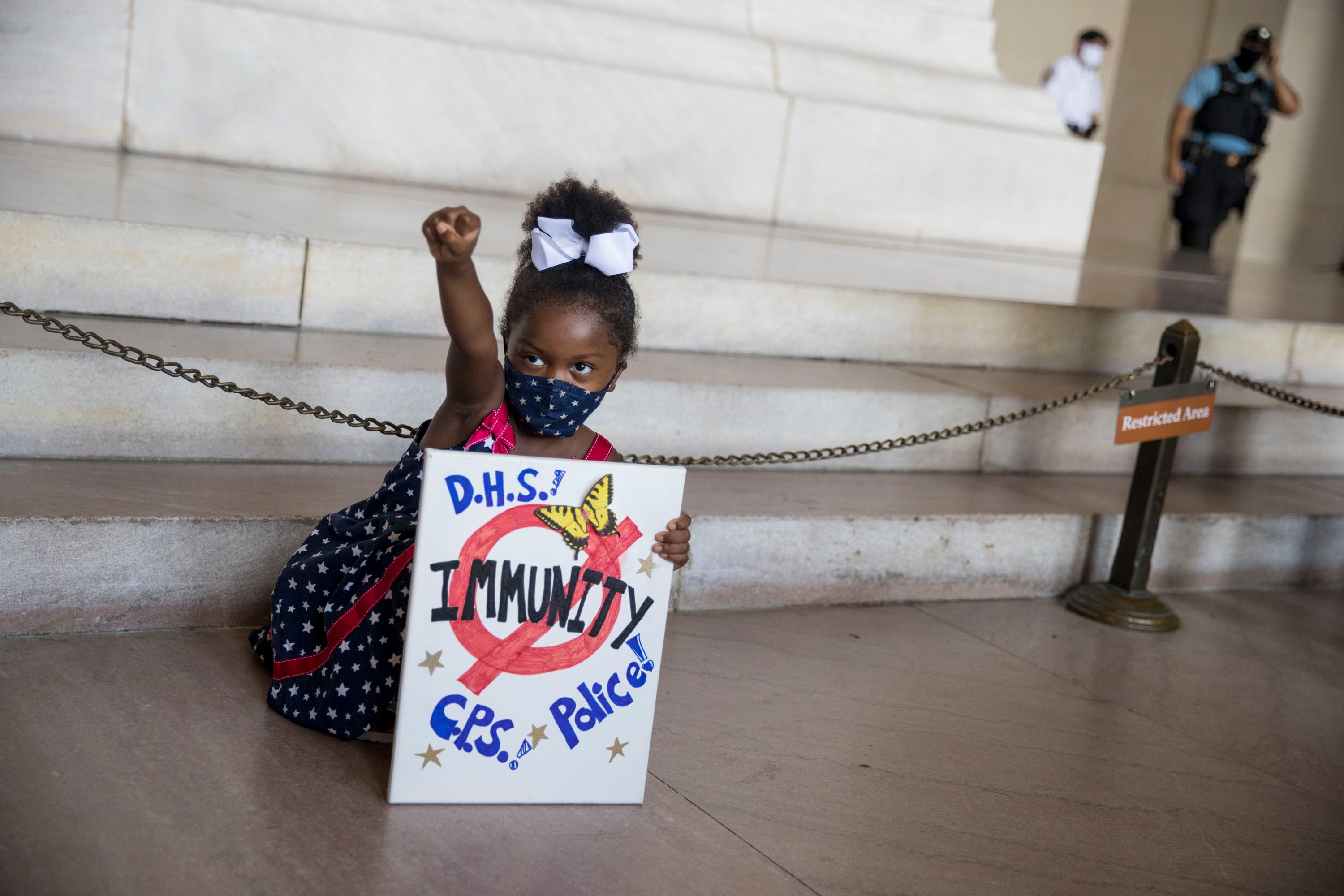
Marqueese Alston’s young daughter also attended the March, according to multiple media reports, wearing a shirt that said “Good trouble for my daddy Marqueese Alston killed by D.C. police” and “I want to know the truth…Why did D.C. police kill my daddy Marqueese Alston in front of me?”
As with many large protests, the day included tensions between local and national organizers, even though some D.C. leaders were given a chance to speak.
Jay Brown, whose nephew was killed in a collision with an MPD vehicle in 2018, said he and other locals whose loved ones had been killed by police were asked at one point to move to the back of the seating section to allow the Floyd family to sit up front.
“We share the pain of the Floyd family,” Brown said. “We shouldn’t put one pain in front of the other. The pain is the same.”
Speaking from his seat at the Lincoln Memorial, he said felt “distance from the movement.”
Later, Brown said he was disappointed about the incident, and that it had pulled his focus away from the shared sense of purpose and outrage.
“I wanted to center myself and my family more so in that situation [at the march] than I did,” he said. “Sometimes it’s just hard to not feel that maybe your loved one is ignored.”
Brown also pointed out that many speakers at the March, including Al Sharpton, focused on federal-level reforms. But in the absence of statehood, D.C. residents are not represented by a voting member of Congress.
“That was painful within itself to know that we don’t even have a vote to take action on what was being called for the most,” he said.
Other locals who have been in the midst of the D.C. protest movement had mixed feelings about the national focus of the day — a contrast to the protest community that has flourished in the city for months.
“There was a large influx of people from out of state, from out of the area coming into D.C., obviously, for the national march, which is very exciting,” said Andrew Jasiura, a local filmmaker who has been following protests for months now. “However, they have a different tone and a different care for the community than the people who have been in the city protesting for three months straight.”
Jasiura and his filmmaking partner, Kian Kelley-Chung, said they noticed surprise and shock from out-of-towners when police arrested three protesters in Black Lives Matter plaza the night before the march.
“All of them were very new to the environment here in D.C., so they weren’t very aware of how MPD has responded to other altercations,” said Kelley-Chung, who was one of the more than forty people arrested during a protest on August 13.
Other locals saw the moment as a chance to get more people involved in the work they’ve been doing for years.
“It’s just another day in the office for me. Some people, this is their only way of plugging in, is coming to a march, but Black Lives Matter, we are out here at every turn,” said Qiana Johnson, a core organizer with the D.C. group who focuses on justice for incarcerated people. “I’m using it as an opportunity and a point of intervention where we can bring them in.”
By the end of the evening, as groups of protesters ranged across the city, the focus had shifted from the jumbotrons and back to the energy, excitement, and outrage that has flooded D.C.’s streets for months.
Kelley-Chung was with a group of protesters who blocked both lanes of traffic in the I-395 underpass during an evening downpour. The group took shelter from the rain, chanted, and danced.
“It was a moment where the movement was able to show that Black Lives Matter is not just about acknowledging Black death and Black trauma,” he said, “but also honoring and respecting and celebrating Black joy and Black life.”
Previously:
Where To Grab A Snack, Use The Bathroom, And Charge Your Phone During The March On Washington
The March On Washington 2020 Is Set To Draw Tens Of Thousands Of People To The National Mall